ガドリニウム(III) nitrate hexahydrate SDS
Original Stanford Advanced 材料 safety data sheet for Gadolinium(III) nitrate hexahydrate. 原本PDF retained without modification. 情報源 collected on 2026-09-13.
PDFプレビュー
無料で閲覧・ダウンロード可能・登録やログインは不要です。
PDFを読み込み中…
Normalized SDS data & document analysis
RESDS derives the results below from this document’s extracted text and the site’s same-material index. Detected codes are not reclassified. “Not detected” does not mean “not present”; confirm the original PDF for safety-critical use.
GHS & transport evidence
ページ links show the first occurrence found in extracted text.
SDS 16-section coverage
15 section headings detected; 1 not detected by the parser.
Normalized physical-property units
Calculated conversions from values detected in this SDS; not independent laboratory measurements.
| Property | SDS value | SI conversion | US conversion |
|---|---|---|---|
| Melting point | 91 °C | 364.15 K | 195.8 °F |
| Density | 2.406 g/cm³ | 2406 kg/m³ | 0.0869 lb/in³ |
Same-material SDS comparison
9 indexed 件の文書 · 7 publishers · 2 languages · 7 stated revisions · page range 4–9. This compares document metadata, not product equivalence.
| 発行元 | 改訂版 | 言語 | 国・地域 | ページ数 |
|---|---|---|---|---|
| Current Stanford Advanced 材料 | 09/04/2017 · Version 3.0 | 英語 | 米国 · OSHA | 7 |
| Acros-Organics | 28-Aug-2015 · 改訂版 3 | 英語 | European Union · REACH / CLP | 9 |
| Apollo | 21/11/2016 · 改訂版 2 | 英語 | 記載なし | 7 |
| FUJIFILM Wako Pure Chemical Corporation | 04-Feb-2023 · 改訂版 2.04 | 英語 | 日本 | 6 |
| FUJIFILM Wako Pure Chemical Corporation | 2023-2-04 | 日本語 | 日本 | 6 |
| ProChem | 記載なし | 英語 | 記載なし | 4 |
| ProChem | 記載なし | 英語 | 記載なし | 4 |
| Sigma-Aldrich | 09/28/2017 · Version 4.3 | 英語 | 米国 · OSHA | 7 |
材料・文書仕様
- Material
- Gadolinium(III) nitrate hexahydrate
- 製品・グレード
- 記載なし
- 発行元
- Stanford Advanced 材料
- 国・地域
- 米国 · OSHA
- ファイル名
- 080_Gadolinium_III_nitrate_hexahydrate_Stanford_Advanced_材料_EN.pdf
- 文書の種類
- SDS
- CAS登録番号
- 19598-90-4
- 言語
- 英語
- 原本改訂日
- 09/04/2017 · Version 3.0
- ページ数
- 7
- ファイルサイズ
- 209 KB
- ダウンロード数
- 3
- 追加日
- 2026-09-13
Full document text
7ページ · 原文書の言語
Text extracted from the original PDF. ページ order and original wording are preserved; tables and symbols may differ from the PDF layout. Check the original PDF for safety-critical details.
ページ 1
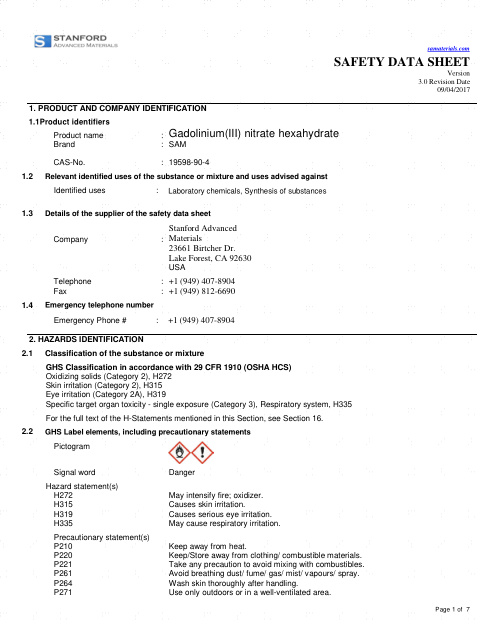
samaterials.com SAFETY DATA SHEET Version 3.0 改訂版 Date 09/04/2017
1. PRODUCT AND COMPANY IDENTIFICATION
1.1Product identifiers 製品名 : Gadolinium(III) nitrate hexahydrate ブランド : SAM
CAS-No. : 19598-90-4 1.2 Relevant identified uses of the substance or mixture and uses advised against Identified uses : Laboratory chemicals, Synthesis of substances
1.3 詳細 of the supplier of the safety data sheet Stanford Advanced Company : 材料 23661 Birtcher Dr. Lake Forest, CA 92630 USA Telephone : +1 (949) 407-8904 Fax : +1 (949) 812-6690 1.4 Emergency telephone number Emergency 電話番号 # : +1 (949) 407-8904
2. HAZARDS IDENTIFICATION
2.1 Classification of the substance or mixture GHS Classification in accordance with 29 CFR 1910 (OSHA HCS) Oxidizing solids (Category 2), H272 Skin irritation (Category 2), H315 Eye irritation (Category 2A), H319 Specific target organ toxicity - single exposure (Category 3), Respiratory system, H335 For the full text of the H-Statements mentioned in this Section, see Section 16. 2.2 GHS Label elements, including precautionary statements Pictogram
Signal word Danger Hazard statement(s) H272 May intensify fire; oxidizer. H315 Causes skin irritation. H319 Causes serious eye irritation. H335 May cause respiratory irritation. Precautionary statement(s) P210 Keep away from heat. P220 Keep/Store away from clothing/ combustible materials. P221 Take any precaution to avoid mixing with combustibles. P261 Avoid breathing dust/ fume/ gas/ mist/ vapours/ spray. P264 Wash skin thoroughly after handling. P271 Use only outdoors or in a well-ventilated area.
ページ 1 of 7
ページ 2
P280 Wear protective gloves/ eye protection/ face protection. P302 + P352 IF ON SKIN: Wash with plenty of soap and water. P304 + P340 + P312 IF INHALED: Remove victim to fresh air and keep at rest in a position comfortable for breathing. Call a POISON CENTER or doctor/ physician if you feel unwell. P305 + P351 + P338 IF IN EYES: Rinse cautiously with water for several minutes. Remove contact lenses, if present and easy to do. Continue rinsing. P332 + P313 If skin irritation occurs: Get medical advice/ attention. P337 + P313 If eye irritation persists: Get medical advice/ attention. P362 Take off contaminated clothing and wash before reuse. P370 + P378 In case of fire: Use dry sand, dry chemical or alcohol-resistant foam for extinction. P403 + P233 Store in a well-ventilated place. Keep container tightly closed. P405 Store locked up. P501 Dispose of contents/ container to an approved waste disposal plant.
2.3Hazards not otherwise classified (HNOC) or not covered by GHS - none
3. COMPOSITION/INFORMATION ON INGREDIENTS
3.1Substances Formula : GdN3O9 · 6H2O 分子量 : 451.36 g/mol CAS-No. : 19598-90-4 EC-No. : 233-437-2 Hazardous components Component Classification Concentration Gadolinium(III) nitrate hexahydrate Ox. Sol. 2; Skin Irrit. 2; Eye 90 - 100 % Irrit. 2A; STOT SE 3; H272, H315, H319, H335 For the full text of the H-Statements mentioned in this Section, see Section 16.
4. FIRST AID MEASURES
4.1 説明 of first aid measures General advice Consult a physician. Show this safety data sheet to the doctor in attendance.Move out of dangerous area. If inhaled If breathed in, move person into fresh air. If not breathing, give artificial respiration. Consult a physician. In case of skin contact Wash off with soap and plenty of water. Consult a physician. In case of eye contact Rinse thoroughly with plenty of water for at least 15 minutes and consult a physician. If swallowed Never give anything by mouth to an unconscious person. Rinse mouth with water. Consult a physician. 4.2 Most important symptoms and effects, both acute and delayed The most important known symptoms and effects are described in the labelling (see section 2.2) and/or in section 11
4.3 Indication of any immediate medical attention and special treatment needed No data available
ページ 2 of 7
ページ 3
5. FIREFIGHTING MEASURES
5.1 Extinguishing media Suitable extinguishing media Use water spray, alcohol-resistant foam, dry chemical or carbon dioxide. 5.2 Special hazards arising from the substance or mixture No data available 5.3 Advice for firefighters Wear self-contained breathing apparatus for firefighting if necessary. 5.4 Further information Use water spray to cool unopened containers.
6. ACCIDENTAL RELEASE MEASURES
6.1 Personal precautions, protective equipment and emergency procedures Use personal protective equipment. Avoid dust formation. Avoid breathing vapours, mist or gas. Ensure adequate ventilation. Evacuate personnel to safe areas. Avoid breathing dust. For personal protection see section 8.
6.2 Environmental precautions Do not let product enter drains. 6.3 Methods and materials for containment and cleaning up Sweep up and shovel. Contain spillage, and then collect with an electrically protected vacuum cleaner or by wet- brushing and place in container for disposal according to local regulations (see section 13). Keep in suitable, closed containers for disposal. 6.4 Reference to other sections For disposal see section 13.
7. HANDLING AND STORAGE
7.1 Precautions for safe handling Avoid contact with skin and eyes. Avoid formation of dust and aerosols.Further processing of solid materials may result in the formation of combustible dusts. The potential for combustible dust formation should be taken into consideration before additional processing occurs. Provide appropriate exhaust ventilation at places where dust is formed.Keep away from sources of ignition - No smoking.Keep away from heat and sources of ignition. For precautions see section 2.2. 7.2 Conditions for safe storage, including any incompatibilities Keep container tightly closed in a dry and well-ventilated place. 7.3 Specific end use(s) Apart from the uses mentioned in section 1.2 no other specific uses are stipulated
8. EXPOSURE CONTROLS/PERSONAL
PROTECTION 8.1 Control parameters Components with workplace control parameters Contains no substances with occupational exposure limit values.
8.2 Exposure controls
Appropriate engineering controls Handle in accordance with good industrial hygiene and safety practice. Wash hands before breaks and at the end of workday. Personal protective equipment Eye/face protection Safety glasses with side-shields conforming to EN166 Use equipment for eye protection tested and approved under appropriate government standards such as NIOSH (US) or EN 166(EU).
ページ 3 of 7
ページ 4
Skin protection Handle with gloves. Gloves must be inspected prior to use. Use proper glove removal technique (without touching glove's outer surface) to avoid skin contact with this product. Dispose of contaminated gloves after use in accordance with applicable laws and good laboratory practices. Wash and dry hands. Body Protection Impervious clothing, The type of protective equipment must be selected according to the concentration and amount of the dangerous substance at the specific workplace. Respiratory protection Where risk assessment shows air-purifying respirators are appropriate use a full-face particle respirator type N100 (US) or type P3 (EN 143) respirator cartridges as a backup to engineering controls. If the respirator is the sole means of protection, use a full-face supplied air respirator. Use respirators and components tested and approved under appropriate government standards such as NIOSH (US) or CEN (EU). Control of environmental exposure Do not let product enter drains.
9. PHYSICAL AND CHEMICAL PROPERTIES
9.1 Information on basic physical and chemical properties a) Appearance Form: Crystals with lumps Colour: white b) Odour No data available c) Odour Threshold No data available d) pH No data available e) Melting point/freezing Melting point/range: 91 °C (196 °F) - lit. point f) Initial boiling point and No data available boiling range g) Flash point Not applicable h) Evaporation rate No data available i) Flammability (solid, gas) No data available j) Upper/lower No data available flammability or explosive limits k) Vapour pressure No data available l) Vapour density No data available m) Relative density 2.406 g/cm3 n) Water solubility No data available o) Partition coefficient: n- No data available octanol/water p) Auto-ignition No data available temperature q) Decomposition No data available temperature r) Viscosity No data available s) Explosive properties No data available t) Oxidizing properties The substance or mixture is classified as oxidizing with the category 2.
9.2 Other safety information
No data available
ページ 4 of 7
ページ 5
10. STABILITY AND REACTIVITY
10.1 Reactivity No data available 10.2 Chemical stability Stable under recommended storage conditions. 10.3 Possibility of hazardous reactions No data available 10.4 Conditions to avoid Avoid moisture. 10.5 Incompatible materials Strong reducing agents, Strong acids, Organic materials, Powdered metals
10.6 Hazardous decomposition products
Hazardous decomposition products formed under fire conditions. - Nitrogen oxides (NOx), gadolinium oxides Other decomposition products - No data available In the event of fire: see section 5
11. TOXICOLOGICAL INFORMATION
11.1 Information on toxicological effects Acute toxicity LD50 Oral - Rat - > 5,000 mg/kg Remarks: Behavioral:Somnolence (general depressed activity). Inhalation: No data available Dermal: No data available No data available Skin corrosion/irritation No data available Serious eye damage/eye irritation No data available Respiratory or skin sensitisation No data available Germ cell mutagenicity No data available Carcinogenicity ACGIH: No component of this product present at levels greater than or equal to 0.1% is identified as a carcinogen or potential carcinogen by ACGIH. NTP: No component of this product present at levels greater than or equal to 0.1% is identified as a known or anticipated carcinogen by NTP. OSHA: No component of this product present at levels greater than or equal to 0.1% is identified as a carcinogen or potential carcinogen by OSHA. Reproductive toxicity No data available No data available Specific target organ toxicity - single exposure Inhalation - May cause respiratory irritation. Specific target organ toxicity - repeated exposure No data available Aspiration hazard No data available
ページ 5 of 7
ページ 6
Additional Information RTECS: LW4725000 To the best of our knowledge, the chemical, physical, and toxicological properties have not been thoroughly investigated., 希土類 compounds may cause delayed blood clotting leading to hemorrhages. Inhalation of rare earths may cause sensitivity to heat, itching, and increased awareness of odor and taste.
12. ECOLOGICAL INFORMATION
12.1 Toxicity No data available 12.2 Persistence and degradability No data available 12.3 Bioaccumulative potential No data available 12.4 Mobility in soil No data available 12.5 検索結果 of PBT and vPvB assessment PBT/vPvB assessment not available as chemical safety assessment not required/not conducted
12.6 Other adverse effects
No data available
13. DISPOSAL CONSIDERATIONS
13.1 Waste treatment methods Product Burn in a chemical incinerator equipped with an afterburner and scrubber but exert extra care in igniting as this material is highly flammable. Offer surplus and non-recyclable solutions to a licensed disposal company. Contact a licensed professional waste disposal service to dispose of this material. Contaminated packaging Dispose of as unused product.
14. TRANSPORT INFORMATION
DOT (US) UN number: 1477 Class: 5.1 Packing group: II Proper shipping name: Nitrates, inorganic, n.o.s. Reportable Quantity (RQ): Poison Inhalation Hazard: No
IMDG UN number: 1477 Class: 5.1 Packing group: II EMS-No: F-A, S-Q Proper shipping name: NITRATES, INORGANIC, N.O.S.
IATA UN number: 1477 Class: 5.1 Packing group: II Proper shipping name: Nitrates, inorganic, n.o.s.
15. REGULATORY INFORMATION
SARA 302 Components No chemicals in this material are subject to the reporting requirements of SARA Title III, Section 302. SARA 313 Components This material does not contain any chemical components with known CAS numbers that exceed the threshold (De Minimis) reporting levels established by SARA Title III, Section 313. SARA 311/312 Hazards Reactivity Hazard, Acute Health Hazard
ページ 6 of 7
ページ 7
Massachusetts Right To Know Components No components are subject to the Massachusetts Right to Know Act. Pennsylvania Right To Know Components CAS-No. 改訂版 Date Gadolinium(III) nitrate hexahydrate 19598-90-4 2007-03-01 New Jersey Right To Know Components CAS-No. 改訂版 Date Gadolinium(III) nitrate hexahydrate 19598-90-4 2007-03-01 California Prop. 65 Components This product does not contain any chemicals known to State of California to cause cancer, birth defects, or any other reproductive harm.
16. OTHER INFORMATION
全文 of H-Statements referred to under sections 2 and 3. Eye Irrit. Eye irritation H272 May intensify fire; oxidizer. H315 Causes skin irritation. H319 Causes serious eye irritation. H335 May cause respiratory irritation. Ox. Sol. Oxidizing solids Skin Irrit. Skin irritation STOT SE Specific target organ toxicity - single exposure HMIS Rating Health hazard: 2 Chronic Health Hazard: Flammability: 0 Physical Hazard 2 NFPA Rating Health hazard: 2 Fire Hazard: 0 Reactivity Hazard: 2 Special hazard.I: OX Further information This material safety data sheet is offered solely for your information, consideration, and investigation. Stanford Advanced 材料 provides no warranties, either express or implied, and assumes no responsibility for the accuracy or completeness of the data contained herein.
ページ 7 of 7
同一材料:他の発行元によるSDS
8 件の文書がこの材料索引にあります。製品グレード、水和状態、配合は各原本PDFで確認してください。
ガドリニウム(III) nitrate hexahydrate 316760000 SDS – CAS 19598-90-4 – Acros-Organics
Acros-Organics
英語 · 28-Aug-2015 · 改訂版 3
PDF · 7ページGADOLINIUM(III) NITRATE HEXAHYDRATE 99.9%. IN1834 SDS – Apollo
Apollo
英語 · 21/11/2016 · 改訂版 2
PDF · 6ページガドリニウム Nitrate Hexahydrate, 99.5% 070-02682 SDS – FUJIFILM Wako Pure Chemical Corporation
FUJIFILM Wako Pure Chemical Corporation
英語 · 04-Feb-2023 · 改訂版 2.04
PDF · 6ページガドリニウム nitrate hexahydrate 99.5% 070-02682 SDS – FUJIFILM Wako Pure Chemical Corporation
FUJIFILM Wako Pure Chemical Corporation
日本語 · 2023-2-04
PDF · 4ページガドリニウム (III) Nitrate Hexahydrate 1834 SDS – CAS 19598-90-4 – ProChem
ProChem
英語 · 改訂版 not stated
PDF · 4ページガドリニウム (III) Nitrate Hexahydrate 1835 SDS – CAS 19598-90-4 – ProChem
ProChem
英語 · 改訂版 not stated
PDF · 7ページガドリニウム(III) nitrate hexahydrate 211591 SDS – CAS 19598-90-4 – Sigma-Aldrich
Sigma-Aldrich
英語 · 09/28/2017 · Version 4.3
PDF · 9ページガドリニウム(III) nitrate hexahydrate (99.9%-Gd) (REO) 93-6417 SDS – CAS 19598-90-4 – Strem Chemicals, Inc.
Strem Chemicals, Inc.
英語 · 07/21/2021
原発行元・企業情報
Stanford Advanced 材料
- ブランド・組織
- SAM
- 国・地域/事業所
- 米国
- ウェブサイト
- samaterials.com
- SDS記載の連絡先メール
- 記載なし in SDS
- SDS記載の電話番号
- +1 (949) 407-8904
- 製品・参照番号
- Gadolinium(III) nitrate hexahydrate
抽出した供給元情報を表示
Details of the supplier of the safety data sheet
                                       Stanford Advanced
      Company                                 :  Materials
                                 23661 Birtcher Dr.
                                 Lake Forest, CA 92630
                           USA
        Telephone                               : +1 (949) 407-8904
       Fax                                          : +1 (949) 812-6690
RESDSについて Stanford Advanced 材料
Stanford Advanced 材料 is the organization attributed as publisher or supplier of this SDS. See the original identification section and official website for its company profile.
Company website & profile文書の出典・収録履歴
原登録: Gadolinium(III) nitrate hexahydrate — 安全データシート — Stanford Advanced 材料
追加日: 2026-09-13T12:45:47.000Z · 登録更新: 2026-09-14T02:29:00.557Z
原本ファイル SHA-256: d181a159e1f32870810ab2103d2ee29d532cfc3d357e3ccc6d9f9bd7f5446360
原典PDF訂正・文書更新を依頼
メタデータの誤り、抽出エラー、供給元による新版、権利上の問題を報告できます。報告内容は運営者が確認するため非公開で保存され、送信しただけで公開中のSDSが直ちに変更されることはありません。
報告内容と任意のメールアドレスは、対応のため非公開で保存されます。サイト上には公開されません。機密情報や個人の重要情報を入力しないでください。
公式化学物質情報源
情報源ガイド ↗このSDSに記載されたCAS番号です。以下の性質は個々の物質に関するもので、製品全体を示すとは限りません。混合物、グレード、水和状態については原本SDSをご確認ください。
CAS 19598-90-4化学物質の参考情報・情報源リンク
CAS 19598-90-4 · CAS Common Chemistry ↗ · PubChem ↗
- 化学物質名(IUPAC)
- PubChemで確認 ↗
- 分子式
- PubChemで確認 ↗
- 分子量
- PubChemで確認 ↗
- 主な別名
- PubChemで確認 ↗
- 化学構造
- PubChemで構造を表示 ↗
この参考リンクを開くと、PubChemで公開されている物性情報を取得できます。公式検索リンクは引き続き利用できます。
ECHA CHEM · CAS番号を検索 19598-90-4 ↗ · AICISインベントリ · CAS番号を検索 19598-90-4 ↗
GHSは分類基準を示すものです。適用される危険有害性分類は、対象製品および各法域について個別に確認してください。
この材料の供給元
該当材料のSDSと公式製品ページから確認した企業です。グレード、組成、供給状況は供給元へ直接ご確認ください。確認できない連絡先は推測して掲載しません。
| Company | 国・地域 | ウェブサイト | メール | 電話番号 | Evidence |
|---|---|---|---|---|---|
| Acros Organics BVBA | Belgium | ウェブサイト | begel.sdsdesk@thermofisher.com | 記載なし | 情報源 Same material SDS; verify grade and availability |
| Apollo | 英国 | ウェブサイト | sales@apolloscientific.co.uk | 0161 337 9971 | 情報源 Same material SDS; verify grade and availability |
| FUJIFILM Wako Pure Chemical Corporation | 日本 | ウェブサイト | 記載なし | +81-6-6203-3741 | 情報源 Same material SDS; verify grade and availability |
| ProChem | 米国 | ウェブサイト | 記載なし | 815-398-1788 | 情報源 Same material SDS; verify grade and availability |
| Sigma-Aldrich | 米国 | ウェブサイト | 記載なし | +1 800-325-5832 | 情報源 Same material SDS; verify grade and availability |
| Strem Chemicals, Inc. | 米国 | ウェブサイト | info@strem.com | 記載なし | 情報源 Same material SDS; verify grade and availability |
ウェブでその他の供給元を検索
この材料を複数の検索エンジンで検索
検索語: Gadolinium(III) nitrate hexahydrate SDS
Wikipediaによる材料の基礎情報
Wikipediaで Gadolinium(III) nitrate hexahydrate を検索します。該当記事がある場合は概要を表示します。製品固有の混合物や標準物質には専用記事がない場合があります。
Wikipediaでこの材料を検索 ↗Wikipedia執筆者による概要: CC BY-SA 4.0. 一般的な材料情報であり、対象製品のSDSに代わるものではありません。