セリウム oxide (CeO2) / diffraction intensity set SRM 674b SDS
RESDSが収集し、発行元の原本PDFをそのまま保持しています。 Complete original SDS packet for ZnO, TiO2, Cr2O3 and CeO2. The cerium oxide sheet is included; this record describes the set, not a single pure substance. 原本SDS発行日: 2017年10月10日. 提供元の許可により再掲載: the 米国国立標準技術研究所. 再利用条件: https://www.nist.gov/copyrights-disclaimers
PDFプレビュー
無料で閲覧・ダウンロード可能・登録やログインは不要です。
PDFを読み込み中…
Normalized SDS data & document analysis
RESDS derives the results below from this document’s extracted text and the site’s same-material index. Detected codes are not reclassified. “Not detected” does not mean “not present”; confirm the original PDF for safety-critical use.
GHS & transport evidence
ページ links show the first occurrence found in extracted text.
SDS 16-section coverage
13 section headings detected; 3 not detected by the parser.
材料・文書仕様
- Material
- Cerium oxide (CeO2) / diffraction intensity set
- 製品・グレード
- SRM 674b
- 発行元
- 米国国立標準技術研究所(NIST)
- 国・地域
- 米国
- ファイル名
- nist-674b-sds.pdf
- 文書の種類
- SDS
- CAS登録番号
- 1306-38-3
- 言語
- 英語
- 原本改訂日
- 2017年10月10日
- ページ数
- 23
- ファイルサイズ
- 267 KB
- ダウンロード数
- 3
- 追加日
- 2026-09-13
Full document text
23ページ · 原文書の言語
Text extracted from the original PDF. ページ order and original wording are preserved; tables and symbols may differ from the PDF layout. Check the original PDF for safety-critical details.
ページ 1
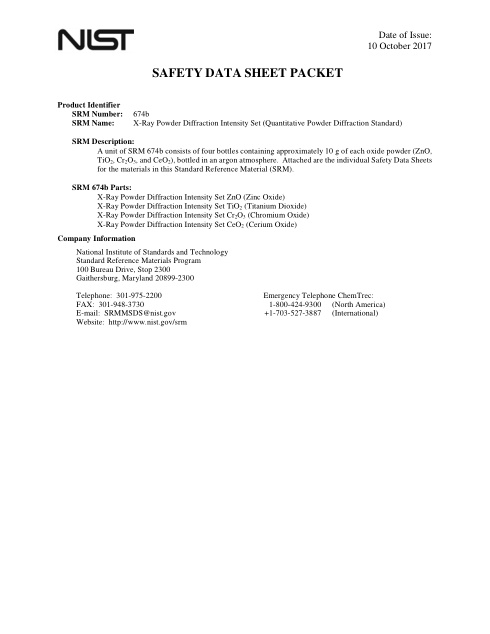
Date of Issue: 2017年10月10日
SAFETY DATA SHEET PACKET
Product Identifier SRM Number: 674b SRM Name: X-Ray Powder Diffraction Intensity Set (Quantitative Powder Diffraction Standard)
SRM 説明: A unit of SRM 674b consists of four bottles containing approximately 10 g of each oxide powder (ZnO, TiO2, Cr2O3, and CeO2), bottled in an argon atmosphere. Attached are the individual 安全データシート for the materials in this Standard Reference Material (SRM).
SRM 674b Parts: X-Ray Powder Diffraction Intensity Set ZnO (Zinc Oxide) X-Ray Powder Diffraction Intensity Set TiO2 (Titanium Dioxide) X-Ray Powder Diffraction Intensity Set Cr2O3 (Chromium Oxide) X-Ray Powder Diffraction Intensity Set CeO2 (Cerium Oxide) Company Information 米国国立標準技術研究所 標準物質プログラム 100 Bureau Drive, Stop 2300 Gaithersburg, Maryland 20899-2300
Telephone: 301-975-2200 Emergency Telephone ChemTrec: FAX: 301-948-3730 1-800-424-9300 (North America) E-mail: SRMMSDS@nist.gov +1-703-527-3887 (International) ウェブサイト: http://www.nist.gov/srm
ページ 2
Date of Issue: 2017年10月10日 SAFETY DATA SHEET
1. SUBSTANCE AND SOURCE IDENTIFICATION Product Identifier SRM Number: 674b SRM Name: X-Ray Powder Diffraction Intensity Set (Quantitative Powder Diffraction Standard) SRM Part: X-Ray Powder Diffraction Intensity Set ZnO (Zinc Oxide) Other Means of Identification: Not applicable.
おすすめ Use of This Material and Restrictions of Use This Standard Reference Material (SRM) is intended primarily for use as internal standards for quantitative X-ray diffraction analysis. This A unit of SRM 674b consists of four bottles containing approximately 10 g of each oxide powder (ZnO, TiO2, Cr2O3, and CeO2), bottled in an argon atmosphere. Company Information 米国国立標準技術研究所 標準物質プログラム 100 Bureau Drive, Stop 2300 Gaithersburg, Maryland 20899-2300
Telephone: 301-975-2200 Emergency Telephone ChemTrec: FAX: 301-948-3730 1-800-424-9300 (North America) E-mail: SRMMSDS@nist.gov +1-703-527-3887 (International) ウェブサイト: http://www.nist.gov/srm
2. HAZARDS IDENTIFICATION
Note: This SDS is for ZnO; see additional SDSs for the classification for TiO2, Cr2O3, and CeO2. Classification Physical Hazard: Not classified. Health Hazard: Not classified.
Label 元素s Symbol: No symbol/No pictogram Signal Word: No signal word Hazard Statement(s): Not applicable. Precautionary Statement(s): Not applicable. Hazards Not Otherwise Classified: Not applicable. Ingredients(s) with Unknown Acute Toxicity: Not applicable.
3. COMPOSITION AND INFORMATION ON HAZARDOUS INGREDIENTS
物質: Zinc Oxide Other Designations: Zinc white; 中国語 white; flowers of zinc; zinc monoxide; zinc gelatin; white zinc; permanent white; philosophers wool; zincoid; snow white; ZnO Components are listed in compliance with OSHA’s 29 CFR 1910.1200; for the actual values see the NIST Certificate of Analysis. Hazardous Component(s) CAS番号 EC Number Nominal Mass Concentration (EINECS) (%) Zinc Oxide 1314-13-2 215-222-5 100
SRM 674b Part: X-Ray Powder Diffraction Intensity Set ページ 1 of 5 ZnO (Zinc Oxide)
ページ 3
4. FIRST AID MEASURES
説明 of First Aid Measures: Inhalation: If adverse effects occur, remove to uncontaminated area. If not breathing, give artificial respiration or oxygen by qualified personnel. Seek immediate medical attention. Skin Contact: Wash skin with soap and water for at least 15 minutes. Thoroughly clean and dry contaminated clothing before reuse. Eye Contact: Flush eyes with water for at least 15 minutes. If necessary, seek medical attention. Ingestion: If a large amount is swallowed, get medical attention. Most Important Symptoms/Effects, Acute and Delayed: May cause irritation. Indication of any immediate medical attention and special treatment needed, if necessary: If any of the above symptoms are present, seek medical attention if needed.
5. FIRE FIGHTING MEASURES
Fire and Explosion Hazards: Negligible fire hazard. See Section 9, “Physical and Chemical Properties” for flammability properties. Extinguishing Media: Suitable: Regular dry chemical, carbon dioxide, water, regular foam. Unsuitable: None listed. Specific Hazards Arising from the Chemical: None listed. Special Protective Equipment and Precautions for Fire-Fighters: Avoid inhalation of material or combustion byproducts. Wear full protective clothing and NIOSH approved self-contained breathing apparatus (SCBA). NFPA Ratings (0 = Minimal; 1 = Slight; 2 = Moderate; 3 = Serious; 4 = Severe) Health = 0 Fire = 0 Reactivity = 0
6. ACCIDENTAL RELEASE MEASURES
Personal Precautions, Protective Equipment and Emergency Procedures: Use suitable protective equipment; see Section 8, “Exposure Controls and Personal Protection”. Methods and 材料 for Containment and Clean up: Collect spilled material in appropriate container for disposal. Avoid generating dust. Clean up residue with a high-efficiency particulate filter vacuum.
7. HANDLING AND STORAGE
Safe Handling Precautions: Minimize dust generation. See Section 8, “Exposure Controls and Personal Protection”. Storage: It is recommended that the unused portion of the powder be stored in a tightly capped container such as the original bottle or in a manner to protect against humidity. Store and handling in accordance with all current regulations and standards. Keep separated from incompatible substances (See Section 10, “Stability and Reactivity”).
8. EXPOSURE CONTROLS AND PERSONAL PROTECTION
Exposure Limits: ACGIH (TLV): 2 mg/m3 (TWA, respirable particulates) 10 mg/m3 (STEL, respirable particulates) NIOSH (REL): 5 mg/m3 (TWA, dust and fume) 10 mg/m3 (STEL, fume) 15 mg/m3 (Ceiling, dust) 500 mg/m3 (IDLH) OSHA (PEL): 5 mg/m3 (TWA, fume) 15 mg/m3 (TWA, total dust) 5 mg/m3 (TWA, respirable fraction)
SRM 674b Part: X-Ray Powder Diffraction Intensity Set ページ 2 of 5 ZnO (Zinc Oxide)
ページ 4
Engineering Controls: Provide local exhaust or process enclosure ventilation system. Ensure compliance with applicable exposure limits. Personal Protection: In accordance with OSHA 29 CFR 1910.132, subpart I, wear appropriate Personal Protective Equipment (PPE) to minimize exposure to this material. Respiratory Protection: If workplace conditions warrant a respirator, a respiratory protection program that meets OSHA 29CFR 1910.134 must be followed. Refer to NIOSH 42 CFR 84 for applicable certified respirators. Eye/Face Protection: Wear splash resistant safety goggles with a face shield. An eye wash station should be readily available near areas of use. Skin and Body Protection: Personal protective equipment for the body should be selected based on the task being performed and the risks involved and should be approved by a specialist before handling this product. Chemical- resistant gloves should be worn at all times when handling chemicals.
9. PHYSICAL AND CHEMICAL PROPERTIES
Descriptive Properties: Appearance white or gray, powder (physical state, color, etc.): Molecular Formula: ZnO Molar Mass (g/mol): 81.37 Odor: odorless Odor threshold: not available pH (solution): 6.95 to 7.37 Evaporation rate: not applicable Melting point/freezing point (ºC): 1975 (3587 ºF) Relative Density (g/mL): 5.6 Vapor Pressure (mmHg): 0.0 at 21 °C Vapor Density (air = 1): >1 Viscosity (cP): not applicable Solubility(ies): water soluble (1.6 ppm at 29 °C); soluble in dilute acetic acid, mineral acids, ammonia, ammonium chloride solutions, ammonium salt solutions, fixed alkali hydroxide solutions, strong alkali Partition coefficient (n-octanol/water): not available Particle Size: not available Thermal Stability Properties: Autoignition Temperature (ºC): not applicable Thermal Decomposition (ºC): not available Initial boiling point and boiling range (ºC): not applicable Explosive Limits, LEL (Volume %): not applicable Explosive Limits, UEL (Volume %): not applicable Flash Point (ºC): not applicable Flammability (solid, gas): not available
10. STABILITY AND REACTIVITY
Reactivity: Stable at normal temperatures and pressure. Stability: X Stable Unstable Possible Hazardous Reactions: None listed. Conditions to Avoid: Avoid generating dust. Incompatible 材料: Halo carbons, combustible materials, metals, acids, oxidizing materials.
SRM 674b Part: X-Ray Powder Diffraction Intensity Set ページ 3 of 5 ZnO (Zinc Oxide)
ページ 5
Fire/Explosion Information: See Section 5, “Fire Fighting Measures”. Hazardous Decomposition: Thermal decomposition will produce zinc, oxides of zinc. Hazardous Polymerization: Will Occur X Will Not Occur
11. TOXICOLOGICAL INFORMATION
Route of Exposure: X Inhalation Skin X Ingestion Symptoms Related to the Physical, Chemical and Toxicological Characteristics: Exposure may cause irritation. Potential Health Effects (Acute, Chronic and Delayed): Inhalation: Acute: irritation; inhaled fumes may cause metal fume fever, difficulty breathing; chronic: nausea and liver damage. Skin Contact: Acute: low potential for skin irritation, although it can alter skin pigmentation; chronic: skin disorders. Eye Contact: Acute: mechanical irritation, redness, and pain; chronic: no information available. Ingestion: Acute: nausea, diarrhea, constipation; chronic: no information available. Numerical Measures of Toxicity: Acute Toxicity: Not classified. Rat, Oral LD50: >5000 mg/kg Mouse, Inhalation LC50: 2500 mg/m3 Skin Corrosion/Irritation: Not classified. Rabbit, Skin (mild): 500 mg (24 h) Serious Eye damage/Eye irritation: Not classified. Rabbit, Eyes (mild): 500 mg (24 h) Respiratory Sensitization: Not classified; no data available. Skin Sensitization: Not classified; no data available. Germ Cell Mutagenicity: Not classified; no data available. Carcinogenicity: Not classified. Listed as a Carcinogen/Potential Carcinogen Yes X No Zinc oxide is not listed by IARC, NTP or OSHA as a carcinogen. Reproductive Toxicity: Not classified. Rat, Oral TDLo: 6846 mg/kg (pregnant 1 d to 22 d) Specific Target Organ Toxicity, Single Exposure: Not classified; no data available. Specific Target Organ Toxicity, Repeated Exposure: Not classified; no data available. Aspiration Hazard: Not classified; no data available.
12. ECOLOGICAL INFORMATION
Ecotoxicity Data: No data available. Persistence and Degradability: No data available. Bioaccumulative Potential: No data available. Mobility in Soil: No data available. Other Adverse effects: No data available.
13. DISPOSAL CONSIDERATIONS
Waste Disposal: Dispose of waste in accordance with all applicable federal, state, and local regulations.
14. TRANSPORTATION INFORMATION
U.S. DOT and IATA: Not regulated by DOT or IATA.
SRM 674b Part: X-Ray Powder Diffraction Intensity Set ページ 4 of 5 ZnO (Zinc Oxide)
ページ 6
15. REGULATORY INFORMATION
U.S. Regulations: CERCLA Sections 102a/103 (40 CFR 302.4): Not regulated. SARA Title III Section 302 (40 CFR 355.30): Not regulated. SARA Title III Section 304 (40 CFR 355.40): Not regulated. SARA Title III Section 313 (40 CFR 372.65): 1.0 % de minimis concentration (related to Zinc compounds). OSHA Process Safety (29 CFR 1910.119): Not regulated. SARA Title III Sections 311/312 Hazardous Categories (40 CFR 370.21): ACUTE HEALTH: No. CHRONIC HEALTH: No. FIRE: No. REACTIVE: No. PRESSURE: No. State Regulations: California Proposition 65: Not listed. U.S. TSCA Inventory: Listed. TSCA 12(b), Export Notification: Not listed. Canadian Regulations: WHMIS Information: Not provided for this material.
16. OTHER INFORMATION
Issue Date: 2017年10月10日 情報源s: ChemAdvisor, Inc., MSDS Zinc Oxide, 2015年12月9日.
Key of Acronyms: ACGIH American Conference of Governmental Industrial NIOSH National Institute for Occupational Safety and Hygienists Health ALI Annual Limit on Intake NIST 米国国立標準技術研究所 CAS Chemical Abstracts Service NRC Nuclear Regulatory Commission CEN European Committee for Standardization NTP National Toxicology Program CERCLA Comprehensive Environmental Response, OSHA Occupational Safety and Health Administration Compensation, and Liability Act CFR Code of Federal Regulations PEL Permissible Exposure Limit CPSU Coal Mine Dust Personal Sample Unit RCRA Resource Conservation and Recovery Act DOT Department of Transportation REL おすすめ Exposure Limit EC50 Effective Concentration, 50 % RM Reference Material EINECS European Inventory of Existing Commercial RQ Reportable Quantity Chemical Substances EPCRA Emergency Planning and Community Right-to-Know RTECS Registry of Toxic Effects of Chemical Substances Act IARC International Agency for Research on Cancer SARA Superfund Amendments and Reauthorization Act IATA International Air Transport Association SCBA Self-Contained Breathing Apparatus IDLH Immediately Dangerous to Life and Health SRM Standard Reference Material ISO International Organization for Standardization STEL Short Term Exposure Limit LC50 Lethal Concentration, 50 % TDLo Toxic Dose Low LD50 Lethal Dose, 50 % TLV Threshold Limit Value LEL Lower Explosive Limit TPQ Threshold Planning Quantity MSDS Material 安全データシート TSCA Toxic Substances Control Act NFPA National Fire Protection Association TWA Time Weighted Average MSHA Mine Safety and Health Administration UEL Upper Explosive Limit WHMIS Workplace Hazardous 材料 Information System
Disclaimer: Physical and chemical data contained in this SDS are provided only for use in assessing the hazardous nature of the material. The SDS was prepared carefully, using current references; however, NIST does not certify the data in the SDS. The certified values for this material are given in the NIST Certificate of Analysis. Users of this SRM should ensure that the SDS in their possession is current. This can be accomplished by contacting the SRM Program: telephone (301) 975-2200; fax (301) 948-3730; e-mail srmmsds@nist.gov; or via the Internet at http://www.nist.gov/srm.
SRM 674b Part: X-Ray Powder Diffraction Intensity Set ページ 5 of 5 ZnO (Zinc Oxide)
ページ 7
Date of Issue: 2017年10月10日 SAFETY DATA SHEET
1. SUBSTANCE AND SOURCE IDENTIFICATION Product Identifier SRM Number: 674b SRM Name: X-Ray Powder Diffraction Intensity Set (Quantitative Powder Diffraction Standard) SRM Part: X-Ray Powder Diffraction Intensity Set TiO2 (Titanium Dioxide) Other Means of Identification: Not applicable. おすすめ Use of This Material and Restrictions of Use This Standard Reference Material (SRM) is intended primarily for use as internal standards for quantitative X-ray diffraction analysis. A unit of SRM 674b consists of four bottles containing approximately 10 g of each oxide powder (ZnO, TiO2, Cr2O3, and CeO2), bottled in an argon atmosphere. Company Information 米国国立標準技術研究所 標準物質プログラム 100 Bureau Drive, Stop 2300 Gaithersburg, Maryland 20899-2300
Telephone: 301-975-2200 Emergency Telephone ChemTrec: FAX: 301-948-3730 1-800-424-9300 (North America) E-mail: SRMMSDS@nist.gov +1-703-527-3887 (International) ウェブサイト: http://www.nist.gov/srm
2. HAZARDS IDENTIFICATION
Note: This SDS is for TiO2; see additional SDSs for the classification for ZnO, Cr2O3, and CeO2. Classification Physical Hazard: Not classified. Health Hazard: Carcinogenicity Category 2
Label 元素s Symbol
Signal Word WARNING Hazard Statement(s): H351 Suspected of causing cancer (inhalation). Precautionary Statement(s): P201 Obtain special instructions before use. P202 Do not handle until all safety precautions have been read and understood. P281 Use personal protective equipment as required. P308+P313 If exposed or concerned: Get medical attention. P405 Store locked up. P501 Dispose of contents and container in accordance with local regulations. Hazards Not Otherwise Classified: Not applicable. Ingredients(s) with Unknown Acute Toxicity: Not applicable.
SRM 674b Part: X-Ray Powder Diffraction Intensity Set ページ 1 of 6 TiO2 (Titanium Dioxide)
ページ 8
3. COMPOSITION AND INFORMATION ON HAZARDOUS INGREDIENTS
物質: Titanium Dioxide Other Designations: Titanium oxide; titanium dioxide: TiO2; titanium peroxide; titanic oxide; brookite; rutile Components are listed in compliance with OSHA’s 29 CFR 1910.1200; for the actual values see the NIST Certificate of Analysis. Hazardous Component(s) CAS番号 EC Number Nominal Mass Concentration (EINECS) (%) Titanium Dioxide 13463-67-7 236-675-5 100
4. FIRST AID MEASURES
説明 of First Aid Measures: Inhalation: If adverse effects occur, remove to uncontaminated area. If not breathing, give artificial respiration or oxygen by qualified personnel. Seek immediate medical attention. Skin Contact: Wash skin with soap and water for at least 15 minutes. Thoroughly clean and dry contaminated clothing before reuse. Eye Contact: Flush eyes with water for at least 15 minutes. If necessary, seek medical attention. Ingestion: If a large amount is swallowed, get medical attention. Most Important Symptoms/Effects, Acute and Delayed: Irritation, cancer inhalation hazard. Indication of any immediate medical attention and special treatment needed, if necessary: If any of the above symptoms are present, seek medical attention if needed.
5. FIRE FIGHTING MEASURES
Fire and Explosion Hazards: Negligible fire hazard. See Section 9, “Physical and Chemical Properties” for flammability properties. Extinguishing Media: Suitable: Use extinguishing agents appropriate for surrounding fire. Unsuitable: None listed. Specific Hazards Arising from the Chemical: None listed. Special Protective Equipment and Precautions for Fire-Fighters: Avoid inhalation of material or combustion byproducts. Wear full protective clothing and NIOSH approved self-contained breathing apparatus (SCBA). NFPA Ratings (0 = Minimal; 1 = Slight; 2 = Moderate; 3 = Serious; 4 = Severe) Health = 1 Fire = 0 Reactivity = 0
6. ACCIDENTAL RELEASE MEASURES
Personal Precautions, Protective Equipment and Emergency Procedures: Use suitable protective equipment; see Section 8, “Exposure Controls and Personal Protection”. Methods and 材料 for Containment and Clean up: Collect spilled material in appropriate container for disposal. Avoid generating dust.
7. HANDLING AND STORAGE
Safe Handling Precautions: Minimize dust generation. See Section 8, “Exposure Controls and Personal Protection”. Storage: It is recommended that the unused portion of the powder be stored in a tightly capped container such as the original bottle or in a manner to protect against humidity. Store and handling in accordance with all current regulations and standards. Keep separated from incompatible substances (See Section 10, “Stability and Reactivity”).
SRM 674b Part: X-Ray Powder Diffraction Intensity Set ページ 2 of 6 TiO2 (Titanium Dioxide)
ページ 9
8. EXPOSURE CONTROLS AND PERSONAL PROTECTION
Exposure Limits: ACGIH (TLV): 10 mg/m3 (TWA) 5000 mg/m3 (IDLH) NIOSH (REL): No occupational exposure limits available. OSHA (PEL): 15 mg/m3 (TWA, total dust) Engineering Controls: Provide local exhaust or process enclosure ventilation system. Ensure compliance with applicable exposure limits. Personal Protection: In accordance with OSHA 29 CFR 1910.132, subpart I, wear appropriate Personal Protective Equipment (PPE) to minimize exposure to this material. Respiratory Protection: If workplace conditions warrant a respirator, a respiratory protection program that meets OSHA 29CFR 1910.134 must be followed. Refer to NIOSH 42 CFR 84 for applicable certified respirators. Eye/Face Protection: Wear splash resistant safety goggles with a face shield. An eye wash station should be readily available near areas of use. Skin and Body Protection: Personal protective equipment for the body should be selected based on the task being performed and the risks involved and should be approved by a specialist before handling this product. Chemical- resistant gloves should be worn at all times when handling chemicals.
9. PHYSICAL AND CHEMICAL PROPERTIES
Descriptive Properties: Appearance colorless, white or black, powder (physical state, color, etc.): Molecular Formula: TiO2 Molar Mass (g/mol): 79.88 Odor: odorless Odor threshold: not available pH (solution): neutral (10 % suspension) Evaporation rate: not applicable Melting point/freezing point (ºC): 1825 to 1850 (3317 ºF to 3362 ºF) Relative Density 3.84 to 4.26 as Specific Gravity (water = 1): Vapor Pressure (mmHg): not applicable Vapor Density (air = 1): not applicable Viscosity (cP): not applicable Solubility(ies): soluble in hot concentrated sulfuric acid, hydrofluoric acid, alkali; insoluble in water, hydrochloric acid, nitric acid, dilute sulfuric acid. Partition coefficient (n-octanol/water): not available Particle Size: not available Thermal Stability Properties: Autoignition Temperature (ºC): not applicable Thermal Decomposition (ºC): not available Initial boiling point and boiling range (ºC): 2500 to 3000 (4532 ºF to 5432 ºF) Explosive Limits, LEL (Volume %): not applicable Explosive Limits, UEL (Volume %): not applicable Flash Point (ºC): not applicable Flammability (solid, gas): not available
SRM 674b Part: X-Ray Powder Diffraction Intensity Set ページ 3 of 6 TiO2 (Titanium Dioxide)
ページ 10
10. STABILITY AND REACTIVITY
Reactivity: Stable at normal temperatures and pressure. Stability: X Stable Unstable Possible Hazardous Reactions: None listed. Conditions to Avoid: Avoid generating dust. Incompatible 材料: Metals. Fire/Explosion Information: See Section 5, “Fire Fighting Measures”. Hazardous Decomposition: Thermal decomposition will produce oxides of titanium. Hazardous Polymerization: Will Occur X Will Not Occur
11. TOXICOLOGICAL INFORMATION
Route of Exposure: X Inhalation X Skin Ingestion Symptoms Related to the Physical, Chemical and Toxicological Characteristics: Exposure may cause irritation; inhalation may cause cancer. Potential Health Effects (Acute, Chronic and Delayed): Inhalation: Acute: irritation, cough; chronic: same as acute, difficulty breathing, may cause cancer. Skin Contact: Acute: no information available; chronic: irritation. Eye Contact: No information available. Ingestion: No information available. Numerical Measures of Toxicity: Acute Toxicity: Not classified. Rat, Oral LD50: >10 000 mg/kg Skin Corrosion/Irritation: Not classified. Human, Skin intermittent (mild): 300 ug (3 d) Serious Eye damage/Eye irritation: Not classified; no data available. Respiratory Sensitization: Not classified; no data available. Skin Sensitization: Not classified; no data available. Germ Cell Mutagenicity: Not classified; no data available. Carcinogenicity: Category 2. Listed as a Carcinogen/Potential Carcinogen X Yes No Titanium dioxide is listed by IARC as Group 2B (possibly carcinogenic to humans). Titanium dioxide is not listed by NTP or OSHA as a carcinogen. Reproductive Toxicity: Not classified; no data available. Specific Target Organ Toxicity, Single Exposure: Not classified; no data available. Specific Target Organ Toxicity, Repeated Exposure: Not classified; no data available. Aspiration Hazard: Not classified; no data available.
12. ECOLOGICAL INFORMATION
Ecotoxicity Data: No data available. Persistence and Degradability: No data available. Bioaccumulative Potential: No data available. Mobility in Soil: No data available. Other Adverse effects: No data available.
SRM 674b Part: X-Ray Powder Diffraction Intensity Set ページ 4 of 6 TiO2 (Titanium Dioxide)
ページ 11
13. DISPOSAL CONSIDERATIONS
Waste Disposal: Dispose of waste in accordance with all applicable federal, state, and local regulations.
14. TRANSPORTATION INFORMATION
U.S. DOT and IATA: Not regulated by DOT or IATA.
15. REGULATORY INFORMATION
U.S. Regulations: CERCLA Sections 102a/103 (40 CFR 302.4): Not regulated. SARA Title III Section 302 (40 CFR 355.30): Not regulated. SARA Title III Section 304 (40 CFR 355.40): Not regulated. SARA Title III Section 313 (40 CFR 372.65): Not regulated. OSHA Process Safety (29 CFR 1910.119): Not regulated. SARA Title III Sections 311/312 Hazardous Categories (40 CFR 370.21): ACUTE HEALTH: No. CHRONIC HEALTH: Yes. FIRE: No. REACTIVE: No. PRESSURE: No. State Regulations: California Proposition 65: WARNING! This product contains a chemical (titanium dioxide) known to the state of California to cause cancer. U.S. TSCA Inventory: Listed. TSCA 12(b), Export Notification: Not listed. Canadian Regulations: WHMIS Information: Not provided for this material.
16. OTHER INFORMATION
Issue Date: 2017年10月10日 情報源s: ChemAdvisor, Inc., MSDS Titanium Dioxide, 2015年12月9日.
SRM 674b Part: X-Ray Powder Diffraction Intensity Set ページ 5 of 6 TiO2 (Titanium Dioxide)
ページ 12
Key of Acronyms: ACGIH American Conference of Governmental Industrial NIOSH National Institute for Occupational Safety and Hygienists Health ALI Annual Limit on Intake NIST 米国国立標準技術研究所 CAS Chemical Abstracts Service NRC Nuclear Regulatory Commission CEN European Committee for Standardization NTP National Toxicology Program CERCLA Comprehensive Environmental Response, OSHA Occupational Safety and Health Administration Compensation, and Liability Act CFR Code of Federal Regulations PEL Permissible Exposure Limit CPSU Coal Mine Dust Personal Sample Unit RCRA Resource Conservation and Recovery Act DOT Department of Transportation REL おすすめ Exposure Limit EC50 Effective Concentration, 50 % RM Reference Material EINECS European Inventory of Existing Commercial RQ Reportable Quantity Chemical Substances EPCRA Emergency Planning and Community Right-to-Know RTECS Registry of Toxic Effects of Chemical Substances Act IARC International Agency for Research on Cancer SARA Superfund Amendments and Reauthorization Act IATA International Air Transport Association SCBA Self-Contained Breathing Apparatus IDLH Immediately Dangerous to Life and Health SRM Standard Reference Material ISO International Organization for Standardization STEL Short Term Exposure Limit LC50 Lethal Concentration, 50 % TDLo Toxic Dose Low LD50 Lethal Dose, 50 % TLV Threshold Limit Value LEL Lower Explosive Limit TPQ Threshold Planning Quantity MSDS Material 安全データシート TSCA Toxic Substances Control Act NFPA National Fire Protection Association TWA Time Weighted Average MSHA Mine Safety and Health Administration UEL Upper Explosive Limit WHMIS Workplace Hazardous 材料 Information System
Disclaimer: Physical and chemical data contained in this SDS are provided only for use in assessing the hazardous nature of the material. The SDS was prepared carefully, using current references; however, NIST does not certify the data in the SDS. The certified values for this material are given in the NIST Certificate of Analysis. Users of this SRM should ensure that the SDS in their possession is current. This can be accomplished by contacting the SRM Program: telephone (301) 975-2200; fax (301) 948-3730; e-mail srmmsds@nist.gov; or via the Internet at http://www.nist.gov/srm.
SRM 674b Part: X-Ray Powder Diffraction Intensity Set ページ 6 of 6 TiO2 (Titanium Dioxide)
ページ 13
Date of Issue: 2017年10月10日 SAFETY DATA SHEET
1. SUBSTANCE AND SOURCE IDENTIFICATION Product Identifier SRM Number: 674b SRM Name: X-Ray Powder Diffraction Intensity Set (Quantitative Powder Diffraction Standard) SRM Part: X-Ray Powder Diffraction Intensity Set Cr2O3 (Chromium Oxide) Other Means of Identification: Not applicable.
おすすめ Use of This Material and Restrictions of Use This Standard Reference Material (SRM) is intended primarily for use as internal standards for quantitative X-ray diffraction analysis. A unit of SRM 674b consists of four bottles containing approximately 10 g of each oxide powder (ZnO, TiO2, Cr2O3, and CeO2), bottled in an argon atmosphere. Company Information 米国国立標準技術研究所 標準物質プログラム 100 Bureau Drive, Stop 2300 Gaithersburg, Maryland 20899-2300
Telephone: 301-975-2200 Emergency Telephone ChemTrec: FAX: 301-948-3730 1-800-424-9300 (North America) E-mail: SRMMSDS@nist.gov +1-703-527-3887 (International) ウェブサイト: http://www.nist.gov/srm
2. HAZARDS IDENTIFICATION
Note: This SDS is for Cr2O3; see additional SDSs for the classification for ZnO, TiO2, and CeO2. Classification Physical Hazard: Not classified. Health Hazard: Not classified.
Label 元素s Symbol: No symbol/No pictogram Signal Word: No signal word Hazard Statement(s): Not applicable. Precautionary Statement(s): Not applicable. Hazards Not Otherwise Classified: Not applicable. Ingredients(s) with Unknown Acute Toxicity: Not applicable.
3. COMPOSITION AND INFORMATION ON HAZARDOUS INGREDIENTS
物質: Chromium oxide Other Designations: Chromium (III) oxide; chromic oxide; dichromium trioxide; chrome oxide; anadomis green; casalis green oxide pigment; chromia; chromium sesquioxide; green rouge; Cr2O3 Components are listed in compliance with OSHA’s 29 CFR 1910.1200; for the actual values see the NIST Certificate of Analysis. Hazardous Component(s) CAS番号 EC Number Nominal Mass Concentration (EINECS) (%) Chromium Oxide 1308-38-9 215-160-9 100
SRM 674b Part: X-Ray Powder Diffraction Intensity Set ページ 1 of 5 Cr2O3 (Chromium Oxide)
ページ 14
4. FIRST AID MEASURES
説明 of First Aid Measures: Inhalation: If adverse effects occur, remove to uncontaminated area. If not breathing, give artificial respiration or oxygen by qualified personnel. Seek immediate medical attention. Skin Contact: Wash skin with soap and water for at least 15 minutes. Thoroughly clean and dry contaminated clothing before reuse. Eye Contact: Flush eyes with water for at least 15 minutes. If necessary, seek medical attention. Ingestion: If a large amount is swallowed, get medical attention. Most Important Symptoms/Effects, Acute and Delayed: May cause irritation and allergic reactions. Indication of any immediate medical attention and special treatment needed, if necessary: If any of the above symptoms are present, seek medical attention if needed.
5. FIRE FIGHTING MEASURES
Fire and Explosion Hazards: Negligible fire hazard. Dust/air mixtures may ignite or explode. See Section 9, “Physical and Chemical Properties” for flammability properties. Extinguishing Media: Suitable: Use extinguishing agents appropriate for surrounding fire. Unsuitable: None listed. Specific Hazards Arising from the Chemical: None listed. Special Protective Equipment and Precautions for Fire-Fighters: Avoid inhalation of material or combustion byproducts. Wear full protective clothing and NIOSH approved self-contained breathing apparatus (SCBA). NFPA Ratings (0 = Minimal; 1 = Slight; 2 = Moderate; 3 = Serious; 4 = Severe) Health = 1 Fire = 0 Reactivity = 0
6. ACCIDENTAL RELEASE MEASURES
Personal Precautions, Protective Equipment and Emergency Procedures: Use suitable protective equipment; see Section 8, “Exposure Controls and Personal Protection”. Methods and 材料 for Containment and Clean up: Collect spilled material in appropriate container for disposal. Avoid generating dust.
7. HANDLING AND STORAGE
Safe Handling Precautions: Minimize dust generation. See Section 8, “Exposure Controls and Personal Protection”. Storage: It is recommended that the unused portion of the powder be stored in a tightly capped container such as the original bottle or in a manner to protect against humidity. Store and handling in accordance with all current regulations and standards. Keep separated from incompatible substances (See Section 10, “Stability and Reactivity”).
8. EXPOSURE CONTROLS AND PERSONAL PROTECTION
Exposure Limits: [as Cr, related to Chromium(III) compounds] ACGIH (TLV): No occupational exposure limits established. NIOSH (REL): 0.5 mg/m3 (TWA) 25 mg/m3 (IDLH) OSHA (PEL): 0.5 mg/m3 (TWA) Engineering Controls: Provide local exhaust or process enclosure ventilation system. Ensure compliance with applicable exposure limits.
SRM 674b Part: X-Ray Powder Diffraction Intensity Set ページ 2 of 5 Cr2O3 (Chromium Oxide)
ページ 15
Personal Protection: In accordance with OSHA 29 CFR 1910.132, subpart I, wear appropriate Personal Protective Equipment (PPE) to minimize exposure to this material. Respiratory Protection: If workplace conditions warrant a respirator, a respiratory protection program that meets OSHA 29CFR 1910.134 must be followed. Refer to NIOSH 42 CFR 84 for applicable certified respirators. Eye/Face Protection: Wear splash resistant safety goggles with a face shield. An eye wash station should be readily available near areas of use. Skin and Body Protection: Personal protective equipment for the body should be selected based on the task being performed and the risks involved and should be approved by a specialist before handling this product. Chemical- resistant gloves should be worn at all times when handling chemicals.
9. PHYSICAL AND CHEMICAL PROPERTIES
Descriptive Properties: Appearance green powder (physical state, color, etc.): Molecular Formula: Cr2O3 Molar Mass (g/mol): 151.99 Odor: odorless Odor threshold: not available pH (solution): 7.5 at 5 % Evaporation rate: not applicable Melting point/freezing point (ºC): 2435 (4415 ºF) Relative Density as Specific Gravity (water = 1): 5.21 Vapor Pressure (mmHg): not available Vapor Density (air = 1): not available Viscosity (cP): not applicable Solubility(ies): insoluble in water, acids, alkali, alcohol, acetone Partition coefficient (n-octanol/water): not available Particle Size: not available Thermal Stability Properties: Autoignition Temperature (ºC): not applicable Thermal Decomposition (ºC): not available Initial boiling point and boiling range (ºC): 4000 (7232 ºF) Explosive Limits, LEL (Volume %): not applicable Explosive Limits, UEL (Volume %): not applicable Flash Point (ºC): not applicable Flammability (solid, gas): not available
10. STABILITY AND REACTIVITY
Reactivity: Stable at normal temperatures and pressure. Stability: X Stable Unstable Possible Hazardous Reactions: None listed. Conditions to Avoid: Avoid generating dust. Incompatible 材料: Halogens, metals, combustible materials, oxidizing materials, metal carbide. Fire/Explosion Information: See Section 5, “Fire Fighting Measures”. Hazardous Decomposition: Thermal decomposition will produce oxides of chromium. Hazardous Polymerization: Will Occur X Will Not Occur
SRM 674b Part: X-Ray Powder Diffraction Intensity Set ページ 3 of 5 Cr2O3 (Chromium Oxide)
ページ 16
11. TOXICOLOGICAL INFORMATION
Route of Exposure: X Inhalation X Skin Ingestion Symptoms Related to the Physical, Chemical and Toxicological Characteristics: Exposure may cause irritation and allergic reactions. Potential Health Effects (Acute, Chronic and Delayed): Inhalation: Acute: irritation, allergic reactions, chest pain; chronic: same as acute, lung damage, kidney damage, and liver damage. Skin Contact: Acute and chronic: irritation and allergic reactions. Eye Contact: Acute: irritation; chronic: no information available. Ingestion: Acute: nausea, diarrhea, vomiting; chronic: no information available. Numerical Measures of Toxicity: Acute Toxicity: Not classified; no data available. Skin Corrosion/Irritation: Not classified; no data available. Serious Eye damage/Eye irritation: Not classified; no data available. Respiratory Sensitization: Not classified; no data available. Skin Sensitization: Not classified; no data available. Germ Cell Mutagenicity: Not classified; no data available. Carcinogenicity: Not classified. Listed as a Carcinogen/Potential Carcinogen Yes X No Chromium (III) compounds are listed by IARC as Group 3 (not classifiable). Chromium oxide is not listed by NTP or OSHA as a carcinogen. Reproductive Toxicity: Not classified; no data available. Specific Target Organ Toxicity, Single Exposure: Not classified; no data available. Specific Target Organ Toxicity, Repeated Exposure: Not classified; no data available. Aspiration Hazard: Not classified; no data available.
12. ECOLOGICAL INFORMATION
Ecotoxicity Data: No data available. Persistence and Degradability: No data available. Bioaccumulative Potential: No data available. Mobility in Soil: No data available. Other Adverse effects: No data available.
13. DISPOSAL CONSIDERATIONS
Waste Disposal: Dispose of waste in accordance with all applicable federal, state, and local regulations.
14. TRANSPORTATION INFORMATION
U.S. DOT and IATA: Not regulated by DOT or IATA.
15. REGULATORY INFORMATION
U.S. Regulations: CERCLA Sections 102a/103 (40 CFR 302.4): Not regulated. SARA Title III Section 302 (40 CFR 355.30): Not regulated. SARA Title III Section 304 (40 CFR 355.40): Not regulated.
SRM 674b Part: X-Ray Powder Diffraction Intensity Set ページ 4 of 5 Cr2O3 (Chromium Oxide)
ページ 17
SARA Title III Section 313 (40 CFR 372.65): 1.0 % de minimis concentration; Chemical Category N090, (related to Chromium(III) compounds). OSHA Process Safety (29 CFR 1910.119): Not regulated. SARA Title III Sections 311/312 Hazardous Categories (40 CFR 370.21): ACUTE HEALTH: No. CHRONIC HEALTH: No. FIRE: No. REACTIVE: No. PRESSURE: No. State Regulations: California Proposition 65: Not listed. U.S. TSCA Inventory: Listed. TSCA 12(b), Export Notification: Not listed. Canadian Regulations: WHMIS Information: Not provided for this material.
16. OTHER INFORMATION
Issue Date: 2017年10月10日 情報源s: ChemAdvisor, Inc., MSDS Chromium(III) Oxide, 2015年12月9日.
Key of Acronyms: ACGIH American Conference of Governmental Industrial NIOSH National Institute for Occupational Safety and Hygienists Health ALI Annual Limit on Intake NIST 米国国立標準技術研究所 CAS Chemical Abstracts Service NRC Nuclear Regulatory Commission CEN European Committee for Standardization NTP National Toxicology Program CERCLA Comprehensive Environmental Response, OSHA Occupational Safety and Health Administration Compensation, and Liability Act CFR Code of Federal Regulations PEL Permissible Exposure Limit CPSU Coal Mine Dust Personal Sample Unit RCRA Resource Conservation and Recovery Act DOT Department of Transportation REL おすすめ Exposure Limit EC50 Effective Concentration, 50 % RM Reference Material EINECS European Inventory of Existing Commercial RQ Reportable Quantity Chemical Substances EPCRA Emergency Planning and Community Right-to-Know RTECS Registry of Toxic Effects of Chemical Substances Act IARC International Agency for Research on Cancer SARA Superfund Amendments and Reauthorization Act IATA International Air Transport Association SCBA Self-Contained Breathing Apparatus IDLH Immediately Dangerous to Life and Health SRM Standard Reference Material ISO International Organization for Standardization STEL Short Term Exposure Limit LC50 Lethal Concentration, 50 % TDLo Toxic Dose Low LD50 Lethal Dose, 50 % TLV Threshold Limit Value LEL Lower Explosive Limit TPQ Threshold Planning Quantity MSDS Material 安全データシート TSCA Toxic Substances Control Act NFPA National Fire Protection Association TWA Time Weighted Average MSHA Mine Safety and Health Administration UEL Upper Explosive Limit WHMIS Workplace Hazardous 材料 Information System
Disclaimer: Physical and chemical data contained in this SDS are provided only for use in assessing the hazardous nature of the material. The SDS was prepared carefully, using current references; however, NIST does not certify the data in the SDS. The certified values for this material are given in the NIST Certificate of Analysis. Users of this SRM should ensure that the SDS in their possession is current. This can be accomplished by contacting the SRM Program: telephone (301) 975-2200; fax (301) 948-3730; e-mail srmmsds@nist.gov; or via the Internet at http://www.nist.gov/srm.
SRM 674b Part: X-Ray Powder Diffraction Intensity Set ページ 5 of 5 Cr2O3 (Chromium Oxide)
ページ 18
Date of Issue: 2017年10月10日 SAFETY DATA SHEET
1. SUBSTANCE AND SOURCE IDENTIFICATION Product Identifier SRM Number: 674b SRM Name: X-Ray Powder Diffraction Intensity Set (Quantitative Powder Diffraction Standard) SRM Part: X-Ray Powder Diffraction Intensity Set CeO2 (Cerium Oxide) Other Means of Identification: Not applicable.
おすすめ Use of This Material and Restrictions of Use This Standard Reference Material (SRM) is intended primarily for use as internal standards for quantitative X-ray diffraction analysis. A unit of SRM 674b consists of four bottles containing approximately 10 g of each oxide powder (ZnO, TiO2, Cr2O3, and CeO2), bottled in an argon atmosphere. Company Information 米国国立標準技術研究所 標準物質プログラム 100 Bureau Drive, Stop 2300 Gaithersburg, Maryland 20899-2300
Telephone: 301-975-2200 Emergency Telephone ChemTrec: FAX: 301-948-3730 1-800-424-9300 (North America) E-mail: SRMMSDS@nist.gov +1-703-527-3887 (International) ウェブサイト: http://www.nist.gov/srm
2. HAZARDS IDENTIFICATION
Note: This SDS is for CeO2; see additional SDSs for the classification for ZnO, TiO2, and Cr2O3. Classification Physical Hazard: Not classified. Health Hazard: Acute Toxicity, Oral Category 4 Acute Toxicity, Inhalation Category 4
Label 元素s Symbol
Signal Word WARNING Hazard Statement(s): H302 Harmful if swallowed. H332 Harmful if inhaled. Precautionary Statement(s): P261 Avoid breathing dust. P264 Wash hands thoroughly. P270 Do not eat, drink or smoke when using this product. P271 Use in a well-ventilated area. P301+P312 If swallowed: Call a doctor if you feel unwell. P330 Rinse mouth.
SRM 674b Part: X-Ray Powder Diffraction Intensity Set ページ 1 of 6 CeO2 (Cerium Oxide)
ページ 19
P304+P340 If inhaled: Remove person to fresh air and keep comfortable for breathing. P312 If inhaled: Call a doctor if you feel unwell. P501 Dispose of contents and container in accordance with local regulations. Hazards Not Otherwise Classified: Not applicable. Ingredients(s) with Unknown Acute Toxicity: Not applicable.
3. COMPOSITION AND INFORMATION ON HAZARDOUS INGREDIENTS
物質: Cerium Oxide Other Designations: Cerium (IV) oxide; cerium dioxide; ceria; cerium oxide; CeO2; ceric oxide Components are listed in compliance with OSHA’s 29 CFR 1910.1200; for the actual values see the NIST Certificate of Analysis. Hazardous Component(s) CAS番号 EC Number Nominal Mass Concentration (EINECS) (%) Cerium Oxide 1306-38-3 215-150-4 100
4. FIRST AID MEASURES
説明 of First Aid Measures: Inhalation: If adverse effects occur, remove to uncontaminated area. If not breathing, give artificial respiration or oxygen by qualified personnel. Seek immediate medical attention. Skin Contact: Wash skin with soap and water for at least 15 minutes. Thoroughly clean and dry contaminated clothing before reuse. Eye Contact: Flush eyes with water for at least 15 minutes. If necessary, seek medical attention. Ingestion: If a large amount is swallowed, get medical attention. Most Important Symptoms/Effects, Acute and Delayed: May cause irritation, nausea, headache, lung damage. Indication of any immediate medical attention and special treatment needed, if necessary: If any of the above symptoms are present, seek medical attention if needed.
5. FIRE FIGHTING MEASURES
Fire and Explosion Hazards: Negligible fire hazard. See Section 9, “Physical and Chemical Properties” for flammability properties. Extinguishing Media: Suitable: Use extinguishing agents appropriate for surrounding fire. Unsuitable: None listed. Specific Hazards Arising from the Chemical: None listed. Special Protective Equipment and Precautions for Fire-Fighters: Avoid inhalation of material or combustion byproducts. Wear full protective clothing and NIOSH approved self-contained breathing apparatus (SCBA). NFPA Ratings (0 = Minimal; 1 = Slight; 2 = Moderate; 3 = Serious; 4 = Severe) Health = 1 Fire = 0 Reactivity = 0
6. ACCIDENTAL RELEASE MEASURES
Personal Precautions, Protective Equipment and Emergency Procedures: Use suitable protective equipment; see Section 8, “Exposure Controls and Personal Protection”. Methods and 材料 for Containment and Clean up: Collect spilled material in appropriate container for disposal. Avoid generating dust. Clean up residue with a high-efficiency particulate filter vacuum.
SRM 674b Part: X-Ray Powder Diffraction Intensity Set ページ 2 of 6 CeO2 (Cerium Oxide)
ページ 20
7. HANDLING AND STORAGE
Safe Handling Precautions: Minimize dust generation. See Section 8, “Exposure Controls and Personal Protection”. Storage: It is recommended that the unused portion of the powder be stored in a tightly capped container such as the original bottle or in a manner to protect against humidity. Store and handling in accordance with all current regulations and standards. Keep separated from incompatible substances (See Section 10, “Stability and Reactivity”).
8. EXPOSURE CONTROLS AND PERSONAL PROTECTION
Exposure Limits: This material is a particulate matter and adequate inhalation/respiratory protection should be used to minimize exposure. No occupational exposure limits have been established for cerium oxide. The exposure limits for Particulates Not Otherwise Regulated are applicable. OSHA (PEL): 15 mg/m3 (TWA, total particulates not otherwise regulated) 5 mg/m3 (TWA, respirable particulates not otherwise regulated) Engineering Controls: Provide local exhaust or process enclosure ventilation system. Ensure compliance with applicable exposure limits. Personal Protection: In accordance with OSHA 29 CFR 1910.132, subpart I, wear appropriate Personal Protective Equipment (PPE) to minimize exposure to this material. Respiratory Protection: If workplace conditions warrant a respirator, a respiratory protection program that meets OSHA 29CFR 1910.134 must be followed. Refer to NIOSH 42 CFR 84 for applicable certified respirators. Eye/Face Protection: Wear splash resistant safety goggles with a face shield. An eye wash station should be readily available near areas of use. Skin and Body Protection: Personal protective equipment for the body should be selected based on the task being performed and the risks involved and should be approved by a specialist before handling this product. Chemical- resistant gloves should be worn at all times when handling chemicals.
9. PHYSICAL AND CHEMICAL PROPERTIES
Descriptive Properties: Appearance white or yellow, powder (physical state, color, etc.): Molecular Formula: CeO2 Molar Mass (g/mol): 172.12 Odor: not available Odor threshold: not available pH (solution): not available Evaporation rate: not applicable Melting point/freezing point (ºC): 2600 (4712 ºF) Relative Density 7.132 at 23 °C as specific gravity (water = 1): Vapor Pressure (mmHg): not available Vapor Density (air = 1): not available Viscosity (cP): not available Solubility(ies): water: insoluble; soluble in sulfuric acid, nitric acid; insoluble in dilute acids Partition coefficient (n-octanol/water): not available Particle Size: not available
SRM 674b Part: X-Ray Powder Diffraction Intensity Set ページ 3 of 6 CeO2 (Cerium Oxide)
ページ 21
Thermal Stability Properties: Autoignition Temperature (ºC): not applicable Thermal Decomposition (ºC): not available Initial boiling point and boiling range (ºC): not applicable Explosive Limits, LEL (Volume %): not applicable Explosive Limits, UEL (Volume %): not applicable Flash Point (ºC): not applicable Flammability (solid, gas): not available
10. STABILITY AND REACTIVITY
Reactivity: Stable at normal temperatures and pressure. Stability: X Stable Unstable Possible Hazardous Reactions: None listed. Conditions to Avoid: Avoid generating dust. Incompatible 材料: No data available. Fire/Explosion Information: See Section 5, “Fire Fighting Measures”. Hazardous Decomposition: Thermal decomposition will produce oxides of cerium. Hazardous Polymerization: Will Occur X Will Not Occur
11. TOXICOLOGICAL INFORMATION
Route of Exposure: X Inhalation X Skin X Ingestion Symptoms Related to the Physical, Chemical and Toxicological Characteristics: Exposure may cause irritation, nausea, headache, lung damage. Potential Health Effects (Acute, Chronic and Delayed): Inhalation: Acute: nausea, headache, lung damage; chronic: itching, sensitivity to heat, and lung damage. Skin Contact: Acute: hair loss; chronic: no information available. Eye Contact: Acute: irritation and eye damage; chronic: no information available. Ingestion: Acute and chronic: no information available. Numerical Measures of Toxicity: Acute Toxicity: Category 4, Oral; Category 4, Inhalation. Rat, Oral LD50: >1000 mg/kg Rat, Inhalation LC50: >2.01 mg/L (4 h) Rat, Dermal LD50: >2000 mg/kg Skin Corrosion/Irritation: Not classified. Serious Eye damage/Eye irritation: Not classified. Respiratory Sensitization: Not classified; no data available. Skin Sensitization: Not classified; no data available. Germ Cell Mutagenicity: Not classified; no data available. Carcinogenicity: Not classified. Listed as a Carcinogen/Potential Carcinogen Yes X No Cerium oxide is not listed by IARC, NTP or OSHA as a carcinogen. Reproductive Toxicity: Not classified; no data available. Specific Target Organ Toxicity, Single Exposure: Not classified; no data available. Specific Target Organ Toxicity, Repeated Exposure: Not classified; no data available.
SRM 674b Part: X-Ray Powder Diffraction Intensity Set ページ 4 of 6 CeO2 (Cerium Oxide)
ページ 22
Aspiration Hazard: Not classified; no data available.
12. ECOLOGICAL INFORMATION
Ecotoxicity Data: No data available. Persistence and Degradability: No data available. Bioaccumulative Potential: No data available. Mobility in Soil: No data available. Other Adverse effects: No data available.
13. DISPOSAL CONSIDERATIONS
Waste Disposal: Dispose of waste in accordance with all applicable federal, state, and local regulations.
14. TRANSPORTATION INFORMATION
U.S. DOT and IATA: Not regulated by DOT or IATA.
15. REGULATORY INFORMATION
U.S. Regulations: CERCLA Sections 102a/103 (40 CFR 302.4): Not regulated. SARA Title III Section 302 (40 CFR 355.30): Not regulated. SARA Title III Section 304 (40 CFR 355.40): Not regulated. SARA Title III Section 313 (40 CFR 372.65): Not regulated. OSHA Process Safety (29 CFR 1910.119): Not regulated. SARA Title III Sections 311/312 Hazardous Categories (40 CFR 370.21): ACUTE HEALTH: Yes. CHRONIC HEALTH: No. FIRE: No. REACTIVE: No. PRESSURE: No. State Regulations: California Proposition 65: Not listed. U.S. TSCA Inventory: Listed. TSCA 12(b), Export Notification: Not listed. Canadian Regulations: WHMIS Information: Not provided for this material.
16. OTHER INFORMATION
Issue Date: 2017年10月10日 情報源s: ChemAdvisor, Inc., MSDS Ceric Oxide, 2015年12月9日. CDC; NIOSH; NIOSH Pocket Guide to Chemical Hazards; Department of Health and Human Services (DHHS), Centers for Disease Control and Prevention (CDC), National Institute for Safety and Health; Particulates Not Otherwise Regulated, 2011年5月4日; available at http://www.cdc.gov/niosh/npg/npgd0480.html (accessed Oct 2017).
SRM 674b Part: X-Ray Powder Diffraction Intensity Set ページ 5 of 6 CeO2 (Cerium Oxide)
ページ 23
Key of Acronyms: ACGIH American Conference of Governmental Industrial NIOSH National Institute for Occupational Safety and Hygienists Health ALI Annual Limit on Intake NIST 米国国立標準技術研究所 CAS Chemical Abstracts Service NRC Nuclear Regulatory Commission CEN European Committee for Standardization NTP National Toxicology Program CERCLA Comprehensive Environmental Response, OSHA Occupational Safety and Health Administration Compensation, and Liability Act CFR Code of Federal Regulations PEL Permissible Exposure Limit CPSU Coal Mine Dust Personal Sample Unit RCRA Resource Conservation and Recovery Act DOT Department of Transportation REL おすすめ Exposure Limit EC50 Effective Concentration, 50 % RM Reference Material EINECS European Inventory of Existing Commercial RQ Reportable Quantity Chemical Substances EPCRA Emergency Planning and Community Right-to-Know RTECS Registry of Toxic Effects of Chemical Substances Act IARC International Agency for Research on Cancer SARA Superfund Amendments and Reauthorization Act IATA International Air Transport Association SCBA Self-Contained Breathing Apparatus IDLH Immediately Dangerous to Life and Health SRM Standard Reference Material ISO International Organization for Standardization STEL Short Term Exposure Limit LC50 Lethal Concentration, 50 % TDLo Toxic Dose Low LD50 Lethal Dose, 50 % TLV Threshold Limit Value LEL Lower Explosive Limit TPQ Threshold Planning Quantity MSDS Material 安全データシート TSCA Toxic Substances Control Act NFPA National Fire Protection Association TWA Time Weighted Average MSHA Mine Safety and Health Administration UEL Upper Explosive Limit WHMIS Workplace Hazardous 材料 Information System
Disclaimer: Physical and chemical data contained in this SDS are provided only for use in assessing the hazardous nature of the material. The SDS was prepared carefully, using current references; however, NIST does not certify the data in the SDS. The certified values for this material are given in the NIST Certificate of Analysis. Users of this SRM should ensure that the SDS in their possession is current. This can be accomplished by contacting the SRM Program: telephone (301) 975-2200; fax (301) 948-3730; e-mail srmmsds@nist.gov; or via the Internet at http://www.nist.gov/srm.
SRM 674b Part: X-Ray Powder Diffraction Intensity Set ページ 6 of 6 CeO2 (Cerium Oxide)
同一材料:他の発行元によるSDS
0 件の文書がこの材料索引にあります。製品グレード、水和状態、配合は各原本PDFで確認してください。
現在、この材料について他の発行元のPDFは収録されていません。
原発行元・企業情報
- ブランド・組織
- NIST・標準物質プログラム
- 国・地域/事業所
- 米国
- ウェブサイト
- nist.gov
- SDS記載の連絡先メール
- SRMMSDS@nist.gov
- SDS記載の電話番号
- 301-975-2200
- 製品・参照番号
- SRM 674b
抽出した供給元情報を表示
Company Information
     National Institute of Standards and Technology
     Standard Reference Materials Program
     100 Bureau Drive, Stop 2300
      Gaithersburg, Maryland 20899-2300

     Telephone: 301-975-2200                         Emergency Telephone ChemTrec:
    FAX: 301-948-3730                                  1-800-424-9300   (North America)
     E-mail: SRMMSDS@nist.gov                       +1-703-527-3887    (International)
     Website: http://www.nist.gov/srm
                                                                       Date of Issue:
                                                                 10 October 2017
               SAFETY DATA SHEET

 1. SUBSTANCE AND SOURCE IDENTIFICATION
Product Identifier
  SRM Number:   674b
  SRM Name:    X-Ray Powder Diffraction Intensity Set (Quantitative Powder Diffraction Standard)
  SRM Part:      X-Ray Powder Diffraction Intensity Set ZnO (Zinc Oxide)
    Other Means of Identification: Not applicable.

Recommended Use of This Material and Restrictions of Use
    This Standard Reference Material (SRM) is intended primarily for use as internal standards for quantitative X-ray
     diffraction analysis.  This A unit of SRM 674b consists of four bottles containing approximately 10 g of each
    oxide powder (ZnO, TiO2, Cr2O3, and CeO2), bottled in an argon atmosphere.
Company Information
     National Institute of Standards and Technology
     Standard Reference Materials Program
     100 Bureau Drive, Stop 2300
      Gaithersburg, Maryland 20899-2300

     Telephone: 301-975-2200                         Emergency Telephone ChemTrec:
    FAX: 301-948-3730                                  1-800-424-9300   (North America)
     E-mail: SRMMSDS@nist.gov                       +1-703-527-3887    (International)
     Website: http://www.nist.gov/srm
RESDSについて 米国国立標準技術研究所
米国国立標準技術研究所 is the organization attributed as publisher or supplier of this SDS. See the original identification section and official website for its company profile.
Company website & profile文書の出典・収録履歴
原登録: Cerium Oxide-containing X-Ray Powder Diffraction Intensity Set - NIST SRM 674b SDS Packet
追加日: 2026-09-13T12:14:46.000Z · 登録更新: 2026-09-14T02:29:00.557Z
原本ファイル SHA-256: 215812cdc93a335e1169420a23b4f1d7177eae10380429751a0665487ba62e92
原典PDF訂正・文書更新を依頼
メタデータの誤り、抽出エラー、供給元による新版、権利上の問題を報告できます。報告内容は運営者が確認するため非公開で保存され、送信しただけで公開中のSDSが直ちに変更されることはありません。
報告内容と任意のメールアドレスは、対応のため非公開で保存されます。サイト上には公開されません。機密情報や個人の重要情報を入力しないでください。
公式化学物質情報源
情報源ガイド ↗このSDSに記載されたCAS番号です。以下の性質は個々の物質に関するもので、製品全体を示すとは限りません。混合物、グレード、水和状態については原本SDSをご確認ください。
CAS 1306-38-3dioxocerium
CAS 1306-38-3 · CAS Common Chemistry ↗ · PubChem ↗
- 化学物質名(IUPAC)
- dioxocerium ↗
- 分子式
- CeO2 ↗
- 化学構造
- PubChemで構造を表示 ↗
PubChem reference retrieved 2026-09-14. Exact CAS synonym match.
ECHA CHEM · CAS番号を検索 1306-38-3 ↗ · AICISインベントリ · CAS番号を検索 1306-38-3 ↗
GHSは分類基準を示すものです。適用される危険有害性分類は、対象製品および各法域について個別に確認してください。
この材料の供給元
該当材料のSDSと公式製品ページから確認した企業です。グレード、組成、供給状況は供給元へ直接ご確認ください。確認できない連絡先は推測して掲載しません。
この材料について、追加の供給元はまだ確認されていません。
ウェブでその他の供給元を検索
この材料を複数の検索エンジンで検索
検索語: Cerium oxide (CeO2) / diffraction intensity set SDS
Wikipediaによる材料の基礎情報
Wikipediaで Cerium oxide (CeO2) / diffraction intensity set を検索します。該当記事がある場合は概要を表示します。製品固有の混合物や標準物質には専用記事がない場合があります。
Wikipediaでこの材料を検索 ↗Wikipedia執筆者による概要: CC BY-SA 4.0. 一般的な材料情報であり、対象製品のSDSに代わるものではありません。