ガドリニウム Doped Ceria SDS
Original Nexceris safety data sheet for Gadolinium Doped Ceria. CAS entries are substances/components identified in the original SDS: 1306-38-3; 12064-62-9. 原本PDF retained without modification. 情報源 collected on 2026-09-13.
PDFプレビュー
無料で閲覧・ダウンロード可能・登録やログインは不要です。
PDFを読み込み中…
Normalized SDS data & document analysis
RESDS derives the results below from this document’s extracted text and the site’s same-material index. Detected codes are not reclassified. “Not detected” does not mean “not present”; confirm the original PDF for safety-critical use.
GHS & transport evidence
ページ links show the first occurrence found in extracted text.
SDS 16-section coverage
15 section headings detected; 1 not detected by the parser.
材料・文書仕様
- Material
- Gadolinium Doped Ceria
- 製品・グレード
- 記載なし
- 発行元
- Nexceris
- 国・地域
- 米国 · OSHA
- ファイル名
- 118_Gadolinium_Doped_Ceria_Nexceris_EN.pdf
- 文書の種類
- SDS
- CAS登録番号
- 1306-38-3; 12064-62-9
- 言語
- 英語
- 原本改訂日
- 06/12/2025 · Version 1.2
- ページ数
- 13
- ファイルサイズ
- 394 KB
- ダウンロード数
- 6
- 追加日
- 2026-09-13
Full document text
13ページ · 原文書の言語
Text extracted from the original PDF. ページ order and original wording are preserved; tables and symbols may differ from the PDF layout. Check the original PDF for safety-critical details.
ページ 1
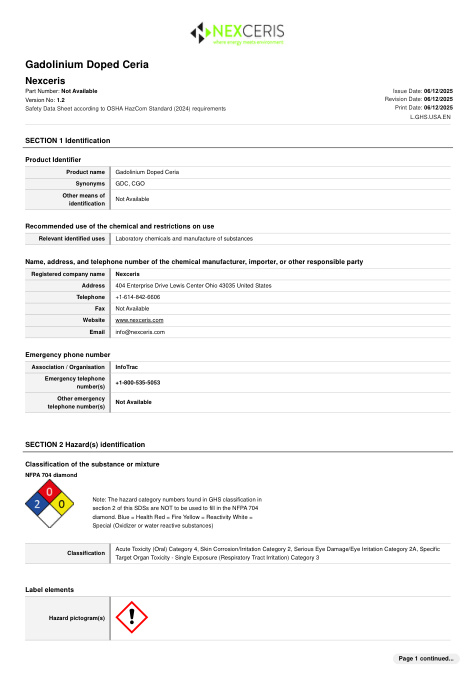
Gadolinium Doped Ceria
Nexceris Part Number: Not Available Issue Date: 06/12/2025 Version No: 1.2 改訂版 Date: 06/12/2025 安全データシート according to OSHA HazCom Standard (2024) requirements Print Date: 06/12/2025
L.GHS.USA.EN
SECTION 1 化学品および会社情報
Product Identifier
製品名 Gadolinium Doped Ceria
別名 GDC, CGO
Other means of Not Available identification
おすすめ use of the chemical and restrictions on use
Relevant identified uses Laboratory chemicals and manufacture of substances
Name, address, and telephone number of the chemical manufacturer, importer, or other responsible party
Registered company name Nexceris
住所 404 Enterprise Drive Lewis Center Ohio 43035 米国
Telephone +1-614-842-6606
Fax Not Available
ウェブサイト www.nexceris.com
メール info@nexceris.com
Emergency phone number
Association / Organisation InfoTrac
Emergency telephone +1-800-535-5053 number(s)
Other emergency Not Available telephone number(s)
SECTION 2 危険有害性の要約
Classification of the substance or mixture
NFPA 704 diamond
Note: The hazard category numbers found in GHS classification in
section 2 of this SDSs are NOT to be used to fill in the NFPA 704
diamond. Blue = Health Red = Fire Yellow = Reactivity White =
Special (Oxidizer or water reactive substances)
Acute Toxicity (Oral) Category 4, Skin Corrosion/Irritation Category 2, Serious Eye Damage/Eye Irritation Category 2A, Specific Classification Target Organ Toxicity - Single Exposure (Respiratory Tract Irritation) Category 3
Label elements
Hazard pictogram(s)
ページ 1 continued...
ページ 2
Part Number: Not Available ページ 2 of 13 Issue Date: 06/12/2025 Version No: 1.2 改訂版 Date: 06/12/2025 Gadolinium Doped Ceria Print Date: 06/12/2025
Signal word Warning
Hazard statement(s)
H302 Harmful if swallowed.
H315 Causes skin irritation.
H319 Causes serious eye irritation.
H335 May cause respiratory irritation.
Hazard(s) not otherwise classified
Not Applicable
Precautionary statement(s) Prevention
P271 Use only outdoors or in a well-ventilated area.
P261 Avoid breathing dust/fumes.
P264 Wash all exposed external body areas thoroughly after handling.
P270 Do not eat, drink or smoke when using this product.
P280 Wear protective gloves, protective clothing, eye protection and face protection.
Precautionary statement(s) Response
P305+P351+P338 IF IN EYES: Rinse cautiously with water for several minutes. Remove contact lenses, if present and easy to do. Continue rinsing.
P312 Call a POISON CENTER/doctor/physician/first aider/if you feel unwell.
P337+P313 If eye irritation persists: Get medical advice/attention.
P301+P312 IF SWALLOWED: Call a POISON CENTER/doctor/physician/first aider/if you feel unwell.
P302+P352 IF ON SKIN: Wash with plenty of water and soap.
P304+P340 IF INHALED: Remove person to fresh air and keep comfortable for breathing.
P330 Rinse mouth.
P332+P313 If skin irritation occurs: Get medical advice/attention.
P362+P364 Take off contaminated clothing and wash it before reuse.
Precautionary statement(s) Storage
P405 Store locked up.
P403+P233 Store in a well-ventilated place. Keep container tightly closed.
Precautionary statement(s) Disposal
P501 Dispose of contents/container to authorised hazardous or special waste collection point in accordance with any local regulation.
SECTION 3 組成 / information on ingredients
Substances
See section below for composition of 混合物s
混合物s
CAS No %[weight] Name
1306-38-3 80-100 Cerium Oxide (1306-38-3) 12064-62-9 10-30 Gadolinium Oxide (12064-62-9)
The specific chemical identity and/or exact percentage (concentration) of composition has been withheld as a trade secret.
SECTION 4 応急措置
説明 of first aid measures
If this product comes in contact with the eyes: Wash out immediately with fresh running water. Ensure complete irrigation of the eye by keeping eyelids apart and away from eye and moving the eyelids by occasionally Eye Contact lifting the upper and lower lids. Seek medical attention without delay; if pain persists or recurs seek medical attention. Removal of contact lenses after an eye injury should only be undertaken by skilled personnel.
Skin Contact If skin contact occurs:
Continued...
ページ 3
Part Number: Not Available ページ 3 of 13 Issue Date: 06/12/2025 Version No: 1.2 改訂版 Date: 06/12/2025 Gadolinium Doped Ceria Print Date: 06/12/2025
Immediately remove all contaminated clothing, including footwear. Flush skin and hair with running water (and soap if available). Seek medical attention in event of irritation.
If fumes, aerosols or combustion products are inhaled remove from contaminated area. Inhalation Other measures are usually unnecessary.
Immediately give a glass of water. Ingestion First aid is not generally required. If in doubt, contact a Poisons Information Centre or a doctor.
Most important symptoms and effects, both acute and delayed
See Section 11
Indication of any immediate medical attention and special treatment needed
Treat symptomatically. As in all cases of suspected poisoning, follow the ABCDEs of emergency medicine (airway, breathing, circulation, disability, exposure), then the ABCDEs of toxicology (antidotes, basics, change absorption, change distribution, change elimination). For poisons (where specific treatment regime is absent): -------------------------------------------------------------- BASIC TREATMENT -------------------------------------------------------------- Establish a patent airway with suction where necessary. Watch for signs of respiratory insufficiency and assist ventilation as necessary. Administer oxygen by non-rebreather mask at 10 to 15 L/min. Monitor and treat, where necessary, for pulmonary oedema. Monitor and treat, where necessary, for shock. Anticipate seizures. DO NOT use emetics. Where ingestion is suspected rinse mouth and give up to 200 ml water (5 ml/kg recommended) for dilution where patient is able to swallow, has a strong gag reflex and does not drool. -------------------------------------------------------------- ADVANCED TREATMENT -------------------------------------------------------------- Consider orotracheal or nasotracheal intubation for airway control in unconscious patient or where respiratory arrest has occurred. Positive-pressure ventilation using a bag-valve mask might be of use. Monitor and treat, where necessary, for arrhythmias. Start an IV D5W TKO. If signs of hypovolaemia are present use lactated Ringers solution. Fluid overload might create complications. Drug therapy should be considered for pulmonary oedema. Hypotension with signs of hypovolaemia requires the cautious administration of fluids. Fluid overload might create complications. Treat seizures with diazepam. Proparacaine hydrochloride should be used to assist eye irrigation. BRONSTEIN, A.C. and CURRANCE, P.L. EMERGENCY CARE FOR HAZARDOUS 材料名S EXPOSURE: 2nd Ed. 1994
SECTION 5 火災時の措置
Extinguishing media
There is no restriction on the type of extinguisher which may be used. Use extinguishing media suitable for surrounding area.
Special hazards arising from the substrate or mixture
Fire Incompatibility None known.
Special protective equipment and precautions for fire-fighters
Alert Fire Brigade and tell them location and nature of hazard. Wear breathing apparatus plus protective gloves in the event of a fire. Prevent, by any means available, spillage from entering drains or water courses. Use fire fighting procedures suitable for surrounding area. Fire Fighting DO NOT approach containers suspected to be hot. Cool fire exposed containers with water spray from a protected location. If safe to do so, remove containers from path of fire. Equipment should be thoroughly decontaminated after use.
Under certain conditions the material may become combustible because of the ease of ignition which occurs after the material reaches a high specific area ratio (thin sections, fine particles, or molten states). However, the same material in massive solid form is comparatively difficult to ignite. Nearly all metals will burn in air under certain conditions. Some are oxidised rapidly in the presence of air or moisture, generating sufficient heat to reach their ignition temperatures. Others oxidise so slowly that heat generated during oxidation is dissipated before the metal becomes hot enough to ignite. Fire/Explosion Hazard Particle size, shape, quantity, and alloy are important factors to be considered when evaluating metal combustibility. Combustibility of metallic alloys may differ and vary widely from the combustibility characteristics of the alloys' constituent elements. Decomposition may produce toxic fumes of: metal oxides May emit poisonous fumes.
Continued...
ページ 4
Part Number: Not Available ページ 4 of 13 Issue Date: 06/12/2025 Version No: 1.2 改訂版 Date: 06/12/2025 Gadolinium Doped Ceria Print Date: 06/12/2025
SECTION 6 漏出時の措置
Personal precautions, protective equipment and emergency procedures
See section 8
Environmental precautions
See section 12
Methods and material for containment and cleaning up
Clean up all spills immediately. Avoid breathing vapours/ aerosols/ or dusts and avoid contact with skin and eyes. Minor Spills Control personal contact with the substance, by using protective equipment. Contain and absorb spill with sand, earth, inert material or vermiculite. Place in a suitable, labelled container for waste disposal.
Clear area of personnel and move upwind. Alert Fire Brigade and tell them location and nature of hazard. Wear breathing apparatus plus protective gloves. Prevent, by any means available, spillage from entering drains or water course. Stop leak if safe to do so. Contain spill with sand, earth or vermiculite. Major Spills Collect recoverable product into labelled containers for recycling. Neutralise/decontaminate residue (see Section 13 for specific agent). Collect solid residues and seal in labelled drums for disposal. Wash area and prevent runoff into drains. After clean up operations, decontaminate and launder all protective clothing and equipment before storing and re-using. If contamination of drains or waterways occurs, advise emergency services.
Personal Protective Equipment advice is contained in Section 8 of the SDS.
SECTION 7 取扱い・保管上の注意
Precautions for safe handling
Avoid all personal contact, including inhalation. Wear protective clothing when risk of exposure occurs. Use in a well-ventilated area. Prevent concentration in hollows and sumps. DO NOT enter confined spaces until atmosphere has been checked. DO NOT allow material to contact humans, exposed food or food utensils. Avoid contact with incompatible materials. When handling, DO NOT eat, drink or smoke. Safe handling Keep containers securely sealed when not in use. Avoid physical damage to containers. Always wash hands with soap and water after handling. Work clothes should be laundered separately. Launder contaminated clothing before re-use. Use good occupational work practice. Observe manufacturer's storage and handling recommendations contained within this SDS. Atmosphere should be regularly checked against established exposure standards to ensure safe working conditions are maintained.
Other information
Conditions for safe storage, including any incompatibilities
Polyethylene or polypropylene container. Suitable container Packing as recommended by manufacturer. Check all containers are clearly labelled and free from leaks.
Storage incompatibility Derivative of very electropositive metal.
+ x + o + + +
X — Must not be stored together 0 — May be stored together with specific preventions + — May be stored together
Note: Depending on other risk factors, compatibility assessment based on the table above may not be relevant to storage situations, particularly where large volumes
of dangerous goods are stored and handled. Reference should be made to the 安全データシート for each substance or article and risks assessed accordingly.
SECTION 8 Exposure controls / personal protection
Continued...
ページ 5
Part Number: Not Available ページ 5 of 13 Issue Date: 06/12/2025 Version No: 1.2 改訂版 Date: 06/12/2025 Gadolinium Doped Ceria Print Date: 06/12/2025
Control parameters
Occupational Exposure Limits (OEL)
INGREDIENT DATA
Not Available
Emergency Limits
Ingredient TEEL-1 TEEL-2 TEEL-3
Gadolinium Doped Ceria Not Available Not Available Not Available
Ingredient Original IDLH Revised IDLH
Gadolinium Doped Ceria Not Available Not Available
材料名 DATA
as cerium CEL TWA: 1 mg/m3 (compare TLV-TWA yttrium) (CEL=Chemwatch Exposure Limit) Exposure to the vapours of some rare earth salts reportedly produces sensitivity to heat, itching and an increased perception of odour and taste. Other effects may include bronchiolitis, subacute bronchitis, acute transient chemical pneumonitis, focal hypertrophic emphysema, regional bronchiolar stricturing and cellular eosinophilia. In rare fatal cases of exposure to the rare-earth fluoride and/or oxide mixtures, delayed chemical hyperaemia has occurred. Lung granulomas have also been seen in experimental animals. as gadolinium CEL TWA: 1 mg/m3 (compare TLV-TWA yttrium) (CEL = Chemwatch Exposure Limit) Exposure to the vapours of some rare earth salts reportedly produces sensitivity to heat, itching and an increased perception of odour and taste. Other effects may include bronchiolitis, subacute bronchitis, acute transient chemical pneumonitis, focal hypertrophic emphysema, regional bronchiolar stricturing and cellular eosinophilia. In rare fatal cases of exposure to the rare-earth fluoride and/or oxide mixtures, delayed chemical hyperaemia has occurred. Lung granulomas have also been seen in experimental animals. The concentration of dust, for application of respirable dust limits, is to be determined from the fraction that penetrates a separator whose size collection efficiency is described by a cumulative log-normal function with a median aerodynamic diameter of 4.0 um (+-) 0.3 um and with a geometric standard deviation of 1.5 um (+-) 0.1 um, i.e..generally less than 5 um.
Exposure controls
Appropriate engineering Engineering controls are used to remove a hazard or place a barrier between the worker and the hazard. Well-designed controls engineering controls can be highly effective in protecting workers and will typically be independent of worker interactions to provide this high level of protection. The basic types of engineering controls are: Process controls which involve changing the way a job activity or process is done to reduce the risk. Enclosure and/or isolation of emission source which keeps a selected hazard "physically" away from the worker and ventilation that strategically "adds" and "removes" air in the work environment. Ventilation can remove or dilute an air contaminant if designed properly. The design of a ventilation system must match the particular process and chemical or contaminant in use. Employers may need to use multiple types of controls to prevent employee overexposure.
General exhaust is adequate under normal operating conditions. If risk of overexposure exists, wear SAA approved respirator. Correct fit is essential to obtain adequate protection. Provide adequate ventilation in warehouse or closed storage areas. Air contaminants generated in the workplace possess varying "escape" velocities which, in turn, determine the "capture velocities" of fresh circulating air required to effectively remove the contaminant.
種類 of Contaminant: Air Speed:
0.25-0.5 m/s (50- solvent, vapours, degreasing etc., evaporating from tank (in still air) 100 f/min)
aerosols, fumes from pouring operations, intermittent container filling, low speed conveyer transfers, 0.5-1 m/s (100- welding, spray drift, plating acid fumes, pickling (released at low velocity into zone of active generation) 200 f/min.)
direct spray, spray painting in shallow booths, drum filling, conveyer loading, crusher dusts, gas discharge 1-2.5 m/s (200- (active generation into zone of rapid air motion) 500 f/min)
grinding, abrasive blasting, tumbling, high speed wheel generated dusts (released at high initial velocity 2.5-10 m/s (500- into zone of very high rapid air motion). 2000 f/min.)
Within each range the appropriate value depends on:
Lower end of the range Upper end of the range
1: Room air currents minimal or favourable to capture 1: Disturbing room air currents
2: Contaminants of low toxicity or of nuisance value only 2: Contaminants of high toxicity
3: Intermittent, low production. 3: High production, heavy use
4: Large hood or large air mass in motion 4: Small hood - local control only
Simple theory shows that air velocity falls rapidly with distance away from the opening of a simple extraction pipe. Velocity generally decreases with the square of distance from the extraction point (in simple cases). Therefore the air speed at the
Continued...
ページ 6
Part Number: Not Available ページ 6 of 13 Issue Date: 06/12/2025 Version No: 1.2 改訂版 Date: 06/12/2025 Gadolinium Doped Ceria Print Date: 06/12/2025
extraction point should be adjusted, accordingly, after reference to distance from the contaminating source. The air velocity at the extraction fan, for example, should be a minimum of 1-2 m/s (200-400 f/min.) for extraction of solvents generated in a tank 2 meters distant from the extraction point. Other mechanical considerations, producing performance deficits within the extraction apparatus, make it essential that theoretical air velocities are multiplied by factors of 10 or more when extraction systems are installed or used.
Individual protection measures, such as personal protective equipment
Safety glasses with side shields Chemical goggles. [AS/NZS 1337.1, EN166 or national equivalent] Contact lenses may pose a special hazard; soft contact lenses may absorb and concentrate irritants. A written policy document, describing the wearing of lenses or restrictions on use, should be created for each workplace or task. This should Eye and face protection include a review of lens absorption and adsorption for the class of chemicals in use and an account of injury experience. Medical and first-aid personnel should be trained in their removal and suitable equipment should be readily available. In the event of chemical exposure, begin eye irrigation immediately and remove contact lens as soon as practicable. Lens should be removed at the first signs of eye redness or irritation - lens should be removed in a clean environment only after workers have washed hands thoroughly. [CDC NIOSH Current Intelligence Bulletin 59].
Skin protection See Hand protection below
Wear chemical protective gloves, e.g. PVC. Hands/feet protection Wear safety footwear or safety gumboots, e.g. Rubber
Body protection See Other protection below
Overalls. P.V.C apron. Other protection Barrier cream. Skin cleansing cream. Eye wash unit.
Respiratory protection
種類 -P 絞り込み of sufficient capacity. (AS/NZS 1716 & 1715, EN 143:2000 & 149:2001, ANSI Z88 or national equivalent)
Required Minimum Protection Factor Half-Face Respirator Full-Face Respirator Powered Air Respirator
P1 - PAPR-P1 up to 10 x ES Air-line* - -
up to 50 x ES Air-line** P2 PAPR-P2
up to 100 x ES - P3 -
Air-line* -
100+ x ES - Air-line** PAPR-P3
* - Negative pressure demand ** - Continuous flow A(All classes) = Organic vapours, B AUS or B1 = Acid gasses, B2 = Acid gas or hydrogen cyanide(HCN), B3 = Acid gas or hydrogen cyanide(HCN), E = Sulfur dioxide(SO2), G = Agricultural chemicals, K = Ammonia(NH3), Hg = Mercury, NO = Oxides of nitrogen, MB = Methyl bromide, AX = Low boiling point organic compounds(below 65 degC)
· Respirators may be necessary when engineering and administrative controls do not adequately prevent exposures. · The decision to use respiratory protection should be based on professional judgment that takes into account toxicity information, exposure measurement data, and frequency and likelihood of the worker's exposure - ensure users are not subject to high thermal loads which may result in heat stress or distress due to personal protective equipment (powered, positive flow, full face apparatus may be an option). · 公開日 occupational exposure limits, where they exist, will assist in determining the adequacy of the selected respiratory protection. These may be government mandated or vendor recommended. · Certified respirators will be useful for protecting workers from inhalation of particulates when properly selected and fit tested as part of a complete respiratory protection program. · Where protection from nuisance levels of dusts are desired, use type N95 (US) or type P1 (EN143) dust masks. Use respirators and components tested and approved under appropriate government standards such as NIOSH (US) or CEN (EU) · Use approved positive flow mask if significant quantities of dust becomes airborne. · Try to avoid creating dust conditions. Class P2 particulate filters are used for protection against mechanically and thermally generated particulates or both. P2 is a respiratory filter rating under various international standards, 絞り込み at least 94% of airborne particles Suitable for: · Relatively small particles generated by mechanical processes eg. grinding, cutting, sanding, drilling, sawing. · Sub-micron thermally generated particles e.g. welding fumes, fertilizer and bushfire smoke. · Biologically active airborne particles under specified infection control applications e.g. viruses, bacteria, COVID-19, SARS
SECTION 9 物理的・化学的性質
Information on basic physical and chemical properties
Appearance Beige
Continued...
ページ 7
Part Number: Not Available ページ 7 of 13 Issue Date: 06/12/2025 Version No: 1.2 改訂版 Date: 06/12/2025 Gadolinium Doped Ceria Print Date: 06/12/2025
Relative density (Water = Physical state Powder Not Available 1)
Partition coefficient n- Odour Not Available Not Available octanol / water
Auto-ignition temperature Odour threshold Not Available Not Available (°C)
Decomposition pH (as supplied) Not Available Not Available temperature (°C)
Melting point / freezing Not Available Viscosity (cSt) Not Available point (°C)
Initial boiling point and Not Available 分子量 (g/mol) Not Available boiling range (°C)
Flash point (°C) Not Available Taste Not Available
Evaporation rate Not Available Explosive properties Not Available
Flammability Not Applicable Oxidising properties Not Available
Surface Tension (dyn/cm Upper Explosive Limit (%) Not Available Not Available or mN/m)
Lower Explosive Limit (%) Not Available Volatile Component (%vol) Not Available
Vapour pressure (kPa) Not Available Gas group Not Available
Solubility in water Immiscible pH as a solution (1%) Not Available
Vapour density (Air = 1) Not Available VOC g/L Not Available
Heat of Combustion (kJ/g) Not Available Ignition Distance (cm) Not Available
Flame Height (cm) Not Available Flame Duration (s) Not Available
Enclosed Space Ignition Enclosed Space Ignition Not Available Deflagration Density Not Available Time Equivalent (s/m3) (g/m3)
Nanoform Particle Nanoform Solubility Not Available Not Available Characteristics
Particle Size Not Available
SECTION 10 安定性・反応性
Reactivity See section 7
Chemical stability Product is considered stable and hazardous polymerisation will not occur.
Possibility of hazardous See section 7 reactions
Conditions to avoid See section 7
Incompatible materials See section 7
Hazardous decomposition See section 5 products
SECTION 11 有害性情報
Information on toxicological effects
a) Acute Toxicity There is sufficient evidence to classify this material as acutely toxic.
b) Skin Irritation/Corrosion There is sufficient evidence to classify this material as skin corrosive or irritating.
c) Serious Eye There is sufficient evidence to classify this material as eye damaging or irritating Damage/Irritation
d) Respiratory or Skin Based on available data, the classification criteria are not met. sensitisation
e) Mutagenicity Based on available data, the classification criteria are not met.
f) Carcinogenicity Based on available data, the classification criteria are not met.
g) Reproductivity Based on available data, the classification criteria are not met.
h) STOT - Single Exposure There is sufficient evidence to classify this material as toxic to specific organs through single exposure
i) STOT - Repeated Based on available data, the classification criteria are not met. Exposure
j) Aspiration Hazard Based on available data, the classification criteria are not met.
Inhaled The material is not thought to produce either adverse health effects or irritation of the respiratory tract following inhalation (as classified by EC Directives using animal models). Nevertheless, adverse systemic effects have been produced following
Continued...
ページ 8
Part Number: Not Available ページ 8 of 13 Issue Date: 06/12//2025 Version No: 1.2 改訂版 Date: 06/12//2025 Gadolinium Doped Ceria Print Date: 06/12//2025
exposure of animals by at least one other route and good hygiene practice requires that exposure be kept to a minimum and that suitable control measures be used in an occupational setting. The toxicology of rare earth metal oxides has been determined by pathological and biochemical examination of rodents exposed to the oxides by oral, intraperitoneal or endotracheal routes. Weakly expressed general toxic action of the oxides is seen in acute and prolonged exposure. The dusts cause pronounced changes in the lungs. (The oxides of the rare earth metals are significantly less toxic than their salts.) Symptoms of exposure to rare earth oxides are coughing, congestion, granuloma in lungs and haemoglobinaemia. 希土類s may cause impairment of blood clotting. Exposure to rare earth oxide vapours has been reported to result in sensitivity to heat, itching, and an increased awareness of odour and taste, bronchiolitis, sub-acute bronchiolitis (inflammation of the bronchial tubes), acute transient chemical pneumonitis (inflammation of the lungs caused by chemical irritation), focal hypertrophia (excessive development of an organ), emphysema, regional bronchiolar stricturing, cellular eosinophilia (abnormal increase in the number of leucocytes with cytoplasmic inclusions, in the blood that is characteristic of allergic reactions), and, in some cases, fatal delayed chemical hyperemia (excess of blood in a body part). Intratracheal administration to animals of some rare earth oxides, has been reported to cause changes ranging from mild to marked fibrosis (a condition marked by the increase of interstitial fibrous tissue), emphysema ( a condition of the lungs marked by abnormal dilation of the its air spaces and distension of its walls), small white nodules, granulomas (a mass or nodule of chronically inflamed tissue with granulations that are generally associated with an infective process), giant cells, and accumulation of dust in the lungs. In rare fatal cases of exposure to the rare-earth fluoride and/or oxide mixtures, delayed chemical hyperaemia has occurred. Lung granulomas have also been seen in experimental animals. Inhalation of dusts, generated by the material during the course of normal handling, may be damaging to the health of the individual. Effects on lungs are significantly enhanced in the presence of respirable particles. Overexposure to respirable dust may produce wheezing, coughing and breathing difficulties leading to or symptomatic of impaired respiratory function.
Gadolinium is a member of the so-called heavy-group (the yttriums) of the rare earths (or lanthanoids). No occupational diseases or cases of poisoning in workers producing 種類の希土類元素 have been described. Lanthanoids entering the human body due to exposure to various industrial processes can affect metabolic processes. Trivalent lanthanoid ions, especially lanthanum 3+ and gadolinium 3+, can interfere with calcium channels in human and animal cells. Lanthanoids can also alter or even inhibit the action of various enzymes. Lanthanoid ions found in neurons can regulate synaptic transmission, as well as block some receptors (for example, glutamate receptors). Lanthanoids target the liver causing fatty liver degeneration and a decrease in liver glycogen and blood glucose levels.
Lanthanoids because of their high density can produce significant abnormalities on chest X-rays but these lesions typically have little or no clinical importance and generally are not felt to be fibrogenic The toxicity of all elements in the yttrium group has been investigated in workers and animals alike. Effects on peripheral blood including a decrease haemoglobin and erythrocyte content and changes in the leucocyte formula have been recorded. Animal lungs show productive inflammation and a tendency to develop nodular or diffuse sclerosis following administration by intratracheal injection. The main risks to workers involved in the production of rare earths are due to dust inhalation.
A risk of nephrogenic systemic fibrosis (NSF) with gadolinium-based contrast agents (GBCAs) has been described. This relates to patients with acute or chronic severe renal insufficiency (glomerular filtration rate <30 mL/min/1.73m2) and patients with acute renal insufficiency of any severity due to the hepato-renal syndrome or in the peri-operative liver transplantation period. Healthcare professionals should avoid the use of a GBCA in these patients unless the diagnostic information is essential and not available with non-contrast enhanced magnetic resonance imaging.
Ingestion Based on the available toxicity data, the rare earth chlorides appear to have moderate acute and chronic toxicity. However these substances cause severe eye irritation and severe irritation in abraded skin. They are poorly absorbed by the gastrointestinal tract and by unbroken skin but slight liver damage has been demonstrated in subchronic oral toxicity studies at high doses. The literature indicates that chronic inhalation exposure to the rare earth chlorides may cause pneumoconiosis in humans. There are no indications of carcinogenicity in the rare earth chlorides. Mutagenicity studies on these substances have mixed results, but are predominantly negative.
* IUPAC currently recommends the name lanthanoid rather than lanthanide, as the suffix "-ide" generally indicates negative ions whereas the suffix "-oid" indicates similarity to one of the members of the containing family of elements. In the older literature, the name "lanthanon" was often used. The material has NOT been classified by EC Directives or other classification systems as "harmful by ingestion". This is because of the lack of corroborating animal or human evidence. The material may still be damaging to the health of the individual, following ingestion, especially where pre-existing organ (e.g liver, kidney) damage is evident. Present definitions of harmful or toxic substances are generally based on doses producing mortality rather than those producing morbidity (disease, ill-health). Gastrointestinal tract discomfort may produce nausea and vomiting. In an occupational setting however, ingestion of insignificant quantities is not thought to be cause for concern. Symptoms of acute lanthanide toxicity in rats are immediate defecation, writhing, ataxia (the inability to coordinate voluntary muscular movement), sedation, laboured respiration and reduced activity. Death is due mainly to respiratory and cardiac failure. The rare earths exhibit low toxicity following ingestion but may be toxic by the intraperitoneal route and mildly toxic when administered by the subcutaneous route.The production of skin and lung granulomas, following exposure, may also occur. Accidental ingestion of the material may be harmful; animal experiments indicate that ingestion of less than 150 gram may be fatal or may produce serious damage to the health of the individual.
Skin Contact The material is not thought to be a skin irritant (i.e. is unlikely to produce irritant dermatitis as described in EC Directives using animal models). Temporary discomfort, however, may result from prolonged dermal exposures. Good hygiene practice requires that exposure be kept to a minimum and that suitable gloves be used in an occupational setting. Skin contact with the material may damage the health of the individual; systemic effects may result following absorption. 開く cuts, abraded or irritated skin should not be exposed to this material Entry into the blood-stream through, for example, cuts, abrasions, puncture wounds or lesions, may produce systemic injury with harmful effects. Examine the skin prior to the use of the material and ensure that any external damage is suitably protected.
Continued...
ページ 9
Part Number: Not Available ページ 9 of 13 Issue Date: 06/12/2025 Version No: 1.2 改訂版 Date: 06/12/2025 Gadolinium Doped Ceria Print Date: 06/12/2025
Absorption by skin may readily exceed vapour inhalation exposure. Symptoms for skin absorption are the same as for inhalation.
Eye Although the material is not thought to be an irritant (as classified by EC Directives), direct contact with the eye may produce transient discomfort characterised by tearing or conjunctival redness (as with windburn).
Long-term exposure to the product is not thought to produce chronic effects adverse to health (as classified by EC Directives using animal models); nevertheless exposure by all routes should be minimised as a matter of course. Toxic: danger of serious damage to health by prolonged exposure through inhalation, in contact with skin and if swallowed. Serious damage (clear functional disturbance or morphological change which may have toxicological significance) is likely to be caused by repeated or prolonged exposure. As a rule the material produces, or contains a substance which produces severe lesions. Such damage may become apparent following direct application in subchronic (90 day) toxicity studies or following sub- acute (28 day) or chronic (two-year) toxicity tests. Cerium is a member of the so-called light-group (the ceriums) of the rare earths (or lanthanoids* - previously lanthanides). No occupational diseases or cases of poisoning in workers producing 種類の希土類元素 have been described. Lanthanoids entering the human body due to exposure to various industrial processes can affect metabolic processes. Trivalent lanthanoid ions, especially lanthanum 3+ and gadolinium 3+, can interfere with calcium channels in human and animal cells. Lanthanoids can also alter or even inhibit the action of various enzymes. Lanthanoid ions found in neurons can regulate synaptic transmission, as well as block some receptors (for example, glutamate receptors). Lanthanoids target the liver causing fatty liver degeneration and a decrease in liver glycogen and blood glucose levels. Lanthanoids because of their high density can produce significant abnormalities on chest X-rays but these lesions typically have little or no clinical importance. Lanthanoids generally are not felt to be fibrogenic Occasional cases of suspected pneumoconiosis Chronic have however been reported. The toxicity of all elements in the cerium group has been investigated and found to be insignificant. The respiratory tracts of rats show pathogenic effects when injected intratracheally (the oxides produce a lesser effect than the salts). The main risks to workers involved in the production of rare earths are due to dust inhalation. "Cer-pneumoconiosis" has been reported as a lung condition found in graphic arts workers who use ceria-enhanced carbon arc lights in their occupation. Systemically cerium ion induces hepatic (liver) damage. This is reflected by massive lipid accumulation, death of individual liver cells and binding of the ion to the endoplasmic reticulum. Serum levels of cholesterol and the transaminases rise whilst those of the triglycerides fall following such damage. Based on the available toxicity data, the rare earth chlorides appear to have moderate acute and chronic toxicity. However these substances cause severe eye irritation and severe irritation in abraded skin. They are poorly absorbed by the gastrointestinal tract and by unbroken skin but slight liver damage has been demonstrated in subchronic oral toxicity studies at high doses. The literature indicates that chronic inhalation exposure to the rare earth chlorides may cause pneumoconiosis in humans. There are no indications of carcinogenicity in the rare earth chlorides. Mutagenicity studies on these substances have mixed results, but are predominantly negative.
* IUPAC currently recommends the name lanthanoid rather than lanthanide, as the suffix "-ide" generally indicates negative ions whereas the suffix "-oid" indicates similarity to one of the members of the containing family of elements. In the older literature, the name "lanthanon" was often used.
TOXICITY IRRITATION Gadolinium Doped Ceria Not Available Not Available
Legend: 1. Value obtained from Europe ECHA Registered Substances - Acute toxicity 2. Value obtained from manufacturer's SDS. Unless otherwise specified data extracted from RTECS - Register of Toxic Effect of chemical Substances
Symptoms of acute lanthanide toxicity in rats are immediate defecation, writhing, ataxia (the inability to coordinate voluntary muscular movement), sedation, laboured respiration and reduced activity. Death is due mainly to respiratory and cardiac failure. The rare earths exhibit low toxicity following ingestion but may be toxic by the intraperitoneal route and mildly toxic when administered by the subcutaneous route.The production of skin and lung granulomas, following exposure, may also occur. for typical lanthanides: The symptoms of toxicity of the 種類の希土類元素 include writhing, ataxia, labored respiration, walking on the toes with arched back and sedation. The 種類の希土類元素 exhibit low toxicity by ingestion exposure. However, the intraperitoneal route may be highly toxic while the subcutaneous route is poison to moderately toxic. The production of skin and lung granulomas after exposure to them requires extensive protection to prevent such exposure. Gadolinium Doped Ceria Chronic Inhalation Toxicity: An accumulation of insoluble lanthanide particles has been observed in the respiratory tract of humans following chronic occupational exposure and in rodents following chronic exposure to a similar lanthanide cerium oxide. Lymphoid hyperplasia in the bronchial lymph nodes was the critical inhalation health effect identified by the USEPA in a 2008 toxicological review of cerium oxide. Developmental/Reproductive Toxicity: Lanthanum carbonate, did not affect fertility or produce any harm to the fetus in a rat study. Mutagenicity: Cerium oxide, was negative in the Ames bacterial mutagenic test using bacterial strains TA135, TA1537, TA98, TA100, TA102, and WP2uvrA., and in the mouse in vivo micronucleus assay. Carcinogenicity: Lanthanum carbonate, was not carcinogenic in a two-year oral rat study. Not assessed by IARC, NTP, or USEPA.
Acute Toxicity Carcinogenicity
Skin Irritation/Corrosion Reproductivity
Serious Eye STOT - Single Exposure Damage/Irritation
Respiratory or Skin STOT - Repeated Exposure sensitisation
Continued...
ページ 10
Part Number: Not Available ページ 10 of 13 Issue Date: 06/12/2025 Version No: 1.2 改訂版 Date: 06/12/2025 Gadolinium Doped Ceria Print Date: 06/12/2025
Mutagenicity Aspiration Hazard
Legend: – Data either not available or does not fill the criteria for classification – Data available to make classification
SECTION 12 環境影響情報
Toxicity
Endpoint Test Duration (hr) Species Value 情報源
Gadolinium Doped Ceria Not Not Not Not Available Not Available Available Available Available
Legend: Extracted from 1. IUCLID Toxicity Data 2. Europe ECHA Registered Substances - Ecotoxicological Information - Aquatic Toxicity 4. US EPA, Ecotox database - Aquatic Toxicity Data 5. ECETOC Aquatic Hazard Assessment Data 6. NITE (日本) - Bioconcentration Data 7. METI (日本) - Bioconcentration Data 8. Vendor Data
For Metal: Atmospheric Fate - Metal-containing inorganic substances generally have negligible vapour pressure and are not expected to partition to air. Environmental Fate: Environmental processes, such as oxidation, the presence of acids or bases and microbiological processes, may transform insoluble metals to more soluble ionic forms. Environmental processes may enhance bioavailability and may also be important in changing solubilities. Aquatic/Terrestrial Fate: When released to dry soil, most metals will exhibit limited mobility and remain in the upper layer; some will leach locally into ground water and/ or surface water ecosystems when soaked by rain or melt ice. A metal ion is considered infinitely persistent because it cannot degrade further. Once released to surface waters and moist soils their fate depends on solubility and dissociation in water. A significant proportion of dissolved/ sorbed metals will end up in sediments through the settling of suspended particles. The remaining metal ions can then be taken up by aquatic organisms. Ionic species may bind to dissolved ligands or sorb to solid particles in water. Ecotoxicity: Even though many metals show few toxic effects at physiological pH levels, transformation may introduce new or magnified effects. Crops can take up cerium. Cerium has affinity for humic substances that may alter its availability in aquatic systems. Current fate and transport studies are limited and may not adequately address long term environmental exposure risks to both humans and other organisms. Although cerium has low acute toxicity, long term health and environmental effects are less well understood. The form cerium takes can also influence its biological and environmental fate. Oxides and hydroxides of cerium are poorly soluble in body fluids and are slow to clear from the organism. Cerium can affect the respiratory tract and associated lymph nodes (inhalation exposure) and once in the circulatory system can partition to the skeleton, liver, kidney and spleen. Studies subjecting animals to large dosages of cerium show evidence of neurological effects, possibly due to cerium competing with calcium binding sites in the brain. Long term human expose to cerium is correlated with rare earth pneumoconiosis, but the precise role of cerium in this disease is not well characterized due to confounding metal aerosols For lanthanoids (formerly lanthanides; syn rare earth metals and their salts): Environmental fate: The natural occurrence of rare earths in the lithosphere is well established at a concentration level of a few hundred part per million. They are therefore not "rare". 希土類 chlorides are very poorly soluble in water. Modeled water solubilities range from 10-2 to 10-5 mg/l. They are expected to strongly sorb to soil and not expected to volatilise. Water: Lanthanoid emissions to the environment increase as a result of the growing industrial applications of these elements. However, robust data to evaluate the environmental fate of lanthanoids are scarce. Changing environmental conditions may influence the fate and bioavailability of lanthanoids (part of the 種類の希土類元素 [Ln]) in estuaries.Equilibrium model calculations indicate that dissolved lanthanoids are complexed mainly to carbonates and dissolved organic matter. In the water phase, the relative abundance of the free ion, LnCO3, and humic complexes decreases from lanthanum to lutetium, whereas the relative abundance of Ln(CO3)2 increases. Cerium and europium anomalies were found in water. Europium anomalies were also found in some biota. The biota sediment accumulation factors (BSAFs) decreased across the series from lanthanum to lutetium. Regression analysis revealed that alkalinity correlated negatively with lanthanide uptake. This suggests that increasing complexation reduced bioavailability under the prevailing conditions. The BSAFs did not depend on salinity or pH, which may simplify sediment-quality criteria for fresh versus saline waters. Field BSAFs were significantly lower than laboratory values for the same sediments, which is explained by adaptation of the organisms to lanthanides. Plant uptake: Lanthanum concentrations in plants and medium and the amounts sorbed to glass vessels were quantified by using the radioisotope 140La. The amount of La adsorbed on the glass reached values of 25% of the total La present. A model was formulated to describe La uptake in exponentially growing duckweed in the presence of an adsorptive surface. Growth-induced dilution appeared more efficient in lowering plant La concentrations than actual elimination. An elimination study revealed two compartments, of which the smallest eliminated 50 times faster than the bigger compartment, which eliminated mainly by growth dilution. The average bioconcentration factor was 2,000 L/kg fresh weight and 30,000 L/kg dry weight, comparable with those of other higher plants. At the applied concentration of 10 nM, no effects were observed on duckweed growth. However, the high bioconcentration factor warrants monitoring of lanthanide emissions. Ecotoxicity: For cerium oxide (a typical oxide of this group): Fish LC50 (96 h): fathead minnow >50000 mg/l (low toxicity) Green algae IC25: 34484 mg/l (low toxicity) Daphnia LC50 (48 h): Ceriodaphnia dubia >50000 mg/l (low toxicity) 希土類 chlorides exhibit acute aquatic toxicity at concentrations exceeding 100 ppm and chronic toxicity, persisting for more than 21 days, at concentrations greater than 30 ppm (based on structure activity relationships - QSAR). Industrial processes have little impact on altering background levels. Lanthanum 3+ is toxic to some aquatic organisms.
Continued...
ページ 11
Part Number: Not Available ページ 11 of 13 Issue Date: 06/12/2025 Version No: 1.2 改訂版 Date: 06/12/2025 Gadolinium Doped Ceria Print Date: 06/12/2025
Persistence and degradability
Ingredient Persistence: Water/Soil Persistence: Air
No Data available for all ingredients No Data available for all ingredients
Bioaccumulative potential
Ingredient Bioaccumulation
No Data available for all ingredients
Mobility in soil
Ingredient Mobility
No Data available for all ingredients
Other adverse effects
No evidence of ozone depleting properties were found in the current literature.
SECTION 13 廃棄上の注意
Waste treatment methods
Avoid release to the environment. It may be necessary to collect all wash water for treatment before disposal. In all cases disposal to sewer may be subject to local laws and regulations and these should be considered first. Where in doubt contact the responsible authority. Product / Packaging Recycle wherever possible or consult manufacturer for recycling options. disposal Consult State Land Waste Management Authority for disposal. Bury residue in an authorised landfill. Recycle containers if possible, or dispose of in an authorised landfill.
SECTION 14 輸送上の注意
Labels Required
Marine Pollutant NO
Land transport (DOT): NOT REGULATED FOR TRANSPORT OF DANGEROUS GOODS
Air transport (ICAO-IATA / DGR): NOT REGULATED FOR TRANSPORT OF DANGEROUS GOODS
Sea transport (IMDG-Code / GGVSee): NOT REGULATED FOR TRANSPORT OF DANGEROUS GOODS
14.7. Maritime transport in bulk according to IMO instruments
14.7.1. Transport in bulk according to Annex II of MARPOL and the IBC code
Not Applicable
14.7.2. Transport in bulk in accordance with MARPOL Annex V and the IMSBC Code
製品名 Group
Cerium Oxide (1306-38-3) Not Available
Gadolinium Oxide (12064- Not Available 62-9)
14.7.3. Transport in bulk in accordance with the IGC Code
製品名 Ship 種類
Cerium Oxide (1306-38-3) Not Available
Gadolinium Oxide (12064- Not Available 62-9)
SECTION 15 適用法令
Safety, health and environmental regulations / legislation specific for the substance or mixture
Continued...
ページ 12
Part Number: Not Available ページ 12 of 13 Issue Date: 06/12/2025 Version No: 1.2 改訂版 Date: 06/12/2025 Gadolinium Doped Ceria Print Date: 06/12/2025
Additional Regulatory Information
Not Applicable
Federal Regulations
Superfund Amendments and Reauthorization Act of 1986 (SARA)
Section 311/312 hazard categories
Flammable (Gases, Aerosols, Liquids, or Solids) No
Gas under pressure No
Explosive No
Self-heating No
Pyrophoric (Liquid or Solid) No
Pyrophoric Gas No
Corrosive to metal No
Oxidizer (Liquid, Solid or Gas) No
Organic Peroxide No
Self-reactive No
In contact with water emits flammable gas No
Combustible Dust No
Carcinogenicity No
Acute toxicity (any route of exposure) Yes
Reproductive toxicity No
Skin Corrosion or Irritation Yes
Respiratory or Skin Sensitization No
Serious eye damage or eye irritation Yes
Specific target organ toxicity (single or repeated exposure) No
Aspiration Hazard No
Germ cell mutagenicity No
Simple Asphyxiant No
Hazards Not Otherwise Classified No
US. EPA CERCLA Hazardous Substances and Reportable Quantities (40 CFR 302.4)
None Reported
US. EPCRA Section 313 Toxic Release Inventory (TRI) (40 CFR 372)
None Reported
Additional Federal Regulatory Information
Not Applicable
State Regulations
US. California Proposition 65
None Reported
Additional State Regulatory Information
Not Applicable
National Inventory 状態
National Inventory 状態
オーストラリア - AIIC / オーストラリア Yes Non-Industrial Use
Canada - DSL Yes
Canada - NDSL No (Cerium Oxide (1306-38-3); Gadolinium Oxide (12064-62-9))
中国 - IECSC Yes
Europe - EINEC / ELINCS / Yes NLP
日本 - ENCS Yes
Korea - KECI Yes
Continued...
ページ 13
Part Number: Not Available ページ 13 of 13 Issue Date: 06/12/2025 Version No: 1.2 改訂版 Date: 06/12/2025 Gadolinium Doped Ceria Print Date: 06/12/2025
National Inventory 状態
New Zealand - NZIoC Yes
Philippines - PICCS Yes
USA - TSCA All chemical substances in this product have been designated as TSCA Inventory ‘Active'
Taiwan - TCSI Yes
Mexico - INSQ No (Gadolinium Oxide (12064-62-9))
Vietnam - NCI Yes
Russia - FBEPH Yes
Yes = All CAS declared ingredients are on the inventory Legend: No = One or more of the CAS listed ingredients are not on the inventory. These ingredients may be exempt or will require registration.
SECTION 16 その他の情報
改訂版 Date 06/12/2025 Initial Date 06/12/2025
Other information
The SDS is a Hazard Communication tool and should be used to assist in the Risk Assessment. Many factors determine whether the reported Hazards are Risks in the workplace or other settings. Risks may be determined by reference to Exposures Scenarios. Scale of use, frequency of use and current or available engineering controls must be considered.
Definitions and abbreviations
PC
end of SDS
同一材料:他の発行元によるSDS
0 件の文書がこの材料索引にあります。製品グレード、水和状態、配合は各原本PDFで確認してください。
現在、この材料について他の発行元のPDFは収録されていません。
原発行元・企業情報
Nexceris
- ブランド・組織
- Nexceris
- 国・地域/事業所
- 米国
- ウェブサイト
- nexceris.com
- SDS記載の連絡先メール
- info@nexceris.com
- SDS記載の電話番号
- +1-614-842-6606
- 製品・参照番号
- Gadolinium Doped Ceria
Official site identifies Nexceris and provides its Lewis Center, Ohio contact location and inquiry route; no general sales email was verified.
抽出した供給元情報を表示
Gadolinium Doped Ceria

Nexceris
Part Number: Not Available                                                                                                           Issue Date: 06/12/2025
Version No: 1.2                                                                                                                   Revision Date: 06/12/2025
Safety Data Sheet according to OSHA HazCom Standard (2024) requirements                                                                       Print Date: 06/12/2025

                                                                                                                  L.GHS.USA.EN


SECTION 1 Identification


Product Identifier

             Product name    Gadolinium Doped Ceria

              Synonyms   GDC, CGO

            Other means of
                              Not Available
                 identification


Recommended use of the chemical and restrictions on use

    Relevant identified uses    Laboratory chemicals and manufacture of substances


Name, address, and telephone number of the chemical manufacturer, importer, or other responsible party

  Registered company name    Nexceris

                 Address   404 Enterprise Drive Lewis Center Ohio 43035 United States

                Telephone    +1-614-842-6606

                     Fax    Not Available

                  Website    www.nexceris.com

                     Email    info@nexceris.com
RESDSについて Nexceris
Official site identifies Nexceris and provides its Lewis Center, Ohio contact location and inquiry route; no general sales email was verified.
Company website & profile文書の出典・収録履歴
原登録: Gadolinium Doped Ceria — 安全データシート — Nexceris
追加日: 2026-09-13T12:47:55.000Z · 登録更新: 2026-09-14T03:07:49.548Z
原本ファイル SHA-256: e884c1313601db25070b56a07b71d9952a1905769044fa6f1304b60f0673506e
原典PDF訂正・文書更新を依頼
メタデータの誤り、抽出エラー、供給元による新版、権利上の問題を報告できます。報告内容は運営者が確認するため非公開で保存され、送信しただけで公開中のSDSが直ちに変更されることはありません。
報告内容と任意のメールアドレスは、対応のため非公開で保存されます。サイト上には公開されません。機密情報や個人の重要情報を入力しないでください。
公式化学物質情報源
情報源ガイド ↗このSDSに記載されたCAS番号です。以下の性質は個々の物質に関するもので、製品全体を示すとは限りません。混合物、グレード、水和状態については原本SDSをご確認ください。
CAS 1306-38-3dioxocerium
CAS 1306-38-3 · CAS Common Chemistry ↗ · PubChem ↗
- 化学物質名(IUPAC)
- dioxocerium ↗
- 分子式
- CeO2 ↗
- 化学構造
- PubChemで構造を表示 ↗
PubChem reference retrieved 2026-09-14. Exact CAS synonym match.
ECHA CHEM · CAS番号を検索 1306-38-3 ↗ · AICISインベントリ · CAS番号を検索 1306-38-3 ↗
CAS 12064-62-9bis(gadolinium(3+));tris(oxygen(2-))
CAS 12064-62-9 · CAS Common Chemistry ↗ · PubChem ↗
- 化学物質名(IUPAC)
- bis(gadolinium(3+));tris(oxygen(2-)) ↗
- 分子式
- Gd2O3 ↗
- 化学構造
- PubChemで構造を表示 ↗
PubChem reference retrieved 2026-09-14. Exact CAS synonym match.
ECHA CHEM · CAS番号を検索 12064-62-9 ↗ · AICISインベントリ · CAS番号を検索 12064-62-9 ↗
GHSは分類基準を示すものです。適用される危険有害性分類は、対象製品および各法域について個別に確認してください。
この材料の供給元
該当材料のSDSと公式製品ページから確認した企業です。グレード、組成、供給状況は供給元へ直接ご確認ください。確認できない連絡先は推測して掲載しません。
この材料について、追加の供給元はまだ確認されていません。
ウェブでその他の供給元を検索
この材料を複数の検索エンジンで検索
検索語: Gadolinium Doped Ceria SDS
Wikipediaによる材料の基礎情報
Wikipediaで Gadolinium Doped Ceria を検索します。該当記事がある場合は概要を表示します。製品固有の混合物や標準物質には専用記事がない場合があります。
Wikipediaでこの材料を検索 ↗Wikipedia執筆者による概要: CC BY-SA 4.0. 一般的な材料情報であり、対象製品のSDSに代わるものではありません。