ガドリニウム isotopic certified reference material in 2% nitric acid GADS-1 SDS
RESDSが収集し、発行元の原本PDFをそのまま保持しています。 GADS-1 gadolinium isotopic CRM for laboratory use. SDS Section 3 lists nitric acid 2.0% (CAS 7697-37-2) and gadolinium oxide 0.1% (CAS 12064-62-9). 改訂版 2019年8月26日, version 1.0. 情報源: National Research Council Canada. Licensed under the 開く Government Licence – Canada.
PDFプレビュー
無料で閲覧・ダウンロード可能・登録やログインは不要です。
PDFを読み込み中…
Normalized SDS data & document analysis
RESDS derives the results below from this document’s extracted text and the site’s same-material index. Detected codes are not reclassified. “Not detected” does not mean “not present”; confirm the original PDF for safety-critical use.
GHS & transport evidence
ページ links show the first occurrence found in extracted text.
SDS 16-section coverage
16 section headings detected; 0 not detected by the parser.
材料・文書仕様
- Material
- Gadolinium isotopic certified reference material in 2% nitric acid
- 製品・グレード
- GADS-1; Version 1.0
- 発行元
- National Research Council Canada
- 国・地域
- Canada
- ファイル名
- gads1-en.pdf
- 文書の種類
- SDS
- CAS登録番号
- 7697-37-2; 12064-62-9
- 言語
- 英語
- 原本改訂日
- 2019年8月26日
- ページ数
- 7
- ファイルサイズ
- 105 KB
- ダウンロード数
- 6
- 追加日
- 2026-09-13
Full document text
7ページ · 原文書の言語
Text extracted from the original PDF. ページ order and original wording are preserved; tables and symbols may differ from the PDF layout. Check the original PDF for safety-critical details.
ページ 1
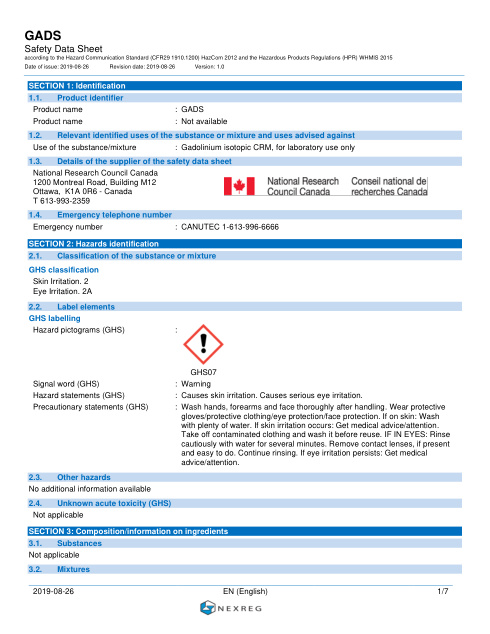
GADS 安全データシート according to the Hazard Communication Standard (CFR29 1910.1200) HazCom 2012 and the Hazardous Products Regulations (HPR) WHMIS 2015 Date of issue: 2019-08-26 改訂日: 2019-08-26 Version: 1.0
SECTION 1: Identification
1.1. Product identifier
製品名 : GADS 製品名 : 情報なし
1.2. Relevant identified uses of the substance or mixture and uses advised against Use of the substance/mixture : Gadolinium isotopic CRM, for laboratory use only
1.3. 詳細 of the supplier of the safety data sheet National Research Council Canada 1200 Montreal Road, Building M12 Ottawa, K1A 0R6 - Canada T 613-993-2359
1.4. Emergency telephone number Emergency number : CANUTEC 1-613-996-6666
SECTION 2: Hazards identification
2.1. Classification of the substance or mixture
GHS classification Skin Irritation. 2 Eye Irritation. 2A
2.2. Label elements GHS labelling Hazard pictograms (GHS) :
GHS07 Signal word (GHS) : Warning Hazard statements (GHS) : Causes skin irritation. Causes serious eye irritation. Precautionary statements (GHS) : Wash hands, forearms and face thoroughly after handling. Wear protective gloves/protective clothing/eye protection/face protection. If on skin: Wash with plenty of water. If skin irritation occurs: Get medical advice/attention. Take off contaminated clothing and wash it before reuse. IF IN EYES: Rinse cautiously with water for several minutes. Remove contact lenses, if present and easy to do. Continue rinsing. If eye irritation persists: Get medical advice/attention.
2.3. Other hazards
No additional information available
2.4. Unknown acute toxicity (GHS) Not applicable
SECTION 3: 組成/information on ingredients
3.1. Substances Not applicable
3.2. 混合物s
2019-08-26 EN (英語) 1/7
ページ 2
GADS 安全データシート according to the Hazard Communication Standard (CFR29 1910.1200) HazCom 2012 and the Hazardous Products Regulations (HPR) WHMIS 2015
Name Product identifier % (by weight) Nitric acid (CAS-No.) 7697-37-2 2.0 Gadolinium oxide (Gd2O3) (CAS-No.) 12064-62-9 0.1
SECTION 4: First aid measures
4.1. 説明 of first aid measures First-aid measures after inhalation : If breathing is difficult, remove victim to fresh air and keep at rest in a position comfortable for breathing. Get medical advice/attention if you feel unwell. First-aid measures after skin contact : IF ON SKIN: Wash with plenty of water. Take off contaminated clothing and wash it before reuse. If skin irritation occurs: Get medical advice/attention. First-aid measures after eye contact : IF IN EYES: Rinse cautiously with water for several minutes. Remove contact lenses, if present and easy to do. Continue rinsing. If eye irritation persists: Get medical advice/attention. First-aid measures after ingestion : If swallowed, do NOT induce vomiting unless directed to do so by medical personnel. Never give anything by mouth to an unconscious person. Get medical advice/attention if you feel unwell.
4.2. Most important symptoms and effects, both acute and delayed Symptoms/effects after inhalation : May cause irritation to the respiratory tract. Symptoms/effects after skin contact : Causes skin irritation. Symptoms may include redness, drying, defatting and cracking of the skin. Symptoms/effects after eye contact : Causes serious eye irritation. Symptoms may include discomfort or pain, excess blinking and tear production, with marked redness and swelling of the conjunctiva. Symptoms/effects after ingestion : May be harmful if swallowed. May cause stomach distress, nausea or vomiting.
4.3. Indication of any immediate medical attention and special treatment needed Symptoms may be delayed. In case of accident or if you feel unwell, seek medical advice immediately (show the label where possible).
SECTION 5: Firefighting measures
5.1. Extinguishing media Suitable extinguishing media : Treat for surrounding material. Unsuitable extinguishing media : None known.
5.2. Special hazards arising from the substance or mixture Fire hazard : Products of combustion may include, and are not limited to: oxides of carbon. Nitrogen oxides.
5.3. Advice for firefighters Protection during firefighting : Keep upwind of fire. Wear full fire fighting turn-out gear (full Bunker gear) and respiratory protection (SCBA).
SECTION 6: Accidental release measures
6.1. Personal precautions, protective equipment and emergency procedures General measures : Use personal protection recommended in Section 8. Isolate the hazard area and deny entry to unnecessary and unprotected personnel.
2019-08-26 EN (英語) 2/7
ページ 3
GADS 安全データシート according to the Hazard Communication Standard (CFR29 1910.1200) HazCom 2012 and the Hazardous Products Regulations (HPR) WHMIS 2015
6.2. Methods and material for containment and cleaning up For containment : Absorb and/or contain spill with inert material (sand, vermiculite or other appropriate material), then place in suitable container. Do not flush into surface water or sewer system. Wear recommended personal protective equipment. Methods for cleaning up : Scoop up material and place in a disposal container. Provide ventilation.
6.3. Reference to other sections For further information refer to section 8: "Exposure controls/personal protection".
SECTION 7: Handling and storage
7.1. Precautions for safe handling Precautions for safe handling : Avoid contact with skin and eyes. Avoid breathing dust/fume/gas/mist/vapours/spray. Do not swallow. Handle and open container with care. When using do not eat, drink or smoke. Hygiene measures : Launder contaminated clothing before reuse. Wash hands, forearms and face thoroughly after handling.
7.2. Conditions for safe storage, including any incompatibilities Storage conditions : Keep out of the reach of children. Keep container tightly closed. Store in a well-ventilated place. Keep cool. Keep away from (strong) bases
SECTION 8: Exposure controls/personal protection
8.1. Control parameters
Nitric acid (7697-37-2) ACGIH ACGIH TWA (ppm) 2 ppm
ACGIH ACGIH STEL (ppm) 4 ppm
OSHA OSHA PEL (TWA) (mg/m³) 5 mg/m³
OSHA OSHA PEL (TWA) (ppm) 2 ppm
IDLH US IDLH (ppm) 25 ppm
NIOSH NIOSH REL (TWA) (mg/m³) 5 mg/m³
NIOSH NIOSH REL (TWA) (ppm) 2 ppm
NIOSH NIOSH REL (STEL) (mg/m³) 10 mg/m³
NIOSH NIOSH REL (STEL) (ppm) 4 ppm
Gadolinium oxide (Gd2O3) (12064-62-9) ACGIH Not applicable
OSHA Not applicable
IDLH Not applicable
NIOSH Not applicable
8.2. Exposure controls
Appropriate engineering controls : Ensure good ventilation of the work station. Hand protection : Wear suitable gloves resistant to chemical penetration. Eye protection : Wear eye/face protection. Skin and body protection : Wear suitable protective clothing.
2019-08-26 EN (英語) 3/7
ページ 4
GADS 安全データシート according to the Hazard Communication Standard (CFR29 1910.1200) HazCom 2012 and the Hazardous Products Regulations (HPR) WHMIS 2015
Respiratory protection : In case of insufficient ventilation, wear suitable respiratory equipment. Respirator selection must be based on known or anticipated exposure levels, the hazards of the product and the safe working limits of the selected respirator. Environmental exposure controls : Maintain levels below Community environmental protection thresholds. Other information : Do not eat, smoke or drink where material is handled, processed or stored. Wash hands carefully before eating or smoking. Handle according to established industrial hygiene and safety practices.
SECTION 9: Physical and chemical properties
9.1. Information on basic physical and chemical properties Physical state : Liquid Appearance : Colourless liquid. Colour : Colourless Odour : No data available Odour threshold : No data available pH : No data available Melting point : No data available Freezing point : No data available Boiling point : No data available Flash point : No data available Relative evaporation rate : No data available (butylacetate=1) Flammability (solid, gas) : Not flammable. Vapour pressure : No data available Relative vapour density at 20 °C : No data available Relative density : No data available Solubility : Completely soluble. Partition coefficient n-octanol/water : No data available Auto-ignition temperature : No data available Decomposition temperature : No data available Viscosity, kinematic : No data available Viscosity, dynamic : No data available Explosive limits : No data available Explosive properties : No data available Oxidising properties : No data available
9.2. Other information
No additional information available
SECTION 10: Stability and reactivity
10.1. Reactivity No dangerous reactions known under normal conditions of use.
10.2. Chemical stability Stable under normal conditions.
10.3. Possibility of hazardous reactions No dangerous reactions known under normal conditions of use.
2019-08-26 EN (英語) 4/7
ページ 5
GADS 安全データシート according to the Hazard Communication Standard (CFR29 1910.1200) HazCom 2012 and the Hazardous Products Regulations (HPR) WHMIS 2015
10.4. Conditions to avoid None known.
10.5. Incompatible materials Bases
10.6. Hazardous decomposition products
May include, and are not limited to: oxides of carbon. Oxides of nitrogen.
SECTION 11: Toxicological information
11.1. Information on toxicological effects
Acute toxicity (oral) : Not classified. Acute toxicity (dermal) : Not classified. Acute toxicity (inhalation) : Not classified.
Nitric acid (7697-37-2) LC50 inhalation rat 1610.68 mg/m³ LC50 inhalation rat 2500 ppm/1h
Gadolinium oxide (Gd2O3) (12064-62-9) LD50 oral rat > 5 g/kg Skin corrosion/irritation : Causes skin irritation. Serious eye damage/irritation : Causes serious eye irritation. Respiratory or skin sensitisation : Based on available data, the classification criteria are not met. Germ cell mutagenicity : Based on available data, the classification criteria are not met. Carcinogenicity : Based on available data, the classification criteria are not met. Reproductive toxicity : Based on available data, the classification criteria are not met. STOT-single exposure : Based on available data, the classification criteria are not met. STOT-repeated exposure : Based on available data, the classification criteria are not met. Aspiration hazard : Based on available data, the classification criteria are not met. Symptoms/effects after inhalation : May cause irritation to the respiratory tract. Symptoms/effects after skin contact : Causes skin irritation. Symptoms may include redness, drying, defatting and cracking of the skin. Symptoms/effects after eye contact : Causes serious eye irritation. Symptoms may include discomfort or pain, excess blinking and tear production, with marked redness and swelling of the conjunctiva. Symptoms/effects after ingestion : May be harmful if swallowed. May cause stomach distress, nausea or vomiting. Other information : Likely routes of exposure: ingestion, inhalation, skin and eye.
SECTION 12: Ecological information
12.1. Toxicity Ecology - general : May cause long-term adverse effects in the aquatic environment.
12.2. Persistence and degradability GADS Persistence and degradability Not established.
12.3. Bioaccumulative potential GADS Bioaccumulative potential Not established.
2019-08-26 EN (英語) 5/7
ページ 6
GADS 安全データシート according to the Hazard Communication Standard (CFR29 1910.1200) HazCom 2012 and the Hazardous Products Regulations (HPR) WHMIS 2015
Nitric acid (7697-37-2) Partition coefficient n-octanol/water -2.3 (at 25 °C)
12.4. Mobility in soil No additional information available
12.5. Other adverse effects
No additional information available
SECTION 13: Disposal considerations
13.1. Waste treatment methods Product/Packaging disposal : This material must be disposed of in accordance with all local, state, recommendations provincial, and federal regulations. The generation of waste should be avoided or minimized wherever possible.
SECTION 14: Transport information
Department of Transportation (DOT) and Transportation of Dangerous Goods (TDG) In accordance with DOT/TDG Not regulated for transport
Additional information Other information : No supplementary information available. Special transport precautions : Do not handle until all safety precautions have been read and understood.
SECTION 15: Regulatory information
15.1. Federal regulations
All components of this product are listed, or excluded from listing, on the 米国 Environmental Protection Agency Toxic Substances Control Act (TSCA) inventory.
All components of this product are listed, or excluded from listing, on the Canadian DSL (Domestic Substances List) and NDSL (Non-Domestic Substances List) inventories.
Nitric acid (7697-37-2) Listed on the 米国 SARA Section 302 Subject to reporting requirements of 米国 SARA Section 313 CERCLA RQ 1000 lb SARA Section 302 Threshold 1000 lb Planning Quantity (TPQ) SARA Section 313 - Emission 1.0 % Reporting
15.2 US State regulations No additional information available
SECTION 16: Other information
Date of issue : 2019-08-26 改訂日 : 2019-08-26 Other information : None. Version # : 1.0 Prepared by : Nexreg Compliance Inc.
2019-08-26 EN (英語) 6/7
ページ 7
GADS 安全データシート according to the Hazard Communication Standard (CFR29 1910.1200) HazCom 2012 and the Hazardous Products Regulations (HPR) WHMIS 2015
DISCLAIMER: The information provided on this 安全データシート is correct to the best of our knowledge, information and belief at the date of its publication. The information given is designed only as a guide for safe handling, use, processing, storage, transportation, disposal and release and is not to be considered as a warranty or quality specification. The information relates only to the specific material designated and may not be valid for such material used in combination with any other material or in any process, unless specified in the text.
This material is for research and experimental applications only. It is not intended for food, drug, household, agricultural, or cosmetic use. Its use must be supervised by technically qualified individuals with experience in the handling of potentially hazardous chemicals. Apart from the solvent in this product (if applicable), the hazardous components present in the solution are at such low concentrations that exact determination of degree of hazard is not warranted and would be misleading. We shall not be held liable for any damage resulting from handling or from contact with the above product.
2019-08-26 EN (英語) 7/7
同一材料:他の発行元によるSDS
0 件の文書がこの材料索引にあります。製品グレード、水和状態、配合は各原本PDFで確認してください。
現在、この材料について他の発行元のPDFは収録されていません。
原発行元・企業情報
- ブランド・組織
- National Research Council Canada
- 国・地域/事業所
- Canada
- ウェブサイト
- nrc.canada.ca
- SDS記載の連絡先メール
- 記載なし in SDS
- SDS記載の電話番号
- 613-993-2359
- 製品・参照番号
- GADS-1; Version 1.0
抽出した供給元情報を表示
Details of the supplier of the safety data sheet
  National Research Council Canada
  1200 Montreal Road, Building M12
  Ottawa, K1A 0R6 - Canada
  T 613-993-2359
RESDSについて National Research Council Canada
National Research Council Canada is the organization attributed as publisher or supplier of this SDS. See the original identification section and official website for its company profile.
Company website & profile文書の出典・収録履歴
原登録: GADS-1 Isotopic Certified Reference Material of Natural Gadolinium
追加日: 2026-09-13T21:06:43.000Z · 登録更新: 2026-09-14T02:29:00.557Z
原本ファイル SHA-256: a8b1cde7a858082c70d3744d2c58320f67d2defccda742825a2bca04856b9dff
原典PDF訂正・文書更新を依頼
メタデータの誤り、抽出エラー、供給元による新版、権利上の問題を報告できます。報告内容は運営者が確認するため非公開で保存され、送信しただけで公開中のSDSが直ちに変更されることはありません。
報告内容と任意のメールアドレスは、対応のため非公開で保存されます。サイト上には公開されません。機密情報や個人の重要情報を入力しないでください。
公式化学物質情報源
情報源ガイド ↗このSDSに記載されたCAS番号です。以下の性質は個々の物質に関するもので、製品全体を示すとは限りません。混合物、グレード、水和状態については原本SDSをご確認ください。
CAS 7697-37-2化学物質の参考情報・情報源リンク
CAS 7697-37-2 · CAS Common Chemistry ↗ · PubChem ↗
- 化学物質名(IUPAC)
- PubChemで確認 ↗
- 分子式
- PubChemで確認 ↗
- 分子量
- PubChemで確認 ↗
- 主な別名
- PubChemで確認 ↗
- 化学構造
- PubChemで構造を表示 ↗
この参考リンクを開くと、PubChemで公開されている物性情報を取得できます。公式検索リンクは引き続き利用できます。
ECHA CHEM · CAS番号を検索 7697-37-2 ↗ · AICISインベントリ · CAS番号を検索 7697-37-2 ↗
CAS 12064-62-9bis(gadolinium(3+));tris(oxygen(2-))
CAS 12064-62-9 · CAS Common Chemistry ↗ · PubChem ↗
- 化学物質名(IUPAC)
- bis(gadolinium(3+));tris(oxygen(2-)) ↗
- 分子式
- Gd2O3 ↗
- 化学構造
- PubChemで構造を表示 ↗
PubChem reference retrieved 2026-09-14. Exact CAS synonym match.
ECHA CHEM · CAS番号を検索 12064-62-9 ↗ · AICISインベントリ · CAS番号を検索 12064-62-9 ↗
GHSは分類基準を示すものです。適用される危険有害性分類は、対象製品および各法域について個別に確認してください。
この材料の供給元
該当材料のSDSと公式製品ページから確認した企業です。グレード、組成、供給状況は供給元へ直接ご確認ください。確認できない連絡先は推測して掲載しません。
この材料について、追加の供給元はまだ確認されていません。
ウェブでその他の供給元を検索
この材料を複数の検索エンジンで検索
検索語: Gadolinium isotopic certified reference material in 2% nitric acid SDS
Wikipediaによる材料の基礎情報
Wikipediaで Gadolinium isotopic certified reference material in 2% nitric acid を検索します。該当記事がある場合は概要を表示します。製品固有の混合物や標準物質には専用記事がない場合があります。
Wikipediaでこの材料を検索 ↗Wikipedia執筆者による概要: CC BY-SA 4.0. 一般的な材料情報であり、対象製品のSDSに代わるものではありません。