Magnesium Alloy containing Zinc, Rare Earths and Zirconium SDS
RESDSが収集し、発行元の原本PDFをそのまま保持しています。 Original Aimtek, Inc. SDS for magnesium alloy forms including ingot, bar, extrusion, billet, plate, sheet and welding rod. Section 3 identifies neodymium, cerium and lanthanum among the alloy constituents. 改訂版 2017年4月4日. Publication authorization confirmed by the RESDS site owner on 2026年9月14日.
PDFプレビュー
無料で閲覧・ダウンロード可能・登録やログインは不要です。
PDFを読み込み中…
Normalized SDS data & document analysis
RESDS derives the results below from this document’s extracted text and the site’s same-material index. Detected codes are not reclassified. “Not detected” does not mean “not present”; confirm the original PDF for safety-critical use.
GHS & transport evidence
ページ links show the first occurrence found in extracted text.
SDS 16-section coverage
13 section headings detected; 3 not detected by the parser.
Normalized physical-property units
Calculated conversions from values detected in this SDS; not independent laboratory measurements.
| Property | SDS value | SI conversion | US conversion |
|---|---|---|---|
| Melting point | 650 °C | 923.15 K | 1202.0 °F |
| Boiling point | 1095 °C | 1368.15 K | 2003.0 °F |
材料・文書仕様
- Material
- Magnesium Alloy containing Zinc, Rare Earths and Zirconium
- 製品・グレード
- 記載なし
- 発行元
- Aimtek, Inc.
- 国・地域
- 米国
- ファイル名
- aimtek-ams4439-2024.pdf
- 文書の種類
- SDS
- 言語
- 英語
- 原本改訂日
- 2017年4月4日
- ページ数
- 8
- ファイルサイズ
- 154 KB
- ダウンロード数
- 5
- 追加日
- 2026-09-14
この文書が該当する理由
組成が完全に確認されていない場合があります。記載のない元素が含まれていないとは限りません。
Full document text
8ページ · 原文書の言語
Text extracted from the original PDF. ページ order and original wording are preserved; tables and symbols may differ from the PDF layout. Check the original PDF for safety-critical details.
ページ 1
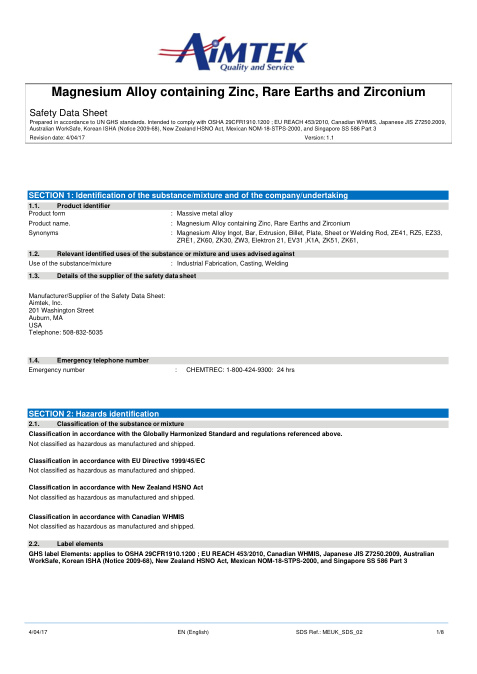
Magnesium Alloy containing Zinc, Rare Earths and Zirconium 安全データシート Prepared in accordance to UN GHS standards. Intended to comply with OSHA 29CFR1910.1200 ; EU REACH 453/2010, Canadian WHMIS, 日本語 JIS Z7250.2009, オーストラリアn WorkSafe, 韓国語 ISHA (Notice 2009-68), New Zealand HSNO Act, Mexican NOM-18-STPS-2000, and Singapore SS 586 Part 3 改訂日: 4/04/17 Version: 1.1
SECTION 1: Identification of the substance/mixture and of the company/undertaking
1.1. Product identifier
製品形態 : Massive metal alloy 製品名. : Magnesium Alloy containing Zinc, Rare Earths and Zirconium 別名 : Magnesium Alloy Ingot, Bar, Extrusion, Billet, Plate, Sheet or Welding Rod, ZE41, RZ5, EZ33, ZRE1, ZK60, ZK30, ZW3, Elektron 21, EV31 ,K1A, ZK51, ZK61,
1.2. Relevant identified uses of the substance or mixture and uses advisedagainst Use of the substance/mixture : Industrial Fabrication, Casting, Welding 1.3. 詳細 of the supplier of the safety data sheet
メーカー/供給元 of the 安全データシート: Aimtek, Inc. 201 Washington Street Auburn, MA USA Telephone: 508-832-5035
1.4. Emergency telephone number Emergency number : CHEMTREC: 1-800-424-9300: 24 hrs
SECTION 2: Hazards identification
2.1. Classification of the substance or mixture Classification in accordance with the Globally Harmonized Standard and regulations referenced above. Not classified as hazardous as manufactured and shipped.
Classification in accordance with EU Directive 1999/45/EC Not classified as hazardous as manufactured and shipped.
Classification in accordance with New Zealand HSNO Act Not classified as hazardous as manufactured and shipped.
Classification in accordance with Canadian WHMIS Not classified as hazardous as manufactured and shipped.
2.2. Label elements GHS label 元素s: applies to OSHA 29CFR1910.1200 ; EU REACH 453/2010, Canadian WHMIS, 日本語 JIS Z7250.2009, オーストラリアn WorkSafe, 韓国語 ISHA (Notice 2009-68), New Zealand HSNO Act, Mexican NOM-18-STPS-2000, and Singapore SS 586 Part 3
4/04/17 EN (英語) SDS Ref.: MEUK_SDS_02 1/8
ページ 2
Magnesium Alloy containing Zinc, Rare Earths and Zirconium 安全データシート according to GHS
GHS labelling No labelling applicable
Labelling according to EU Directive 1999/45/EC No labelling applicable.
Labelling according to Canadian WHMIS
No labelling applicable.
2.3. Other hazards
PBT: not relevant – no registration required vPvB: not relevant – no registration required
SECTION 3: 組成/information on ingredients
3.1. Substances Not applicable 3.2. 混合物 Name CAS番号 EINECS Number % Magnesium CAS No: 7439-95-4 EINECS No: 231-104-6 87 - 99 Zinc CAS No: 7440-66-6 EINECS No: 231-175-3 0-7 Zirconium CAS No: 7440-67-7 EINECS No: 231-176-9 0-1 Neodymium CAS No: 7440-00-8 EINECS No: 231-109-3 0-4 Cerium CAS No: 7440-45-1 EINECS No: 231-154-9 0-2 Lanthanum CAS No: 7439-91-0 EINECS No: 231-099-0 0-2 Praseodymium CAS No: 7440-10-0 EINECS No: 231-120-3 0-1 Gadolinium CAS No: 7440-54-2 EINECS No: 231-162-2 0-2
SECTION 4: First aid measures
4.1. 説明 of first aid measures First-aid measures after inhalation : Machining may result in release of dust. If inhaled and if breathing is difficult, remove victim to fresh air and keep at rest in a position comfortable for breathing. If dust are formed : First-aid measures after skin contact : Machining may result in release of dust. Gently wash with plenty of soap and water. First-aid measures after eye contact : Machining may result in release of dust. If in eyes: Rinse cautiously with water for several minutes. Remove contact lenses, if present and easy to do. Continue rinsing. Obtain medical attention if pain, blinking or redness persist. First-aid measures after ingestion : Not expected to present a significant ingestion hazard under anticipated conditions of normal use. 4.2. Most important symptoms and effects, both acute and delayed Symptoms/injuries : No significant signs or symptoms indicative of any health hazard are expected to occur. Symptoms/injuries after inhalation : Machining may result in release of dust. Inhalation may cause: irritation, coughing, shortness of breath. Symptoms/injuries after skin contact : Mechanical injury only. Molten material may burn skin. Symptoms/injuries after eye contact : Mechanical injury only. Metal dust or fume may be dangerous to eye and surrounding tissue. Symptoms/injuries after ingestion : Ingestion is unlikely due to physical state. No significant signs or symptoms indicative of any adverse health hazard are expected to occur as a result of ingestion. 4.3. Indication of any immediate medical attention and special treatment needed All treatments should be based on observed signs and symptoms of distress in the patient.
SECTION 5: Firefighting measures
5.1. Extinguishing media Suitable extinguishing media : Smother burning magnesium by covering with an extinguishing powder approved for use on magnesium fires, such as Class D fire extinguisher, G1, METL-X, dry sand or other media for metal fires. Consult National Fire Protection Association standards for other extinguishing media which may be applicable to certain operations such as foundries or heat-treat furnaces. Unsuitable extinguishing media : Do not use water.
4/04/17 EN (英語) SDS Ref.: MEUK_SDS_02 2/8
ページ 3
Magnesium Alloy containing Zinc, Rare Earths and Zirconium 安全データシート according to GHS 5.2. Special hazards arising from the substance or mixture Fire hazard : When heated in air to a temperature near its melting point, magnesium alloys ignite and burn with a white flame. Finely divided magnesium will readily ignite in the presence of any spark or flame. It will also auto ignite when heated in air even below the melting point. The finer the particle size the more readily the powder will ignite and the more intense the fire will be. As a dust magnesium has an Explosive Concentration of 20 mg/litre.
Explosion hazard : Use of water on molten or burning magnesium will produce hydrogen gas and may cause an explosion. Reactivity : Water and acids may react with magnesium releasing hydrogen. 5.3. Advice for firefighters Firefighting instructions : Avoid contact with water. Use dry extinguishing materials (e.g. dry sand, fluxes, iron chips, cement, class D fire extinguisher or dry sand).
Protection during firefighting : Do not enter fire area without proper protective equipment, including respiratory protection. Wear fire/flame resistant/retardant clothing. Use self-contained breathing apparatus. Magnesium burns with a bright white flame, tinted goggles should be used.
SECTION 6: Accidental release measures
6.1. Personal precautions, protective equipment and emergency procedures General measures : Collect all waste in suitable and labelled containers and dispose according to local legislation. Collect contaminated fire fighting water separately. It must not enter the sewage system.
6.1.1. For non-emergency personnel Protective equipment : Machining may result in release of dust. If dust is formed : Dust impervious gloves. Emergency procedures : Machining may result in release of dust. If dust is formed : Avoid all unnecessary exposure.
6.1.2. For emergency responders Protective equipment : Machining may result in release of dust. Where excessive dust may result, use approved respiratory protection equipment. Wear suitable protective clothing and eye/face protection. Dust impervious gloves. Emergency procedures : 6.3. Methods and material for containment and cleaning up. 6.2. Environmental precautions Machining may result in release of dust. Prevent dispersion. This product contains hazardous components for the aquatic environment. Prevent entry to sewers and public waters. 6.3. Methods and material for containment and cleaning up For containment : Avoid generating dust. Contain and collect as any solid. Methods for cleaning up : Collect spillage. Minimize generation of dust. Large spills: scoop solid spill into closing containers. 6.4. Reference to other sections
Section 7: safe handling. Section 8: personal protective equipment. Section 13: disposal information.
SECTION 7: Handling and storage
7.1. Precautions for safe handling Precautions for safe handling : Practice reasonable care in handling magnesium and magnesium alloy product forms to avoid product damage and/or personal injury. If operations involving this product, such as machining, produce fines, such as dust, powder, chips, or turnings, proper measures should be taken to prevent dust clouds around these operations. These fines should be collected frequently and should be stored and disposed of in accordance with National Fire Protection Agency guidelines. If these fines should become ignited, they can be extinguished using procedures described in this document. Hygiene measures : Always wash your hands immediately after handling this product, and once again before leaving the workplace.
7.2. Conditions for safe storage, including any incompatibilities Technical measures : See National Fire Protection Association Bulletin NFPA 480, “Storage, Handling and Processing of Magnesium Solids and Powders”, for detailed storage information. Storage conditions : Store in dry protected location to prevent any moisture contact. Prohibitions on mixed storage : Store away from combustibles. 7.3. Specific end use(s) Not Relevent
4/04/17 EN (英語) SDS Ref.: MEUK_SDS_02 3/8
ページ 4
Magnesium Alloy containing Zinc, Rare Earths and Zirconium 安全データシート according to GHS
SECTION 8: Exposure controls/personal protection
8.1. Control parameters
Magnesium Target Exposure Exposure Duration Effect Value Route DNEL Workers Inhalation Long-term Systematic 10 mg Mg/m3 DNEL General Population Inhalation Long-term Systematic 10 mg Mg/m3 OSHA PEL (TWA) Workers inhalation Long-term Systematic 15 mg Mg/m3
Zinc (as oxide) USA OSHA OSHA PEL (TWA) 15 mg/m³ (total dust) (mg/m3) 5 mg/m³ (respirable dust) USA NIOSH NIOSH REL (ceiling) (mg/m3) 15 mg/m³ (dust)
Zirconium DNEL Workers Inhalation Long-term Systematic 5mg Zr/m3 DNEL Workers Skin route Long-term Systematic 660 mg Zr/day
Neodymium DNEL No hazard identified PNEC No hazard identified
Cerium DNEL Oral DNEL system. effects 3.04 mg/kg bw/day (Human (consumer))
Dermal DNEL system. effects 3.04 mg/kg bw/day (Human (consumer)) 5.07 mg/kg bw/day (Human (worker))
Inhalative DNEL system. effects 6 mg/m³ (Human (consumer)) 10 mg/m³ (Human (worker)) PNEC PNEC STP 60.9 mg/l (Microorganisms (activated sludge)) (OECD 209 (Activated Sludge, Resp. Inhibition Test)) Test material: Dicerium tricarbonate Grutzner I (2006) PNEC freshwater 0.6 mg/l (Freshwater organisms) Extrapolation method: assessment factor PNEC marine water 60.9 μg/l (Marine organisms) Extrapolation method: assessment factor
Lanthanum DNEL No hazard identified PNEC No hazard identified Praseodymium DNEL No hazard identified PNEC No hazard identified
Gadolinium DNEL No hazard identified PNEC No hazard identified
8.2. Exposure controls
Appropriate engineering controls : Provide local exhaust or general room ventilation to minimize exposure to dust. Avoid dispersal of dust in the air (ie, clearing dust surfaces with compressed air). 材料 for protective clothing : Machining may result in release of dust. No special clothing/skin protection equipment is recommended under normal conditions of use. Hand protection : If dust is formed: Wear dust impervious gloves. EN374. Eye protection : Safety glasses. In case of dust production: protective goggles. EN166. Respiratory protection : Machining may result in release of dust. In case of inadequate ventilation wear respiratory protection. Use air-purifying respirator equiped with particulate filtering cartridges. EN 136/140. Thermal hazard protection : Flame retardant clothing should be used when handling in molten state.
SECTION 9: Physical and chemical properties
9.1. Information on basic physical and chemical properties Physical state : Solid Appearance : Silver solid.
4/04/17 EN (英語) SDS Ref.: MEUK_SDS_02 4/8
ページ 5
Magnesium Alloy containing Zinc, Rare Earths and Zirconium 安全データシート according to GHS Colour : silver. Odour : Odorless. Odour threshold : Not applicable pH : Not applicable Relative evaporation rate : Not applicable Melting point : 450 - 650 °C Freezing point : No data available Boiling point : 1095 °C Flash point : Not applicable Self ignition temperature : Not applicable Decomposition temperature : Not applicable Flammability (solid, gas) : Highly flammable as powder Vapour pressure : Not applicable Relative vapour density at 20 °C : Not applicable Relative density : 1.76 - 1.81 Relative density of saturated gas/air mixture : Not applicable Solubility : 6.7 mg/L (21°C, pH ca. 10.8) Log Pow : Not applicable Log Kow : Not applicable Viscosity, kinematic : Not applicable Viscosity, dynamic : Not applicable Explosive properties : Not applicable Oxidising properties : Not applicable Explosive limits : Not applicable
9.2. Other information
No additional information available
SECTION 10: Stability and reactivity
10.1. Reactivity Hazardous polymerization will not occur. 10.2. Chemical stability The product is stable at normal handling and storage conditions. 10.3. Possibility of hazardous reactions No additional information available. 10.4. Conditions to avoid Exposure to extremely high temperatures. Build up of finely divided dust on surfaces. 10.5. Incompatible materials Acid. Reacts with acid to form hydrogen gas. In finely divided form, will react with water or acids to release hydrogen.
10.6. Hazardous decomposition products
See incompatibility statement and fire and explosion hazard data for special situations.
SECTION 11: Toxicological information
11.1 Likely Routes of Exposure Most likely routes of exposure: dermal.
11.2 Symptoms Related to Physical, Chemical and Toxicological Characteristics Symptoms/injuries after inhalation : Machining may result in release of dust. Inhalation may cause: irritation, coughing, shortness of breath. Symptoms/injuries after skin contact : Mechanical injury only. Molten material may burn skin. Symptoms/injuries after eye contact : Mechanical injury only. Metal dust or fume may be dangerous to eye and surrounding tissue.
11.3 Effects from Exposure No significant signs or symptoms indicative of any health hazard are expected to occur. 11.4. Information on toxicological effects Acute toxicity : Not classified. Based on available data, the classification criteria are not met
4/04/17 EN (英語) SDS Ref.: MEUK_SDS_02 5/8
ページ 6
Magnesium Alloy containing Zinc, Rare Earths and Zirconium 安全データシート according to GHS Magnesium (as Magnesium Oxide) LD50 oral rat 3990 mg/kg
Zinc (as Zinc Oxide) LD50 oral rat > 5000 mg/kg no adverse signs of toxicity
Zirconium LD50 oral rat > 5000 mg/kg no adverse signs of toxicity
Neodymium LD50 oral rat Not Determined
Cerium LD50 oral rat > 5000 mg/kg (rat (Sprague-Dawley)) (EPA OPPTS 870.1100 (Acute Oral Toxicity))
Lanthanum LD50 oral rat 10648 ppm (rat (wistar)) (OECD Guideline 408; EU Method B.7) read-across from supporting substance(structural analogue or surrogate)
Praseodymium LD50 oral rat Not Determined
Gadolinium LD50 oral rat Not Determined
Skin corrosion/irritation : Not classified. Based on available data, the classification criteria are not met Serious eye damage/irritation : Not classified. Based on available data, the classification criteria are not met Respiratory or skin sensitisation : Not classified. Based on available data, the classification criteria are not met Germ cell mutagenicity : Not classified. Based on available data, the classification criteria are not met Carcinogenicity : Not classified. Based on available data, the classification criteria are not met Reproductive. toxicity : Not classified. Based on available data, the classification criteria are not met Specific target organ toxicity (single exposure) : Not classified . Based on available data, the classification criteria are not met Specific target organ toxicity (repeated : Not classified. Based on available data, the classification criteria are not met exposure) Aspiration hazard : Not classified. Based on available data, the classification criteria are not met
11.5. Carcinogenicity Lists No components are found on OSHA, NTP or IARC lists.
SECTION 12: Ecological information
12.1. Toxicity
Magnesium Magnesium is not hazardous to the aquatic environment as: - The lowest acute reference values for fish, invertebrates and algae are > 100 mg Mg/l. - The lowest aquatic NOEC for these three trophic levels is > 1 mg Mg/l (i.e., 41 mg Mg/l for Daphnia magna; no data are available for fish but based on the acute toxicity data, fish are less sensitive compared to aquatic invertebrates).- There is no evidence for bioaccumulation or biomagnification in the environment. Zinc Effects on fish: Danio rerio LL50 (96 hrs) 1.793 mg/L Zirconium Effects on fish: Danio rerio LL50 (96 hrs) >100 mg Zr02/L Neodymium Not Determined Cerium Not Determined Lanthanum Not Determined Praseodymium Not Determined Gadolinium Not Determined
4/04/17 EN (英語) SDS Ref.: MEUK_SDS_02 6/8
ページ 7
Magnesium Alloy containing Zinc, Rare Earths and Zirconium 安全データシート according to GHS 12.2. Persistence and degradability
Magnesium Magnesium is naturally occurring and ubiquitous in the environment. Upon contact with water, magnesium metal dissolves and behaves as magnesium naturally present in the environment. Biodegradation is not relevant for Mg metal, which is considered as not biodegradable. Zinc Not Determined Zirconium Non-Biodegradable Neodymium Not Determined Cerium Not Determined Lanthanum Not Determined Praseodymium Not Determined Gadolinium Not Determined 12.3. Bioaccumulative potential
Magnesium Bioaccumulation of magnesium in aquatic/terrestrial organisms is considered to be of no concern since magnesium is an essential element for aquatic and terrestrial organisms. The uptake of essential elements is generally under strict homeostatic control. Under these conditions, the internal concentration of these elements is maintained over a wide concentration range in the environment and rises only dramatically under conditions that are toxic for aquatic and terrestrial organisms Zinc Not expected to bioaccumulate. Zirconium Non Bioaccumulative Neodymium Not Determined Cerium Not Determined Lanthanum Not Determined Praseodymium Not Determined Gadolinium Not Determined
12.4. Mobility in soil Magnesium Magnesium metal is soluble in water. A log Kd value of 2.82 l/kg dw has been determined for freshwater sediment and no data are available for soil. Based on this relatively low Kd value, the Mg2+ ions can leach through normal soil and are relatively mobile in sediment. 検索結果 of PBT and vPvB assessment Zinc Not Determined Zirconium Insoluble in water Neodymium Not Determined Cerium Not Determined Lanthanum Not Determined Praseodymium Not Determined Gadolinium Not Determined
12.5. Other adverse effects
No additional information available
SECTION 13: Disposal considerations
13.1. Waste treatment methods Waste treatment methods : Dispose in a safe manner in accordance with local/national regulations. Waste disposal recommendations : Depending on the local regulations it may be disposed of as solid waste or incinerated in a suitable installation. EURLW code : For disposal within the EC, the appropriate code according to the European Waste Catalogue (EWC) should be used.
SECTION 14: Transport information
In accordance with DOT / ADR / RID / ADNR / IMDG / ICAO / IATA 14.1. UN number Not a dangerous good for transport regulations 14.2. UN proper shipping name Not applicable 14.2 Additional information Overland transport No additional information available Transport by sea No additional information available
4/04/17 EN (英語) SDS Ref.: MEUK_SDS_02 7/8
ページ 8
Magnesium Alloy containing Zinc, Rare Earths and Zirconium 安全データシート according to GHS Air transport No additional information available
SECTION 15: Regulatory information
USA Regulations
SECTION 313 SUPPLIER NOTIFICATION This product contains no chemicals in concentrations subject to the requirements of section
313 of the Emergency Planning and Community Right-To-Know Act of 1986 (Title III of SARA) and of 40 CFR 372
EU Classification WARNING SYMBOL None WARNING WORD None RISK PHRASES None SAFETY PHRASES None
SECTION 16: Other information
Indication of changes : Revised format. GHS classification information.
Data sources : Chemical Inspection & Regulation Service; accessed at: http://www.cirs- reach.com/Inventory/Global_Chemical_Inventories.html. European Chemicals Agency (ECHA) C&L Inventory database. Accessed at http://echa.europa.eu/web/guest/information-on-chemicals/cl-inventory-database. European Chemicals Agency (ECHA) Registered Substances list. Accessed at http://echa.europa.eu/ . Ind. Exposure & Control Techn. for OSHA Regulated Substances - MgO (fume), March, 1989, pp. 1181-1184. Krister Forsberg and S.Z. Mansdorf, "Quick Selection Guide to Chemical Protective Clothing", Fifth Edition. New Zealand GovernmentInformation Sheet: Correlation between GHS and New Zealand HSNO Hazard Classes and Categories . REGULATION (EC) No 1272/2008 OF THE EUROPEAN PARLIAMENT AND OF THE COUNCIL of 2008年12月16日 on classification, labelling and packaging of substances and mixtures, amending and repealing Directives 67/548/EEC and 1999/45/EC, and amending Regulation (EC) No 1907/2006. TSCA Chemical Substance Inventory. Accessed at http://www.epa.gov/oppt/existingchemicals/pubs/tscainventory/howto.html. US National Library of Medicine National Institutes of Health Haz-Map. Accessed at http://hazmap.nlm.nih.gov. Abbreviations and acronyms : ACGIH (American Conference of Government Industrial Hygienists). ATE: Acute Toxicity Estimate. CAS (Chemical Abstracts Service) number. EC50: Environmental Concentration associated with a response by 50% of the test population. GHS: Globally Harmonized System (of Classification and Labeling of Chemicals . LD50: Lethal Dose for 50% of the test population. NOEC: No Observable Effect Concentration. OSHA: Occupational Safety & Health Administration. PBT: Persistent, Bioaccumulative, Toxic . STEL: Short Term Exposure Limits. TSCA: Toxic Substances Control Act. TWA: Time Weighted Average.
This information is based on our current knowledge and is intended to describe the product for the purposes of health, safety and environmental requirements only. It should not therefore be construed as guaranteeing any specific property of the product.
4/04/17 EN (英語) SDS Ref.: MEUK_SDS_02 8/8
同一材料:他の発行元によるSDS
0 件の文書がこの材料索引にあります。製品グレード、水和状態、配合は各原本PDFで確認してください。
現在、この材料について他の発行元のPDFは収録されていません。
原発行元・企業情報
Aimtek, Inc.
- ブランド・組織
- Aimtek
- 国・地域/事業所
- 米国
- ウェブサイト
- aimtek.com
- SDS記載の連絡先メール
- 記載なし in SDS
- SDS記載の電話番号
- 508-832-5035
- 製品・参照番号
- Magnesium Alloy containing Zinc, Rare Earths and Zirconium
Official Aimtek contact page confirms the Auburn, Massachusetts headquarters; the official SDS lists the sales email.
抽出した供給元情報を表示
Details of the supplier of the safety data sheet

Manufacturer/Supplier of the Safety Data Sheet:
Aimtek, Inc.
201 Washington Street
Auburn, MA
USA
Telephone: 508-832-5035
RESDSについて Aimtek, Inc.
Official Aimtek contact page confirms the Auburn, Massachusetts headquarters; the official SDS lists the sales email.
Company website & profile文書の出典・収録履歴
原登録: Magnesium Alloy Containing Zinc, Rare Earths and Zirconium – 安全データシート
追加日: 2026-09-14T00:58:13.000Z · 登録更新: 2026-09-14T04:08:50.757Z
原本ファイル SHA-256: 2a2e5572f8f26ce727af4dbec53e968ce9d989512308f101ad3992488463d302
原典PDF訂正・文書更新を依頼
メタデータの誤り、抽出エラー、供給元による新版、権利上の問題を報告できます。報告内容は運営者が確認するため非公開で保存され、送信しただけで公開中のSDSが直ちに変更されることはありません。
報告内容と任意のメールアドレスは、対応のため非公開で保存されます。サイト上には公開されません。機密情報や個人の重要情報を入力しないでください。
公式化学物質情報源
情報源ガイド ↗このSDSに記載されたCAS番号です。以下の性質は個々の物質に関するもので、製品全体を示すとは限りません。混合物、グレード、水和状態については原本SDSをご確認ください。
CAS 7439-95-4化学物質の参考情報・情報源リンク
CAS 7439-95-4 · CAS Common Chemistry ↗ · PubChem ↗
- 化学物質名(IUPAC)
- PubChemで確認 ↗
- 分子式
- PubChemで確認 ↗
- 分子量
- PubChemで確認 ↗
- 主な別名
- PubChemで確認 ↗
- 化学構造
- PubChemで構造を表示 ↗
この参考リンクを開くと、PubChemで公開されている物性情報を取得できます。公式検索リンクは引き続き利用できます。
ECHA CHEM · CAS番号を検索 7439-95-4 ↗ · AICISインベントリ · CAS番号を検索 7439-95-4 ↗
CAS 7440-66-6化学物質の参考情報・情報源リンク
CAS 7440-66-6 · CAS Common Chemistry ↗ · PubChem ↗
- 化学物質名(IUPAC)
- PubChemで確認 ↗
- 分子式
- PubChemで確認 ↗
- 分子量
- PubChemで確認 ↗
- 主な別名
- PubChemで確認 ↗
- 化学構造
- PubChemで構造を表示 ↗
この参考リンクを開くと、PubChemで公開されている物性情報を取得できます。公式検索リンクは引き続き利用できます。
ECHA CHEM · CAS番号を検索 7440-66-6 ↗ · AICISインベントリ · CAS番号を検索 7440-66-6 ↗
CAS 7440-67-7化学物質の参考情報・情報源リンク
CAS 7440-67-7 · CAS Common Chemistry ↗ · PubChem ↗
- 化学物質名(IUPAC)
- PubChemで確認 ↗
- 分子式
- PubChemで確認 ↗
- 分子量
- PubChemで確認 ↗
- 主な別名
- PubChemで確認 ↗
- 化学構造
- PubChemで構造を表示 ↗
この参考リンクを開くと、PubChemで公開されている物性情報を取得できます。公式検索リンクは引き続き利用できます。
ECHA CHEM · CAS番号を検索 7440-67-7 ↗ · AICISインベントリ · CAS番号を検索 7440-67-7 ↗
CAS 7440-00-8化学物質の参考情報・情報源リンク
CAS 7440-00-8 · CAS Common Chemistry ↗ · PubChem ↗
- 化学物質名(IUPAC)
- PubChemで確認 ↗
- 分子式
- PubChemで確認 ↗
- 分子量
- PubChemで確認 ↗
- 主な別名
- PubChemで確認 ↗
- 化学構造
- PubChemで構造を表示 ↗
この参考リンクを開くと、PubChemで公開されている物性情報を取得できます。公式検索リンクは引き続き利用できます。
ECHA CHEM · CAS番号を検索 7440-00-8 ↗ · AICISインベントリ · CAS番号を検索 7440-00-8 ↗
CAS 7440-45-1cerium
CAS 7440-45-1 · CAS Common Chemistry ↗ · PubChem ↗
- 化学物質名(IUPAC)
- cerium ↗
- 分子式
- Ce ↗
- 化学構造
- PubChemで構造を表示 ↗
PubChem reference retrieved 2026-09-14. Exact CAS synonym match.
ECHA CHEM · CAS番号を検索 7440-45-1 ↗ · AICISインベントリ · CAS番号を検索 7440-45-1 ↗
CAS 7439-91-0化学物質の参考情報・情報源リンク
CAS 7439-91-0 · CAS Common Chemistry ↗ · PubChem ↗
- 化学物質名(IUPAC)
- PubChemで確認 ↗
- 分子式
- PubChemで確認 ↗
- 分子量
- PubChemで確認 ↗
- 主な別名
- PubChemで確認 ↗
- 化学構造
- PubChemで構造を表示 ↗
この参考リンクを開くと、PubChemで公開されている物性情報を取得できます。公式検索リンクは引き続き利用できます。
ECHA CHEM · CAS番号を検索 7439-91-0 ↗ · AICISインベントリ · CAS番号を検索 7439-91-0 ↗
GHSは分類基準を示すものです。適用される危険有害性分類は、対象製品および各法域について個別に確認してください。
この材料の供給元
該当材料のSDSと公式製品ページから確認した企業です。グレード、組成、供給状況は供給元へ直接ご確認ください。確認できない連絡先は推測して掲載しません。
この材料について、追加の供給元はまだ確認されていません。
ウェブでその他の供給元を検索
この材料を複数の検索エンジンで検索
検索語: Magnesium Alloy containing Zinc, Rare Earths and Zirconium SDS
Wikipediaによる材料の基礎情報
Wikipediaで Magnesium Alloy containing Zinc, Rare Earths and Zirconium を検索します。該当記事がある場合は概要を表示します。製品固有の混合物や標準物質には専用記事がない場合があります。
Wikipediaでこの材料を検索 ↗Wikipedia執筆者による概要: CC BY-SA 4.0. 一般的な材料情報であり、対象製品のSDSに代わるものではありません。