ネオジム Iron Boron (NdFeB) Magnet Rev 1.0 SDS
RESDSが収集し、発行元の原本PDFをそのまま保持しています。 Original Allstar Magnetics SDS for neodymium iron boron permanent magnets. Section 3 identifies neodymium and iron; CAS data are retained only where stated. 改訂版 2024年2月8日, Rev 1.0. Publication authorization confirmed by the RESDS site owner on 2026年9月14日.
PDFプレビュー
無料で閲覧・ダウンロード可能・登録やログインは不要です。
PDFを読み込み中…
Normalized SDS data & document analysis
RESDS derives the results below from this document’s extracted text and the site’s same-material index. Detected codes are not reclassified. “Not detected” does not mean “not present”; confirm the original PDF for safety-critical use.
GHS & transport evidence
ページ links show the first occurrence found in extracted text.
SDS 16-section coverage
15 section headings detected; 1 not detected by the parser.
Normalized physical-property units
Calculated conversions from values detected in this SDS; not independent laboratory measurements.
| Property | SDS value | SI conversion | US conversion |
|---|---|---|---|
| Melting point | 1021 °C | 1294.15 K | 1869.8 °F |
| Boiling point | 3074 °C | 3347.15 K | 5565.2 °F |
| Density | 7.008 g/cm³ | 7008 kg/m³ | 0.2532 lb/in³ |
材料・文書仕様
- Material
- Neodymium Iron Boron (NdFeB) Magnet
- 製品・グレード
- Rev 1.0
- 発行元
- Allstar Magnetics
- 国・地域
- 米国
- ファイル名
- allstar-neodymium.pdf
- 文書の種類
- SDS
- CAS登録番号
- 記載なし
- 言語
- 英語
- 原本改訂日
- 2024-02-08
- ページ数
- 6
- ファイルサイズ
- 290 KB
- ダウンロード数
- 8
- 追加日
- 2026-09-14
Full document text
6ページ · 原文書の言語
Text extracted from the original PDF. ページ order and original wording are preserved; tables and symbols may differ from the PDF layout. Check the original PDF for safety-critical details.
ページ 1
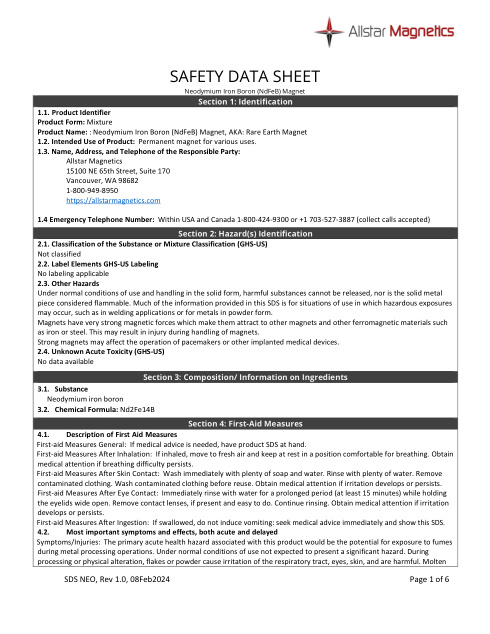
SAFETY DATA SHEET Neodymium Iron Boron (NdFeB) Magnet
Section 1: Identification
1.1. Product Identifier
Product Form: 混合物 Product Name: : Neodymium Iron Boron (NdFeB) Magnet, AKA: Rare Earth Magnet 1.2. Intended Use of Product: Permanent magnet for various uses. 1.3. Name, 住所, and Telephone of the Responsible Party: Allstar Magnetics 15100 NE 65th Street, Suite 170 Vancouver, WA 98682 1-800-949-8950 https://allstarmagnetics.com
1.4 Emergency Telephone Number: Within USA and Canada 1-800-424-9300 or +1 703-527-3887 (collect calls accepted)
Section 2: Hazard(s) Identification
2.1. Classification of the Substance or 混合物 Classification (GHS-US) Not classified 2.2. Label 元素s GHS-US Labeling No labeling applicable
2.3. Other Hazards
Under normal conditions of use and handling in the solid form, harmful substances cannot be released, nor is the solid metal piece considered flammable. Much of the information provided in this SDS is for situations of use in which hazardous exposures may occur, such as in welding applications or for metals in powder form. Magnets have very strong magnetic forces which make them attract to other magnets and other ferromagnetic materials such as iron or steel. This may result in injury during handling of magnets. Strong magnets may affect the operation of pacemakers or other implanted medical devices. 2.4. Unknown Acute Toxicity (GHS-US) No data available
Section 3: 組成/ Information on Ingredients
3.1. Substance Neodymium iron boron 3.2. Chemical Formula: Nd2Fe14B
Section 4: First-Aid Measures
4.1. 説明 of First Aid Measures First-aid Measures General: If medical advice is needed, have product SDS at hand. First-aid Measures After Inhalation: If inhaled, move to fresh air and keep at rest in a position comfortable for breathing. Obtain medical attention if breathing difficulty persists. First-aid Measures After Skin Contact: Wash immediately with plenty of soap and water. Rinse with plenty of water. Remove contaminated clothing. Wash contaminated clothing before reuse. Obtain medical attention if irritation develops or persists. First-aid Measures After Eye Contact: Immediately rinse with water for a prolonged period (at least 15 minutes) while holding the eyelids wide open. Remove contact lenses, if present and easy to do. Continue rinsing. Obtain medical attention if irritation develops or persists. First-aid Measures After Ingestion: If swallowed, do not induce vomiting: seek medical advice immediately and show this SDS. 4.2. Most important symptoms and effects, both acute and delayed Symptoms/Injuries: The primary acute health hazard associated with this product would be the potential for exposure to fumes during metal processing operations. Under normal conditions of use not expected to present a significant hazard. During processing or physical alteration, flakes or powder cause irritation of the respiratory tract, eyes, skin, and are harmful. Molten
SDS NEO, Rev 1.0, 08Feb2024 ページ 1 of 6
ページ 2
material may release toxic, and irritating fumes. Symptoms/Injuries After Inhalation: During processing, inhalation of fumes may cause lung inflammation and injury with symptoms of chest pains, chills, cough, headache, and diarrhea. Inhalation of dusts and fumes can cause metal fume fever. Symptoms can include a metallic or sweet taste in the mouth, sweating, shivering, headache, throat irritation, fever, chills, thirstiness, muscle aches, nausea, vomiting, weakness, fatigue, and shortness of breath. Symptoms/Injuries After Skin Contact: During metal processing, . Dust may cause irritation in skin folds or by contact in combination with tight clothing. Symptoms/Injuries After Eye Contact: Dust generated from material cutting may cause a slight irritation. Slivers may be generated, which could cause mechanical irritation or injure the eye. Symptoms/Injuries After Ingestion: If a large quantity has been ingested: Gastrointestinal irritation. Indication of Any Immediate Medical Attention and Special Treatment Needed If medical advice is needed, have product SDS at hand. Information for Doctors: Ingestion of multiple magnets can pose a serious risk. Consider consulting the algorithm presented in, "Management of Ingested Magnets in Children," (Hussain et al., 2012). Strong magnetic fields found near neodymium magnets can interfere with the operation of implanted medical devices such as pacemakers and ICDs.
Section 5: Fire-Fighting Measures
5.1. Extinguishing Media Suitable Extinguishing Media: Earth, sand, Class D dry powder extinguishing agent, without oxygen compounds. Unsuitable Extinguishing Media: Do not use Halon agents or water. 5.2. Special Hazards Arising From the Substance or 混合物 Fire Hazard: Dry powders or neodymium magnets will oxidize, smolder, and burn rapidly in the presences of air or oxygen. Maintain powders in water slurry or in inert atmospheres of nitrogen or argon to prevent spontaneous combustion. Magnets may spark on impact. Handle carefully in explosive atmospheres. Explosion Hazard: Product itself is not explosive but if dust is generated, dust clouds suspended in air can be explosive. Reactivity: Hazardous reactions will not occur under normal conditions. 5.3. Advice for Firefighters Firefighting Instructions: Do not breathe fumes from fires or vapors from decomposition. Keep upwind. Protection During Firefighting: Firefighters must use full-face, self-contained breathing apparatus with full protective clothing to prevent contact with skin and eyes to protect against potential hazardous combustion and decomposition products.
Section 6: Accidental Release Measures
6.1. Personal Precautions, Protective Equipment and Emergency Procedures 6.1.1. For Non-emergency Personnel Protective Equipment: Wear eye protection. Emergency Procedures: Avoid creating or spreading dust. Eliminate ignition sources. 6.1.2. For Emergency Responders Protective Equipment: Safety glasses. Emergency Procedures: Ventilate area. Eliminate ignition sources. Evacuate unnecessary personnel. 6.2. Environmental Precautions Contain any spills with dikes or absorbents to prevent migration and entry into sewers or streams. 6.3. Methods and Material for Containment and Cleaning Up For Containment: Contain and collect as any solid. Methods for Cleaning Up: Avoid generation of dust during clean-up of spills. Take up mechanically (sweeping, shoveling) and collect in suitable container for disposal. Vacuum must be fitted with HEPA filter to prevent release of particulates during clean- up. Use only non-sparking tools. Use explosion-proof equipment. 6.4. Reference to Other Sections See heading 8, Exposure Controls and Personal Protection.
Section 7: Handling and Storage
7.1. Precautions for Safe Handling Large magnets can attract to one another. Strong attractive forces can cause injury. Impacts of magnets can eject chips or bits of magnet material at speed - eye protection should be used. Strong magnetic fields may affect the operation of implanted medical devices such as pacemakers and ICDs.
SDS NEO, Rev 1.0, 08Feb2024 ページ 2 of 6
ページ 3
Additional Hazards When Processed: Do not handle until all safety precautions have been read and understood. Fine dust dispersed in air may ignite. Dust deposits should not be allowed to accumulate on surfaces, as these may form an explosive mixture if they are released into the atmosphere in sufficient concentration. Precautions for Safe Handling: Do not breathe dust. Do not get in eyes, on skin, or on clothing. Avoid creating or spreading dust. Always wash hands after handling the product. Do not eat, drink or smoke when using this product. Ensure there is adequate ventilation. Wear recommended personal protective equipment. Hygiene Measures: Handle in accordance with good industrial hygiene and safety procedures. Always wash your hands immediately after handling this product, and once again before leaving the workplace. Wash contaminated clothing before reuse. Do not eat, drink or smoke in areas where product is used. Emergency eye wash fountains and safety showers should be available in the immediate vicinity of any potential exposure. Information about protection against Explosions/Fires: No particular measures are required in the provided form. 7.2. Conditions for Safe Storage, Including Any Incompatibilities Storage Conditions: Store in dry location free of corrosive atmosphere. Keep away from magnetic objects such as iron, cobalt or nickel and high energy magnetic fields. Incompatible 材料: Avoid contact with: Strong acids. Mineral acids. Corrosive substances in contact with metals may produce flammable hydrogen gas. 7.3. Specific End Use(s) Cast and Sintered Permanent Magnets
Section 8: Exposure Controls/Personal Protection
8.1. Control Parameters Exposure Limits: Neodymium OSHA/PEL: No exposure limit established ACGIH/TLV: No exposure limit established
8.2. Exposure Controls
Appropriate Engineering Controls: Handle in a humidity controlled atmosphere. Handle in an enclosed, controlled process under dry argon when possible. Ensure adequate ventilation to maintain exposures below occupational limits. Whenever possible the use of local exhaust ventilation or other engineering controls is the preferred method of controlling exposure to airborne dust and fume to meet established occupational exposure limits. Use good housekeeping and sanitation practices. Do not use tobacco or food in work area. Wash thoroughly before eating or smoking. Do not blow dust off clothing or skin with compressed air. Personal Protective Equipment: Not generally required. The use of personal protective equipment may be necessary as conditions warrant. Hand Protection: Wear impermeable gloves, protective work clothing as necessary. Eye Protection: Safety glasses. Respiratory Protection: If permissible levels are exceeded, use NIOSH approved dust respirator.
Section 9: Physical and Chemical Properties
9.1. Information on Basic Physical and Chemical Properties Physical State : Solid Color : Silver gray metallic Odor : Not determined Odor Threshold : Not determined pH : N/A Evaporation Rate : N/A Melting Point : Above 1021°C (2192 - 2642 °F) Freezing Point : No data available Boiling Point : 3074°C Flash Point : N/A Auto-ignition Temperature : No data available Decomposition Temperature : No data available Flammability (solid, gas) : No data available Vapor Pressure : No data available SDS NEO, Rev 1.0, 08Feb2024 ページ 3 of 6
ページ 4
Relative Vapor Density at 20 °C : No data available Relative Density : 7.008 g/cc Density : 7.5 g/cc Solubility : Water: Insoluble Partition Coefficient: N-octanol/water : No data available Viscosity : N/A Explosive Properties : None. Oxidizing Properties : None.
9.2. Other Information No additional information available
Section 10: Stability and Reactivity
10.1 Reactivity: No data. 10.2 Chemical Stability: Product is stable under recommended storage conditions. 10.3 Possibility of Hazardous Reactions: Contact with acids may evolve hydrogen gas. Dusts are flammable. May react with water under fire conditions liberating flammable hydrogen gas. 10.4 Conditions to Avoid: Avoid exposure of powdered magnet material to air, oxygen or halogenated hydrocarbons and to elevated temperatures above 150° C. Do not use or store in conditions as follows: acidic, alkaline or electrically conductive liquids, corrosive gases. 10.5 Incompatible 材料: Fine powders are incompatible with air, oxygen, halogenated hydrocarbons with strong oxidizers. Avoid acids and other oxidizing agents.
10.6 Hazardous Decomposition Products: ネオジム oxides, neodymium hydroxides, hydrogen.
Section 11: Toxicological Information
11.1. Information On Toxicological Effects Acute Toxicity: Not classified. Skin Corrosion/Irritation: Not classified Serious Eye Damage/Irritation: Not classified. Respiratory or Skin Sensitization: Not classified. Not classified. Germ Cell Mutagenicity: Not classified Carcinogenicity: Not classified. Reproductive Toxicity: Not classified. Specific Target Organ Toxicity (Single Exposure): Not classified Specific Target Organ Toxicity (Repeated Exposure): Not classified. Aspiration Hazard: Not classified Symptoms/Injuries After Inhalation: During processing, inhalation of fumes may cause lung inflammation and injury with symptoms of chest pains, chills, cough, headache, and diarrhea. Inhalation of dusts and fumes can cause metal fume fever. Symptoms can include a metallic or sweet taste in the mouth, sweating, shivering, headache, throat irritation, fever, chills, thirstiness, muscle aches, nausea, vomiting, weakness, fatigue, and shortness of breath. Symptoms/Injuries After Skin Contact: During metal processing, . Dust may cause irritation in skin folds or by contact in combination with tight clothing. Symptoms/Injuries After Eye Contact: Dust generated from material cutting may cause a slight irritation. Slivers may be generated, which could cause mechanical irritation or injure the eye. Symptoms/Injuries After Ingestion: If a large quantity has been ingested: Gastrointestinal irritation. Inhalation of Nickel compounds has been shown in studies to provide an increased incidence of cancer of the nasal cavity, lung and possibly larynx in nickel refinery workers. Copper: Overexposure to fumes may cause metal fume fever (chills, muscle aches, nausea, fever, dry throat, cough, weakness, lassitude); metallic or sweet taste; discoloration of skin and hair. Tissue damage of mucous membranes may follow chronic dust exposure.
Section 12: Ecological Information (non-mandatory)
12.1. Toxicity: No further relevant information available. 12.2. Persistence and Degradability: No further relevant information available. 12.3. Bio accumulative Potential: No further relevant information available. 12.4. Mobility in Soil: No further relevant information available.
12.5. Other Adverse Effects
No additional information available SDS NEO, Rev 1.0, 08Feb2024 ページ 4 of 6
ページ 5
Section 13: Disposal Considerations (non-mandatory)
13.1. Waste treatment methods Sewage Disposal Recommendations: Do not empty into drains; dispose of this material and its container in a safe way. Waste Disposal Recommendations: Dispose of waste material in accordance with all local, regional, national, and international regulations.
Section 14: Transport Information (non-mandatory)
Magnets can generate magnetic fields that may affect navigation equipment. Magnets are able to attract ferromagnetic materials. Land Transport: Not regulated for transport. Transport by Sea: Not regulated for transport Air Transport: Neo magnets may or may not require a hazardous material label. See the International Air Transport Association’s (IATA) Dangerous Goods Regulations (DGR) and FAA Title 49, Part 173.21
Section 15: Regulatory Information (non-mandatory)
15.1 US Federal Regulations
Safety, health and environmental regulations/legislation specific for the substance or mixture SARA Section 355 (extremely hazardous None of the ingredients is listed substances):
Section 313 (Specific toxic chemical listings) 7440-48-4 Cobalt
7429-90-5 Aluminum TSCA (Toxic Substances Control Act): All ingredients are listed Proposition 65 (chemicals known to cause cancer) 7440-48-4 Cobalt Chemicals known to cause reproductive toxicity Females: None of the ingredients is listed Males: None of the ingredients is listed Chemicals known to cause developmental toxicity None of the ingredients is listed Cancerogenity categories EPA (Environmental Protection Agency) None of the ingredients is listed TLV (Threshold Limit Value established by ACGIH) 7440-48-4 Cobalt A3 7429-90-5 Aluminum A4 MAK (ドイツ語 Maximum Workplace 7440-48-4 Cobalt 2 Concentration) NIOSH-Ca (National Institute for Occupational None of the ingredients is listed Safety and Health) OSHA-Ca (Occupational Safety & Health None of the ingredients is listed Administration National regulations: Other regulations, limitations and prohibitive regulations Guidelines 67/548/ECC, 1999/45/EC 1272/2008/EG (CLP) 1907/2006/EG (REACH) ドイツ語 Hazardous Substances
PLEASE NOTE: Magnetized parts generate magnetic fields and are able to attract magnetizable materials. This may result in injury during handling of magnets. Electronic devices and measure tools may be changed in calibration or damaged by the high magnetic field strength. Please keep magnetized magnets away from computers, displays and magnetic storage devices. Especially people with heart pacemakers must keep away from magnetic fields. Chemical Safety Assessment VOID (for articles)
SDS NEO, Rev 1.0, 08Feb2024 ページ 5 of 6
ページ 6
Section 16: Other Information
改訂版 Date : 09/02/2014 The information is based on our present knowledge. However, this shall not constitute a guarantee for any specific product features and shall not establish a legally valid contractual relationship. Relevant phrases (Wording of safety instructions H22 Flammable solid quoted <section 3> concerning pure substances 8 Catches fire spontaneously if exposed to (powder). H25 air In contact with water releases 0 flammable gas Cause skin irritation H26 May cause an allergic skin reaction 1 Cause serious eye irritation H31 May cause allergy or asthma symptoms or breathing 5 difficulties H31 7 H31 9 H33 4 R11 Highly flammable R15 Contact with water liberates extremely flammable R17 gases Spontaneously flammable in air R36/3 Irritating to eyes and skin 8 May cause sensitization by inhalation and skin contact R42/4 May cause long-term adverse effects in aquatic 3 R53 environment. Department issuing MSDS Contact Abbreviations and acronyms IMDG: International Maritime Code for Dangerous Goods IATA : International Air Transport Association ACGIH : American Conference of Governmental Industrial Hygienists LC60: Lethal Concentration, 50% LD50: Lethal Dose, 50 % 情報源s
This information is based on our current knowledge and is intended to describe the product for the purposes of health, safety and environmental requirements only. It should not therefore be construed as guaranteeing any specific property of the product.
SDS NEO, Rev 1.0, 08Feb2024 ページ 6 of 6
同一材料:他の発行元によるSDS
0 件の文書がこの材料索引にあります。製品グレード、水和状態、配合は各原本PDFで確認してください。
現在、この材料について他の発行元のPDFは収録されていません。
原発行元・企業情報
Allstar Magnetics
- ブランド・組織
- Allstar Magnetics
- 国・地域/事業所
- 記載なし
- ウェブサイト
- allstarmagnetics.com
- SDS記載の連絡先メール
- 記載なし in SDS
- SDS記載の電話番号
- 記載なし
- 製品・参照番号
- Rev 1.0
Official site identifies Allstar Magnetics and lists its Vancouver, Washington address, sales email and contact form.
抽出した供給元情報を表示
SAFETY DATA SHEET
                                    Neodymium Iron Boron (NdFeB) Magnet
                                       Section 1: Identification
1.1. Product Identifier
Product Form: Mixture
Product Name: : Neodymium Iron Boron (NdFeB) Magnet, AKA: Rare Earth Magnet
1.2. Intended Use of Product: Permanent magnet for various uses.
1.3. Name, Address, and Telephone of the Responsible Party:
          Allstar Magnetics
       15100 NE 65th Street, Suite 170
        Vancouver, WA 98682
        1-800-949-8950
         https://allstarmagnetics.com
RESDSについて Allstar Magnetics
Official site identifies Allstar Magnetics and lists its Vancouver, Washington address, sales email and contact form.
Company website & profile文書の出典・収録履歴
原登録: Neodymium Iron Boron (NdFeB) Magnet – 安全データシート
追加日: 2026-09-14T00:58:51.000Z · 登録更新: 2026-09-14T03:07:49.548Z
原本ファイル SHA-256: 02c9cf5c7935412abb0ed2ba92149e4de531fcf8769a07f7caf16f3171263396
原典PDF訂正・文書更新を依頼
メタデータの誤り、抽出エラー、供給元による新版、権利上の問題を報告できます。報告内容は運営者が確認するため非公開で保存され、送信しただけで公開中のSDSが直ちに変更されることはありません。
報告内容と任意のメールアドレスは、対応のため非公開で保存されます。サイト上には公開されません。機密情報や個人の重要情報を入力しないでください。
公式化学物質情報源
情報源ガイド ↗このSDSに記載されたCAS番号です。以下の性質は個々の物質に関するもので、製品全体を示すとは限りません。混合物、グレード、水和状態については原本SDSをご確認ください。
No valid CAS reference is recorded. 検索 PubChem by chemical name ↗.
GHSは分類基準を示すものです。適用される危険有害性分類は、対象製品および各法域について個別に確認してください。
この材料の供給元
該当材料のSDSと公式製品ページから確認した企業です。グレード、組成、供給状況は供給元へ直接ご確認ください。確認できない連絡先は推測して掲載しません。
この材料について、追加の供給元はまだ確認されていません。
ウェブでその他の供給元を検索
この材料を複数の検索エンジンで検索
検索語: Neodymium Iron Boron (NdFeB) Magnet SDS
Wikipediaによる材料の基礎情報
Wikipediaで Neodymium Iron Boron (NdFeB) Magnet を検索します。該当記事がある場合は概要を表示します。製品固有の混合物や標準物質には専用記事がない場合があります。
Wikipediaでこの材料を検索 ↗Wikipedia執筆者による概要: CC BY-SA 4.0. 一般的な材料情報であり、対象製品のSDSに代わるものではありません。