Yttria-stabilized zirconia powder NIST SRM 1982 SDS
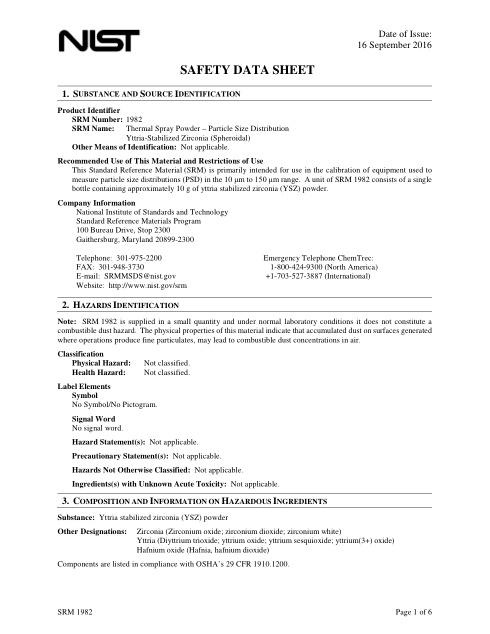
RESDSが収集し、発行元の原本PDFをそのまま保持しています。 SRM 1982: Thermal Spray Powder - Particle Size Distribution. Section 3 lists zirconium oxide >90%, yttrium oxide 7.33% and hafnium oxide 1.39% by mass. 成分CAS番号: 1314-23-4, 1314-36-9 and 12055-23-1, respectively. This is an oxide mixture, not yttrium metal. 原発行元: 米国国立標準技術研究所(NIST). Original issue date: 2016年9月16日. Reuse basis: https://www.nist.gov/copyrights-disclaimers
PDFプレビュー
無料で閲覧・ダウンロード可能・登録やログインは不要です。
PDFを読み込み中…
Normalized SDS data & document analysis
RESDS derives the results below from this document’s extracted text and the site’s same-material index. Detected codes are not reclassified. “Not detected” does not mean “not present”; confirm the original PDF for safety-critical use.
GHS & transport evidence
ページ links show the first occurrence found in extracted text.
SDS 16-section coverage
14 section headings detected; 2 not detected by the parser.
材料・文書仕様
- Material
- Yttria-stabilized zirconia powder
- 製品・グレード
- NIST SRM 1982
- 発行元
- 米国国立標準技術研究所(NIST)
- 国・地域
- 米国
- ファイル名
- 1982-MSDS.pdf
- 文書の種類
- SDS
- CAS登録番号
- 記載なし
- 言語
- 英語
- 原本改訂日
- 2016年9月16日
- ページ数
- 6
- ファイルサイズ
- 97 KB
- ダウンロード数
- 6
- 追加日
- 2026-09-13
この文書が該当する理由
組成が完全に確認されていない場合があります。記載のない元素が含まれていないとは限りません。
Substance: Yttria stabilized zirconia (YSZ) powder
その他の記載元素: O
Full document text
6ページ · 原文書の言語
Text extracted from the original PDF. ページ order and original wording are preserved; tables and symbols may differ from the PDF layout. Check the original PDF for safety-critical details.
ページ 1
Date of Issue: 2016年9月16日
SAFETY DATA SHEET
1. SUBSTANCE AND SOURCE IDENTIFICATION Product Identifier SRM Number: 1982 SRM Name: Thermal Spray Powder – Particle Size Distribution Yttria-Stabilized Zirconia (Spheroidal) Other Means of Identification: Not applicable. おすすめ Use of This Material and Restrictions of Use This Standard Reference Material (SRM) is primarily intended for use in the calibration of equipment used to measure particle size distributions (PSD) in the 10 μm to 150 μm range. A unit of SRM 1982 consists of a single bottle containing approximately 10 g of yttria stabilized zirconia (YSZ) powder. Company Information 米国国立標準技術研究所 標準物質プログラム 100 Bureau Drive, Stop 2300 Gaithersburg, Maryland 20899-2300
Telephone: 301-975-2200 Emergency Telephone ChemTrec: FAX: 301-948-3730 1-800-424-9300 (North America) E-mail: SRMMSDS@nist.gov +1-703-527-3887 (International) ウェブサイト: http://www.nist.gov/srm
2. HAZARDS IDENTIFICATION
Note: SRM 1982 is supplied in a small quantity and under normal laboratory conditions it does not constitute a combustible dust hazard. The physical properties of this material indicate that accumulated dust on surfaces generated where operations produce fine particulates, may lead to combustible dust concentrations in air. Classification Physical Hazard: Not classified. Health Hazard: Not classified. Label 元素s Symbol No Symbol/No Pictogram. Signal Word No signal word. Hazard Statement(s): Not applicable. Precautionary Statement(s): Not applicable. Hazards Not Otherwise Classified: Not applicable. Ingredients(s) with Unknown Acute Toxicity: Not applicable.
3. COMPOSITION AND INFORMATION ON HAZARDOUS INGREDIENTS
物質: Yttria stabilized zirconia (YSZ) powder Other Designations: Zirconia (Zirconium oxide; zirconium dioxide; zirconium white) Yttria (Diyttrium trioxide; yttrium oxide; yttrium sesquioxide; yttrium(3+) oxide) Hafnium oxide (Hafnia, hafnium dioxide) Components are listed in compliance with OSHA’s 29 CFR 1910.1200.
SRM 1982 ページ 1 of 6
ページ 2
Hazardous Component(s) CAS番号 EC Number Nominal Mass Concentration (EINECS) (%) Zirconium oxide 1314-23-4 215-227-2 >90 Yttrium oxide 1314-36-9 215-233-5 7.33 Hafnium oxide 12055-23-1 235-013-2 1.39
4. FIRST AID MEASURES
説明 of First Aid Measures Inhalation: If adverse effects occur, remove to uncontaminated area. Give artificial respiration if not breathing. Get immediate medical attention. Skin Contact: Wash skin with soap and water for at least 15 minutes while removing contaminated clothing and shoes. Get medical attention, if needed. Thoroughly clean and dry contaminated clothing and shoes before reuse. Eye Contact: Flush eyes with plenty of water for at least 15 minutes. Then get immediate medical attention. Ingestion: If a large amount is swallowed, get medical attention. Most Important Symptoms/Effects, Acute and Delayed: Exposure may irritate the eyes, skin, respiratory system, and mucous membranes. Indication of any immediate medical attention and special treatment needed, if necessary: If any of the above symptoms are present, seek immediate medical attention.
5. FIRE FIGHTING MEASURES
Fire and Explosion Hazards: Negligible fire hazard. Avoid generating dust; sufficient concentrations of fine dust dispersed in air, and in the presence of an ignition source is a potential hazard. See Section 9, “Physical and Chemical Properties” for flammability properties. Extinguishing Media Suitable: Regular dry chemical, carbon dioxide, water, regular foam. Unsuitable: None listed. Specific Hazards Arising from the Chemical: Not applicable. Special Protective Equipment and Precautions for Fire-Fighters: Move container from fire area if it can be done without personal risk. Avoid inhalation of material or combustion by-products. Wear full protective clothing and NIOSH-approved self-contained breathing apparatus (SCBA). NFPA Ratings (0 = Minimal; 1 = Slight; 2 = Moderate; 3 = Serious; 4 = Severe) Health = 1 Fire = 0 Reactivity = 0
6. ACCIDENTAL RELEASE MEASURES
Personal Precautions, Protective Equipment and Emergency Procedures: Any accumulated material on surfaces should be removed and properly disposed of. Use suitable protective equipment; see Section 8, “Exposure Controls and Personal Protection”. Methods and 材料 for Containment and Clean up: Collect spilled material in appropriate container for disposal. Avoid generating dust. Clean up residue with a high-efficiency particulate filter vacuum.
7. HANDLING AND STORAGE
Safe Handling Precautions: Minimize dust generation and accumulation on surfaces. Use suitable personal protection equipment (PPE). See Section 8, “Exposure Controls and Personal Protection”. Storage and Incompatible 材料: Store and handle in accordance with all current regulations and standards. Keep separated from incompatible substances (see Section 10, “Stability and Reactivity”).
SRM 1982 ページ 2 of 6
ページ 3
8. EXPOSURE CONTROLS AND PERSONAL PROTECTION
Exposure Limits Component(s) OSHA (PEL) ACGIH (TLV) NIOSH (REL) Zirconium Oxide TWA: 5 mg/m3 TWA: 50 mg/m3 TWA: 5 mg/m3 as Zr (related to STEL: 10 mg/m3 STEL: 10 mg/m3 Zirconium compounds) IDLH: 25 mg/m3 (except Zirconium tetrachloride) Yttrium Oxide No occupational TWA: 1 mg/m3 TWA: 1 mg/m3 as Y (related to Yttrium exposure limits IDLH: 500 mg/m3 compounds) established Hafnium Oxide No occupational TWA: 0.5 mg/m3 TWA: 0.5 mg/m3 as Hf (related to exposure limits IDLH: 50 mg/m3 Hafnium compounds) established Engineering Controls: Provide local exhaust or process enclosure ventilation system. Ensure compliance with applicable exposure limits. Personal Protection Measures: In accordance with OSHA 29 CFR 1910.132, subpart I, wear appropriate PPE to minimize exposure to this material. Respiratory Protection: If workplace conditions warrant a respirator, a respiratory protection program that meets OSHA 29CFR 1910.134 must be followed. Refer to NIOSH 42 CFR 84 for applicable certified respirators. Eye Protection: Splash resistant safety goggles and emergency eyewash are recommended. Skin and Body Protection: Chemical resistant clothing and gloves are recommended.
9. PHYSICAL AND CHEMICAL PROPERTIES
Descriptive Properties YSZ powder Molar Mass (g/mol) varies Molecular Formula not applicable Appearance (physical state, color, etc.) fine powder Odor odorless Odor threshold not available pH not available Evaporation rate not available Melting point/freezing point not available Relative Density as Specific Gravity (water = 1) 5.8(a) Vapor Pressure not available Vapor Density (air = 1) not available Viscosity not available Solubilities insoluble in water Partition coefficient (n-octanol/water) not available
Thermal Stability Properties Autoignition Temperature not available Thermal Decomposition not available Initial boiling point and boiling range not available Explosive Limits, LEL (Volume %) not available Explosive Limits, UEL (Volume %) not available Flash Point (閉じるd Cup) not available Flammability (solid, gas) not available
(a) Vendor supplied health and safety information.
SRM 1982 ページ 3 of 6
ページ 4
10. STABILITY AND REACTIVITY
Reactivity: Stable at normal temperatures and pressure. Stability: X Stable Unstable Possible Hazardous Reactions: Not applicable. Conditions to Avoid: Avoid heat, flames, sparks, and other ignition sources. Avoid contact with incompatible materials. Incompatible 材料: Oxidizing materials. Hazardous Decomposition: Miscellaneous decomposition products. Hazardous Polymerization: Will Occur X Will Not Occur
11. TOXICOLOGICAL INFORMATION
Route of Exposure: X Inhalation X Skin X Ingestion Symptoms Related to the Physical, Chemical and Toxicological Characteristics: Exposure may irritate the eyes, skin, respiratory system, and mucous membranes. Potential Health Effects (Acute, Chronic, and Delayed) Inhalation: Inhalation exposure to zirconia in animals resulted in no detectable effects. Acute inhalation of yttria, a rare earth, has caused sensitivity to heat and itching. Prolonged exposure to rare earth oxides has resulted in transient chemical pneumonitis, subacute bronchitis and bronchiolitis. Hafnia may be irritating to mucous membranes; liver damage may occur. Skin Contact: Acute and chronic exposure of zirconia to abraded skin may cause allergic granuloma formation. Application of yttria and hafnia may cause irritation. Eye Contact: 希土類s may irritate the conjunctiva. Ingestion: Zirconia and rare earths are poorly absorbed by the gastrointestinal tract. Hafnia ingestion may cause liver damage. Numerical Measures of Toxicity Acute Toxicity: Not classified. Zirconium oxide: Mouse, Oral LD50: >8.8 g/kg Yttrium oxide: Rat, Oral LD50: >10 g/kg Hafnium oxide: No data available. Skin Corrosion/Irritation: Not classified. Zirconium oxide: Rabbit, Dermal: not irritating. Hafnium compounds may cause mild irritation. Serious Eye Damage/Irritation: Not classified. Hafnium compounds may cause mild irritation. Respiratory Sensitization: Not classified; no data available. Skin Sensitization: Not classified; no data available. Germ Cell Mutagenicity: Not classified; no data available. Carcinogenicity: Not classified. Listed as a Carcinogen/Potential Carcinogen Yes X No Zirconium oxide, yttrium oxide, and hafnium oxide are not listed by OSHA, IARC, or NTP as a carcinogen/potential carcinogen. Reproductive Toxicity: Not classified; no data available. Specific Target Organ Toxicity, Single Exposure: Not classified; no data available. Specific Target Organ Toxicity, Repeated Exposure: Not classified; no data available. Aspiration Hazard: Not applicable.
SRM 1982 ページ 4 of 6
ページ 5
12. ECOLOGICAL INFORMATION
Ecotoxicity Data: No data available. Persistence and Degradability: No data available. Bioaccumulative Potential: Zirconium oxide (no bioaccumulation expected); yttrium oxide (BCF 1.3 to 54, low to moderate). Mobility in Soil: No data available. Other Adverse effects: No data available.
13. DISPOSAL CONSIDERATIONS
Waste Disposal: Dispose in accordance with all applicable federal, state, and local regulations.
14. TRANSPORTATION INFORMATION
U.S. DOT and IATA: Not regulated by DOT and IATA.
15. REGULATORY INFORMATION
U.S. Regulations CERCLA Sections 102a/103 (40 CFR 302.4): Not regulated. SARA Title III Section 302 (40 CFR 355.30): Not regulated. SARA Title III Section 304 (40 CFR 355.40): Not regulated. SARA Title III Section 313 (40 CFR 372.65): Not regulated. OSHA Process Safety (29 CFR 1910.119): Not regulated. SARA Title III Sections 311/312 Hazardous Categories (40 CFR 370.21) ACUTE HEALTH: No CHRONIC HEALTH: No FIRE: No REACTIVE: No PRESSURE: No State Regulations California Proposition 65: Not listed. U.S. TSCA Inventory: Zirconium oxide, yttrium oxide, and hafnium oxide are listed. TSCA 12(b), Export Notification: Not listed. Canadian Regulations: WHMIS Information is not provided for this material.
16. OTHER INFORMATION
Issue Date: 2016年9月16日 情報源s: ChemADVISOR, Inc., SDS Zirconium Oxide, 2015年12月9日. ChemADVISOR, Inc., SDS Yttrium Oxide, 2015年12月9日. ChemADVISOR, Inc., SDS Hafnium Oxide, 2015年12月9日. Metallurgical Technologies, Inc, Vendor MSDS, Metec 1081 Yttria stabilized zirconia 7 % Yttrium oxide, 1988年7月1日. Hazardous Substances Data Bank (HSDB), National Library of Medicine's TOXNET system, Zirconium 化合物s; Hafnium 化合物s; Yttrium 化合物s; available at http://toxnet.nlm.nih.gov (accessed Sep 2016). ESIS, IUCLID Dataset, Zirconium Dioxide CAS No. 1314-23-4; available at https://echa.europa.eu/ (accessed Sep 2016). ChemIDplus; National Library of Medicine's TOXNET system, Yttria CAS No.1314-36-9; available at http://toxnet.nlm.nih.gov (accessed Sep 2016).
SRM 1982 ページ 5 of 6
ページ 6
Key of Acronyms: ACGIH American Conference of Governmental Industrial NTP National Toxicology Program Hygienists CAS Chemical Abstracts Service OSHA Occupational Safety and Health Administration CERCLA Comprehensive Environmental Response, Compensation, PEL Permissible Exposure Limit and Liability Act CFR Code of Federal Regulations RCRA Resource Conservation and Recovery Act DOT Department of Transportation REL おすすめ Exposure Limit EINECS European Inventory of Existing Commercial Chemical RQ Reportable Quantity Substances EPCRA Emergency Planning and Community Right-to-Know Act RTECS Registry of Toxic Effects of Chemical Substances IARC International Agency for Research on Cancer SARA Superfund Amendments and Reauthorization Act IATA International Air Transport Association SCBA Self-Contained Breathing Apparatus IDLH Immediately Dangerous to Life and Health SRM Standard Reference Material LC50 Lethal Concentration STOT Specific Target Organ Toxicity LD50 Median Lethal Dose or Lethal Dose, 50 % STEL Short Term Exposure Limit LEL Lower Explosive Limit TLV Threshold Limit Value MSDS Material 安全データシート TPQ Threshold Planning Quantity NFPA National Fire Protection Association TSCA Toxic Substances Control Act NIOSH National Institute for Occupational Safety and Health TWA Time Weighted Average NIST 米国国立標準技術研究所 UEL Upper Explosive Limit n.o.s. Not Otherwise Specified WHMIS Workplace Hazardous 材料 Information System
Disclaimer: Physical and chemical data contained in this SDS are provided only for use in assessing the hazardous nature of the material. The SDS was prepared carefully, using current references; however, NIST does not certify the data in the SDS. The values for this material are given in the NIST Certificate of Analysis. Users of this SRM should ensure that the SDS in their possession is current. This can be accomplished by contacting the SRM Program: telephone (301) 975-2200; fax (301) 948-3730; e-mail srmmsds@nist.gov; or via the Internet at http://www.nist.gov/srm.
SRM 1982 ページ 6 of 6
同一材料:他の発行元によるSDS
0 件の文書がこの材料索引にあります。製品グレード、水和状態、配合は各原本PDFで確認してください。
現在、この材料について他の発行元のPDFは収録されていません。
原発行元・企業情報
- ブランド・組織
- NIST・標準物質プログラム
- 国・地域/事業所
- 米国
- ウェブサイト
- nist.gov
- SDS記載の連絡先メール
- SRMMSDS@nist.gov
- SDS記載の電話番号
- 301-975-2200
- 製品・参照番号
- NIST SRM 1982
抽出した供給元情報を表示
Company Information
     National Institute of Standards and Technology
     Standard Reference Materials Program
     100 Bureau Drive, Stop 2300
      Gaithersburg, Maryland 20899-2300

     Telephone: 301-975-2200                         Emergency Telephone ChemTrec:
    FAX: 301-948-3730                                  1-800-424-9300 (North America)
     E-mail: SRMMSDS@nist.gov                        +1-703-527-3887 (International)
     Website: http://www.nist.gov/srm
RESDSについて 米国国立標準技術研究所
米国国立標準技術研究所 is the organization attributed as publisher or supplier of this SDS. See the original identification section and official website for its company profile.
Company website & profile文書の出典・収録履歴
原登録: Yttria-Stabilized Zirconia (Spheroidal), Thermal Spray Powder - NIST SRM 1982 安全データシート
追加日: 2026-09-13T14:05:05.000Z · 登録更新: 2026-09-14T02:29:00.557Z
原本ファイル SHA-256: 2c04738091e58a71ed3d9e6a0ba90bc777cb9e28fc6164eda212492aa25e99a1
原典PDF訂正・文書更新を依頼
メタデータの誤り、抽出エラー、供給元による新版、権利上の問題を報告できます。報告内容は運営者が確認するため非公開で保存され、送信しただけで公開中のSDSが直ちに変更されることはありません。
報告内容と任意のメールアドレスは、対応のため非公開で保存されます。サイト上には公開されません。機密情報や個人の重要情報を入力しないでください。
公式化学物質情報源
情報源ガイド ↗このSDSに記載されたCAS番号です。以下の性質は個々の物質に関するもので、製品全体を示すとは限りません。混合物、グレード、水和状態については原本SDSをご確認ください。
No valid CAS reference is recorded. 検索 PubChem by chemical name ↗.
GHSは分類基準を示すものです。適用される危険有害性分類は、対象製品および各法域について個別に確認してください。
この材料の供給元
該当材料のSDSと公式製品ページから確認した企業です。グレード、組成、供給状況は供給元へ直接ご確認ください。確認できない連絡先は推測して掲載しません。
この材料について、追加の供給元はまだ確認されていません。
ウェブでその他の供給元を検索
この材料を複数の検索エンジンで検索
検索語: Yttria-stabilized zirconia powder SDS
Wikipediaによる材料の基礎情報
Wikipediaで Yttria-stabilized zirconia powder を検索します。該当記事がある場合は概要を表示します。製品固有の混合物や標準物質には専用記事がない場合があります。
Wikipediaでこの材料を検索 ↗Wikipedia執筆者による概要: CC BY-SA 4.0. 一般的な材料情報であり、対象製品のSDSに代わるものではありません。