Cerium(IV) oxide, 20% in H2O, nanoparticle dispersion, high pH ALFAA47240 SDS
Collected by RESDS. Original publisher PDF retained. Original manufacturer safety data sheet for Cerium(IV) oxide, 20% in H2O, nanoparticle dispersion, high pH. Product number: ALFAA47240. Original revision: 04-Aug-2026. Published under the file-level authorization confirmed by the user for the frozen 1,125-file manifest.
PDF preview
FREE TO VIEW AND DOWNLOAD · NO REGISTRATION OR LOGIN REQUIRED.
Loading PDF…
Normalized SDS data & document analysis
RESDS derives the results below from this document’s extracted text and the site’s same-material index. Detected codes are not reclassified. “Not detected” does not mean “not present”; confirm the original PDF for safety-critical use.
GHS & transport evidence
Page links show the first occurrence found in extracted text.
SDS 16-section coverage
16 section headings detected; 0 not detected by the parser.
Normalized physical-property units
Calculated conversions from values detected in this SDS; not independent laboratory measurements.
| Property | SDS value | SI conversion | US conversion |
|---|---|---|---|
| Density | 1.23 g/cm³ | 1230 kg/m³ | 0.0444 lb/in³ |
Material & document specifications
- Material
- Cerium(IV) oxide, 20% in H2O, nanoparticle dispersion, high pH
- Product / grade
- ALFAA47240
- Publisher
- Avocado Research Chemicals Ltd. (Part of Thermo Fisher Scientific)
- Region
- United Kingdom
- File name
- thermofisher-ALFAA47240-Cerium-EN.pdf
- Document type
- SDS
- CAS reference(s)
- Not stated
- Language
- English
- Original revision
- 04-Aug-2026
- Pages
- 8
- File size
- 80 KB
- Downloads
- 5
- Date added
- 2026-09-15
Full document text
8 pages · Original document language
Text extracted from the original PDF. Page order and original wording are preserved; tables and symbols may differ from the PDF layout. Check the original PDF for safety-critical details.
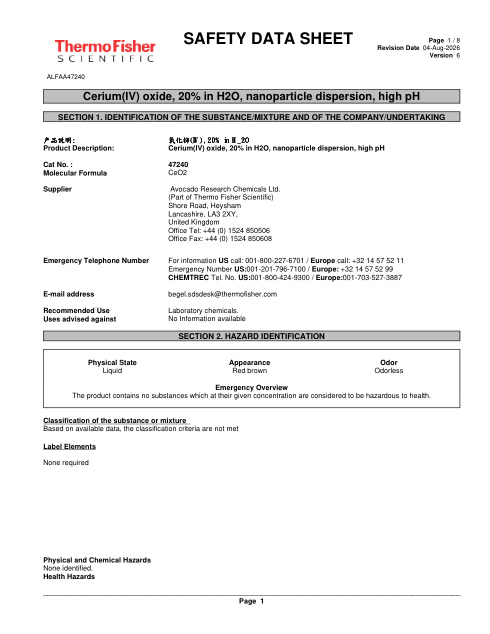
Page 1
Page 1 / 8             SAFETY DATA SHEET
                                                                                                    Revision Date 04-Aug-2026
                                                                                                                   Version 6


 ALFAA47240

       Cerium(IV) oxide, 20% in H2O, nanoparticle dispersion, high pH

   SECTION 1. IDENTIFICATION OF THE SUBSTANCE/MIXTURE AND OF THE COMPANY/UNDERTAKING


产品说明:产品说明:产品说明:产品说明:                氧化铈(IV)氧化铈(IV)氧化铈(IV)氧化铈(IV),,,,20%20%20%20% ininininH_2OH_2OH_2OH_2O
Product Description:               Cerium(IV) oxide, 20% in H2O, nanoparticle dispersion, high pH

Cat No. :                        47240
Molecular Formula             CeO2

Supplier                         Avocado Research Chemicals Ltd.
                                        (Part of Thermo Fisher Scientific)
                                 Shore Road, Heysham
                                     Lancashire, LA3 2XY,
                                    United Kingdom
                                        Office Tel: +44 (0) 1524 850506
                                        Office Fax: +44 (0) 1524 850608
Emergency Telephone Number For information US call: 001-800-227-6701 / Europe call: +32 14 57 52 11 Emergency Number US:001-201-796-7100 / Europe: +32 14 57 52 99 CHEMTREC Tel. No. US:001-800-424-9300 / Europe:001-703-527-3887
E-mail address begel.sdsdesk@thermofisher.com
Recommended Use Laboratory chemicals. Uses advised against No Information available
SECTION 2. HAZARD IDENTIFICATION
Physical State Appearance Odor Liquid Red brown Odorless
Emergency Overview The product contains no substances which at their given concentration are considered to be hazardous to health.
Classification of the substance or mixture Based on available data, the classification criteria are not met
Label Elements
None required
Physical and Chemical Hazards None identified. Health Hazards
______________________________________________________________________________________________ Page 1
Page 2
ALFAA47240 SAFETY DATA SHEET Revision Date 04-Aug-2026Page 2 / 8 Cerium(IV) oxide, 20% in H2O, nanoparticle dispersion, high pH ______________________________________________________________________________________________ The product contains no substances which at their given concentration are considered to be hazardous to health. Environmental hazards Contains no substances known to be hazardous to the environment or not degradable in waste water treatment plants. Is not likely mobile in the environment due its low water solubility. Spillage unlikely to penetrate soil. The product is insoluble and sinks in water.
This product does not contain any known or suspected endocrine disruptors.
SECTION 3. COMPOSITION/INFORMATION ON INGREDIENTS
Component CAS No Weight % Water 7732-18-5 80 Cerium oxide 1306-38-3 20
SECTION 4. FIRST AID MEASURES
General Advice Show this safety data sheet to the doctor in attendance. Immediate medical attention is required.
Eye Contact Rinse immediately with plenty of water, also under the eyelids, for at least 15 minutes. Get medical attention.
Skin Contact Wash off immediately with plenty of water for at least 15 minutes. Get medical attention immediately if symptoms occur.
Inhalation Remove to fresh air. Get medical attention immediately if symptoms occur.
Ingestion Clean mouth with water and drink afterwards plenty of water. Get medical attention if symptoms occur.
Most important symptoms and effects None reasonably foreseeable. Inhalation of high vapor concentrations may cause symptoms like headache, dizziness, tiredness, nausea and vomiting: Product is a corrosive material. Use of gastric lavage or emesis is contraindicated. Possible perforation of stomach or esophagus should be investigated: Ingestion causes severe swelling, severe damage to the delicate tissue and danger of perforation
Self-Protection of the First Aider No special precautions required.
Notes to Physician Treat symptomatically. Symptoms may be delayed.
SECTION 5. FIRE-FIGHTING MEASURES
Suitable Extinguishing Media Carbon dioxide (CO 2). Powder. Water spray. In case of major fire and large quantities: Evacuate area. Fight fire remotely due to the risk of explosion. CO 2, dry chemical, dry sand, alcohol-resistant foam. Water mist may be used to cool closed containers.
Extinguishing media which must not be used for safety reasons Water.
Specific Hazards Arising from the Chemical Thermal decomposition can lead to release of irritating gases and vapors. The product causes burns of eyes, skin and mucous membranes. Reacts violently with water. Flammable. Containers may explode when heated. Vapors may form explosive mixtures with air. Vapors may travel to source of ignition and flash back.
Protective Equipment and Precautions for Firefighters ______________________________________________________________________________________________ Page 2
Page 3
ALFAA47240 SAFETY DATA SHEET Revision Date 04-Aug-2026Page 3 / 8 Cerium(IV) oxide, 20% in H2O, nanoparticle dispersion, high pH ______________________________________________________________________________________________ As in any fire, wear self-contained breathing apparatus pressure-demand, MSHA/NIOSH (approved or equivalent) and full protective gear.
SECTION 6. ACCIDENTAL RELEASE MEASURES
Personal Precautions Ensure adequate ventilation. Use personal protective equipment as required.
Environmental Precautions Should not be released into the environment. Do not allow material to contaminate ground water system. Do not flush into surface water or sanitary sewer system.
Methods for Containment and Clean Up Sweep up and shovel into suitable containers for disposal.
Refer to protective measures listed in Sections 8 and 13.
SECTION 7. HANDLING AND STORAGE
Handling Wear personal protective equipment/face protection. Ensure adequate ventilation. Avoid contact with skin, eyes or clothing. Avoid ingestion and inhalation.
Storage Corrosives area. Keep away from water or moist air. Keep containers tightly closed in a dry, cool and well-ventilated place. Containers should be dated when opened and tested periodically for the presence of peroxides. Should crystals form in a peroxidizable liquid, peroxidation may have occurred and the product should be considered extremely dangerous. In this instance, the container should only be opened remotely by professionals. Keep away from heat, sparks and flame.
Specific Use(s) Use in laboratories
SECTION 8. EXPOSURE CONTROLS/PERSONAL PROTECTION
Control Parameters
Legend
ACGIH - American Conference of Governmental Industrial Hygienists OSHA - Occupational Safety and Health Administration NIOSH: NIOSH - National Institute for Occupational Safety and Health
Monitoring methods BS EN 14042:2003 Title Identifier: Workplace atmospheres. Guide for the application and use of procedures for the assessment of exposure to chemical and biological agents. MDHS70 General methods for sampling airborne gases and vapours MDHS 88 Volatile organic compounds in air. Laboratory method using diffusive samplers, solvent desorption and gas chromatography MDHS 96 Volatile organic compounds in air - Laboratory method using pumped solid sorbent tubes, solvent desorption and gas chromatography MDHS 91 Metals and metalloids in workplace air by X-ray fluorescence spectrometry MDHS 99 Metals in air by ICP-AES
Exposure Controls
Engineering Measures Ensure that eyewash stations and safety showers are close to the workstation location. Ensure adequate ventilation, especially in confined areas. Use explosion-proof electrical/ventilating/lighting equipment. Wherever possible, engineering control measures such as the isolation or enclosure of the process, the introduction of process or equipment changes to minimise release or contact, and the use of properly designed ventilation systems, should be adopted to control hazardous materials at source.
______________________________________________________________________________________________ Page 3
Page 4
ALFAA47240 SAFETY DATA SHEET Revision Date 04-Aug-2026Page 4 / 8 Cerium(IV) oxide, 20% in H2O, nanoparticle dispersion, high pH ______________________________________________________________________________________________
Personal protective equipment
Eye Protection Goggles (European standard - EN 166)
Hand Protection Protective gloves
Glove material Breakthrough time Glove thickness EU standard Glove comments Nitrile rubber See manufacturers - EN 374 (minimum requirement) Viton (R) recommendations Natural rubber Neoprene PVC Butyl rubber Neoprene gloves Inspect gloves before use. Please observe the instructions regarding permeability and breakthrough time which are provided by the supplier of the gloves. (Refer to manufacturer/supplier for information) Ensure gloves are suitable for the task: Chemical compatability, Dexterity, Operational conditions, User susceptibility, e.g. sensitisation effects, also take into consideration the specific local conditions under which the product is used, such as the danger of cuts, abrasion. Remove gloves with care avoiding skin contamination.
Skin and body protection Long sleeved clothing
Respiratory Protection When workers are facing concentrations above the exposure limit they must use appropriate certified respirators. To protect the wearer, respiratory protective equipment must be the correct fit and be used and maintained properly
Large scale/emergency use Use a NIOSH/MSHA or European Standard EN 136 approved respirator if exposure limits are exceeded or if irritation or other symptoms are experienced Recommended Filter type: Organic gases and vapours filter low boiling organic solvent Type AX Brown conforming to EN371 or Type A Brown conforming to EN14387 Particulates filter conforming to EN 143
Small scale/Laboratory use Use a NIOSH/MSHA or European Standard EN 149:2001 approved respirator if exposure limits are exceeded or if irritation or other symptoms are experienced. Recommended half mask:- Valve filtering: EN405; or; Half mask: EN140; plus filter, EN 141; Particle filtering: EN149:2001 When RPE is used a face piece Fit Test should be conducted
Hygiene Measures Handle in accordance with good industrial hygiene and safety practice.
Environmental exposure controls Prevent product from entering drains. Do not allow material to contaminate ground water system.
SECTION 9. PHYSICAL AND CHEMICAL PROPERTIES
Appearance Red brown Physical State Liquid
Odor Odorless Odor Threshold No data available pH 8 Melting Point/Range No data available Softening Point No data available Boiling Point/Range No information available Flash Point No information available Method - No information available Evaporation Rate No data available Flammability (solid,gas) Not applicable Liquid Explosion Limits No data available ______________________________________________________________________________________________ Page 4
Page 5
ALFAA47240 SAFETY DATA SHEET Revision Date 04-Aug-2026Page 5 / 8 Cerium(IV) oxide, 20% in H2O, nanoparticle dispersion, high pH ______________________________________________________________________________________________
Vapor Pressure No data available Vapor Density No data available (Air = 1.0) Specific Gravity / Density 1.23 g/cm3 @ 20 °C Bulk Density Not applicable Liquid Water Solubility Immiscible Solubility in other solvents No information available Partition Coefficient (n-octanol/water) Autoignition Temperature No data available Decomposition Temperature No data available Viscosity No data available Explosive Properties Vapors may form explosive mixtures with air Oxidizing Properties No information available
Molecular Formula CeO2 Molecular Weight 172.12
SECTION 10. STABILITY AND REACTIVITY
Stability Stable under normal conditions.
Hazardous Reactions None under normal processing. Hazardous Polymerization No information available.
Conditions to Avoid Exposure to moist air or water. Exposure to moisture. Keep away from open flames, hot surfaces and sources of ignition.
Materials to avoid Strong bases. Oxidizing agent.
Hazardous Decomposition Products Cerium oxide.
SECTION 11. TOXICOLOGICAL INFORMATION
Product Information
(a) acute toxicity; Toxicology data for the components
Component LD50 Oral LD50 Dermal LC50 Inhalation Water - - - Cerium oxide >5000 mg/kg ( Rat ) >2000 mg/kg ( Rat ) >5.05 mg/L ( Rat ) 4 h
(b) skin corrosion/irritation; No data available
(c) serious eye damage/irritation; No data available
(d) respiratory or skin sensitization; Respiratory No data available Skin No data available
(e) germ cell mutagenicity; No data available
(f) carcinogenicity; No data available
Limited evidence of a carcinogenic effect The table below indicates whether each agency has listed any ingredient as a carcinogen
______________________________________________________________________________________________ Page 5
Page 6
ALFAA47240 SAFETY DATA SHEET Revision Date 04-Aug-2026Page 6 / 8 Cerium(IV) oxide, 20% in H2O, nanoparticle dispersion, high pH ______________________________________________________________________________________________
(g) reproductive toxicity; No data available
(h) STOT-single exposure; No data available
Results / Target organs Central nervous system (CNS)
(i) STOT-repeated exposure; No data available
Target Organs No information available.
(j) aspiration hazard; No data available
Symptoms / effects,both acute and Inhalation of high vapor concentrations may cause symptoms like headache, dizziness, delayed tiredness, nausea and vomiting: Product is a corrosive material. Use of gastric lavage or emesis is contraindicated. Possible perforation of stomach or esophagus should be investigated: Ingestion causes severe swelling, severe damage to the delicate tissue and danger of perforation
SECTION 12. ECOLOGICAL INFORMATION
Ecotoxicity effects Contains a substance which is:. The product contains following substances which are hazardous for the environment. Toxic to aquatic organisms. May cause long-term adverse effects in the environment. Do not allow material to contaminate ground water system.
Component Freshwater Fish Water Flea Freshwater Algae Microtox Cerium oxide LC50 >100 mg/L/96h EC50 >100 mg/L/48h (Brachydanio rerio)
Persistence and Degradability Product contains heavy metals. Discharge into the environment must be avoided. Special pre-treatment is necessary Persistence May persist, based on information available, Immiscible with water. Degradation in sewage Contains substances known to be hazardous to the environment or not degradable in waste treatment plant water treatment plants.
Bioaccumulative Potential May have some potential to bioaccumulate; Product has a high potential to bioconcentrate
Mobility in soil Spillage unlikely to penetrate soil The product is insoluble and sinks in water Is not likely mobile in the environment due its low water solubility
Endocrine Disruptor Information Persistent Organic Pollutant This product does not contain any known or suspected substance Ozone Depletion Potential This product does not contain any known or suspected substance
SECTION 13. DISPOSAL CONSIDERATIONS
Waste from Residues/Unused Waste is classified as hazardous. Dispose of in accordance with the European Directives Products on waste and hazardous waste. Dispose of in accordance with local regulations.
Contaminated Packaging Dispose of this container to hazardous or special waste collection point. Empty containers retain product residue, (liquid and/or vapor), and can be dangerous. Keep product and empty container away from heat and sources of ignition.
Other Information Do not flush to sewer. Waste codes should be assigned by the user based on the
______________________________________________________________________________________________ Page 6
Page 7
ALFAA47240 SAFETY DATA SHEET Revision Date 04-Aug-2026Page 7 / 8 Cerium(IV) oxide, 20% in H2O, nanoparticle dispersion, high pH ______________________________________________________________________________________________ application for which the product was used. Can be landfilled or incinerated, when in compliance with local regulations. Do not empty into drains. Large amounts will affect pH and harm aquatic organisms.
SECTION 14. TRANSPORT INFORMATION
Road and Rail Transport Not Regulated
IMDG/IMO Not regulated
IATA Not regulated
Special Precautions for User No special precautions required
SECTION 15. REGULATORY INFORMATION
International Inventories China, X = listed, Australia, U.S.A. (TSCA), Canada (DSL/NDSL), Europe (EINECS/ELINCS/NLP), Australia (AICS), Korea (KECL), China (IECSC), Japan (ENCS), Philippines (PICCS).
Component The List of IECSC EINECS TSCA DSL PICCS ENCS ISHL AICS KECL Inventory of dangerous Hazardous goods GB Chemicals 12268 - (2015 2012 Edition) Water - - X 231-791-2 X X X X X KE-35400 Cerium oxide - - X 215-150-4 X X X X X X KE-05392
National Regulations
SECTION 16. OTHER INFORMATION
Prepared By Health, Safety and Environmental Department Revision Date 04-Aug-2026 Revision Summary Not applicable.
Training Advice Chemical hazard awareness training, incorporating labelling, Safety Data Sheets (SDS), Personal Protective Equipment (PPE) and hygiene. Use of personal protective equipment, covering appropriate selection, compatibility, breakthrough thresholds, care, maintenance, fit and standards. First aid for chemical exposure, including the use of eye wash and safety showers. Fire prevention and fighting, identifying hazards and risks, static electricity, explosive atmospheres posed by vapours and dusts. Chemical incident response training.
Legend
CAS - Chemical Abstracts Service TSCA - United States Toxic Substances Control Act Section 8(b) Inventory EINECS/ELINCS - European Inventory of Existing Commercial Chemical DSL/NDSL - Canadian Domestic Substances List/Non-Domestic Substances/EU List of Notified Chemical Substances Substances List PICCS - Philippines Inventory of Chemicals and Chemical Substances ENCS - Japanese Existing and New Chemical Substances ______________________________________________________________________________________________ Page 7
Page 8
ALFAA47240 SAFETY DATA SHEET Revision Date 04-Aug-2026Page 8 / 8 Cerium(IV) oxide, 20% in H2O, nanoparticle dispersion, high pH ______________________________________________________________________________________________ IECSC - Chinese Inventory of Existing Chemical Substances AICS - Australian Inventory of Chemical Substances KECL - Korean Existing and Evaluated Chemical Substances NZIoC - New Zealand Inventory of Chemicals
WEL - Workplace Exposure Limit TWA - Time Weighted Average ACGIH - American Conference of Governmental Industrial Hygienists IARC - International Agency for Research on Cancer DNEL - Derived No Effect Level PNEC - Predicted No Effect Concentration RPE - Respiratory Protective Equipment LD50 - Lethal Dose 50% LC50 - Lethal Concentration 50% EC50 - Effective Concentration 50% NOEC - No Observed Effect Concentration POW - Partition coefficient Octanol:Water PBT - Persistent, Bioaccumulative, Toxic vPvB - very Persistent, very Bioaccumulative
ICAO/IATA - International Civil Aviation Organization/International Air IMO/IMDG - International Maritime Organization/International Maritime Transport Association Dangerous Goods Code ADR - European Agreement Concerning the International Carriage of MARPOL - International Convention for the Prevention of Pollution from Dangerous Goods by Road Ships OECD - Organisation for Economic Co-operation and Development ATE - Acute Toxicity Estimate BCF - Bioconcentration factor VOC - (Volatile Organic Compound)
Key literature references and sources for data https://echa.europa.eu/information-on-chemicals Suppliers safety data sheet, Chemadvisor - LOLI, Merck index, RTECS
Physical hazards On basis of test data Health Hazards Calculation method Environmental hazards Calculation method
Disclaimer The information provided in this Safety Data Sheet is correct to the best of our knowledge, information and belief at the date of its publication. The information given is designed only as a guidance for safe handling, use, processing, storage, transportation, disposal and release and is not to be considered a warranty or quality specification. The information relates only to the specific material designated and may not be valid for such material used in combination with any other materials or in any process, unless specified in the text
End of Safety Data Sheet
______________________________________________________________________________________________ Page 8
Same material — SDS from other publishers
0 documents in this material index. Product grades, hydration states and formulations must be checked in each original PDF.
No other publisher PDF is currently indexed for this material.
Original publisher & company information
Avocado Research Chemicals Ltd.
Record publisher: Avocado Research Chemicals Ltd. (Part of Thermo Fisher Scientific)
- Brand / organization
- Avocado Research Chemicals
- Country / office
- United Kingdom
- Website
- thermofisher.com
- SDS contact email
- Not stated in SDS
- Business phone in SDS
- +44 (0) 1524 850506
- Product / reference
- ALFAA47240
The current official SDS identifies Avocado Research Chemicals Ltd. as part of Thermo Fisher Scientific and gives the Heysham, UK supplier address. No public sales email was confirmed; use the official contact page.
View extracted supplier details
Page 1 / 8 SAFETY DATA SHEET
Revision Date 04-Aug-2026
Version 6
ALFAA47240
Cerium(IV) oxide, 20% in H2O, nanoparticle dispersion, high pH
SECTION 1. IDENTIFICATION OF THE SUBSTANCE/MIXTURE AND OF THE COMPANY/UNDERTAKING
产品说明:产品说明:产品说明:产品说明: 氧化铈(IV)氧化铈(IV)氧化铈(IV)氧化铈(IV),,,,20%20%20%20% ininininH_2OH_2OH_2OH_2O
Product Description: Cerium(IV) oxide, 20% in H2O, nanoparticle dispersion, high pH
Cat No. : 47240
Molecular Formula CeO2
Supplier Avocado Research Chemicals Ltd.
(Part of Thermo Fisher Scientific)
Shore Road, Heysham
Lancashire, LA3 2XY,
United Kingdom
Office Tel: +44 (0) 1524 850506
Office Fax: +44 (0) 1524 850608About Avocado Research Chemicals Ltd.
The current official SDS identifies Avocado Research Chemicals Ltd. as part of Thermo Fisher Scientific and gives the Heysham, UK supplier address. No public sales email was confirmed; use the official contact page.
Company website & profileDocument source & record history
Original record: Cerium(IV) oxide, 20% in H2O, nanoparticle dispersion, high pH SDS – Avocado Research Chemicals Ltd. (Part of Thermo Fisher Scientific)
Added: 2026-09-15T02:47:28.000Z · Record updated: 2026-09-15T03:11:49.199Z
Original file SHA-256: 82e061290ef161842ef2b3419d77a57a2232039054f4007a00b1cd31afba5d80
Original source PDFReport a correction or request a document update
Report incorrect metadata, extraction errors, a newer supplier version or a rights concern. Reports are stored for the site operator to review; a submission does not immediately change a published SDS.
Your report and optional email are stored privately for handling this request. They are not published on this site. Do not include sensitive information.
Official chemical reference sources
Source guide ↗CAS references recorded in this SDS. Properties below describe individual substances, not necessarily the complete product. Check the original SDS for mixtures, grades and hydrate states.
No valid CAS reference is recorded. Search PubChem by chemical name ↗.
GHS provides classification criteria. The applicable hazard classification must be checked for the specific product and jurisdiction.
Suppliers of this material
Companies identified from matching material SDS and checked official product pages. Confirm grade, formulation and availability with the supplier. Missing contacts are not inferred.
No additional supplier has been verified for this material yet.
Search the web for more suppliers
Search this material across search engines
Search query: Cerium(IV) oxide, 20% in H2O, nanoparticle dispersion, high pH SDS
Material background on Wikipedia
Look up Cerium(IV) oxide, 20% in H2O, nanoparticle dispersion, high pH on Wikipedia. A matching article introduction is displayed when available; product-specific mixtures and reference materials may not have a dedicated article.
Find this material on Wikipedia ↗Introduction from Wikipedia contributors; CC BY-SA 4.0. General material background, not a replacement for this product’s SDS.