Europium-152 Radioactivity Standard SRM 4370c SDS
Collected by RESDS. Original publisher PDF retained. NIST SRM 4370c: europium-152 dissolved in 1.0 M (3.5%) hydrochloric acid, approximately 5 mL per unit. Radioactive standard solution, not elemental europium metal. Section 3 lists europium-152 at 0.000001% (CAS not applicable), hydrochloric acid CAS 7647-01-0 at 3.5%, and water CAS 7732-18-5 above 96%. Original issue: 19 June 2015. This historical SRM 4370c document is distinct from SRM 4370d; do not substitute it for another product or lot. Source: NIST. Redistributed under NIST Use of NIST information policy; original PDF retained without changes.
PDF preview
FREE TO VIEW AND DOWNLOAD · NO REGISTRATION OR LOGIN REQUIRED.
Loading PDF…
Normalized SDS data & document analysis
RESDS derives the results below from this document’s extracted text and the site’s same-material index. Detected codes are not reclassified. “Not detected” does not mean “not present”; confirm the original PDF for safety-critical use.
GHS & transport evidence
Page links show the first occurrence found in extracted text.
SDS 16-section coverage
15 section headings detected; 1 not detected by the parser.
Material & document specifications
- Material
- Europium-152 Radioactivity Standard
- Product / grade
- SRM 4370c
- Publisher
- National Institute of Standards and Technology (NIST)
- Region
- United States
- File name
- 4370c.pdf
- Document type
- SDS
- CAS reference(s)
- Not stated
- Language
- English
- Original revision
- 19 June 2015
- Pages
- 7
- File size
- 105 KB
- Downloads
- 5
- Date added
- 2026-09-13
Why this document matches
Composition is not fully established. An unlisted element is not proof of absence.
Substance: Europium-152 in 1 M hydrochloric acid.
Other documented elements: Cl, H, O
Full document text
7 pages · Original document language
Text extracted from the original PDF. Page order and original wording are preserved; tables and symbols may differ from the PDF layout. Check the original PDF for safety-critical details.
Page 1
Date of Issue: 19 June 2015
SAFETY DATA SHEET
1. SUBSTANCE AND SOURCE IDENTIFICATION
Product Identifier SRM Number: 4370c SRM Name: Europium-152 Radioactivity Standard Other Means of Identification: Not applicable.
Recommended Use of This Material and Restrictions of Use This Standard Reference Material (SRM) is intended primarily for the calibration of instruments that are used to measure radioactivity and for the monitoring of radiochemical procedures. A unit of SRM 4370c consists of approximately 5 mL of 1.0 M (3.5 %) hydrochloric acid solution in which a certified amount of europium-152 is dissolved.
Company Information
     National Institute of Standards and Technology
     Standard Reference Materials Program
     100 Bureau Drive, Stop 2300
      Gaithersburg, Maryland 20899-2300

     Telephone: 301-975-2200                         Emergency Telephone ChemTrec:
    FAX: 301-948-3730                                  1-800-424-9300   (North America)
     E-mail: SRMMSDS@nist.gov                        +1-703-527-3887    (International)
     Website: http://www.nist.gov/srm
2. HAZARDS IDENTIFICATION
Radiological Hazard
Warning: THIS MATERIAL SHOULD ONLY BE USED BY PERSONS QUALIFIED TO HANDLE RADIOACTIVE MATERIAL!
This product contains licensed radioactive material and is therefore subject to the requirements of 10 CFR Part 20 (e.g., public and occupational exposure limits, waste disposal). At a minimum, the basic radiation safety principles of time, distance, and shielding, and appropriate radiation contamination control should be practiced to avoid/minimize any external and/or internal exposure. Consult with your Radiation Safety office for your facility’s radiation safety requirements/precautions specific to the radionuclide(s) (including its activity and chemical/physical form) in this Radioactive SRM.
SRM 4370c is a radioactive material, Europium-152, with a massic activity of approximately 93 kBq•g-1 in hydrochloric acid. Europium-152 decays by beta-particle emission and by electron capture. During the decay process X-rays and gamma rays with energies from approximately 6 keV to 1600 keV are emitted.
Classification Physical Hazard: There are no known physical hazards associated with this material. Health Hazard: Skin Corrosion/Irritation Category 1B Serious Eye Damage/Irritation Category 1
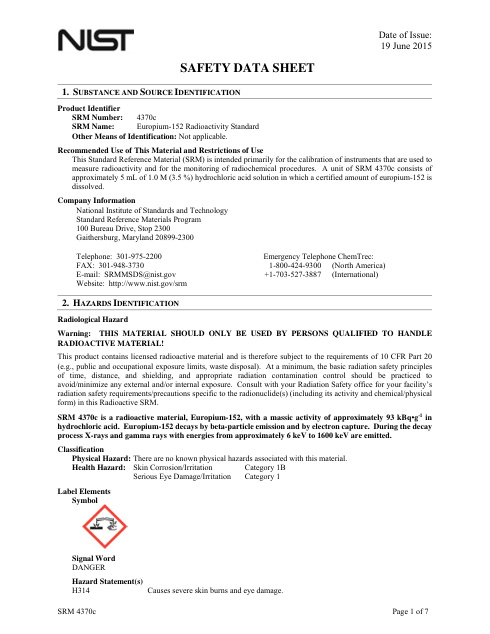
Label Elements Symbol
Signal Word DANGER
Hazard Statement(s) H314 Causes severe skin burns and eye damage.
SRM 4370c Page 1 of 7
Page 2
Precautionary Statement(s) P260 Do not breathe fumes, mists, vapors, or spray. P264 Wash hands thoroughly after handling. P280 Wear protective gloves, protective clothing, and eye protection.
P301+P330+P331 If swallowed: Rinse mouth. Do NOT induce vomiting. P303+P361+P353 If on skin (or hair): Remove immediately all contaminated clothing. Rinse skin with water. P304+P340 If inhaled: Remove person to fresh air and keep comfortable for breathing. P305+P351+P338 If in eyes: Rinse cautiously with water for several minutes. Remove contact lenses, if present and easy to do. Continue rinsing. P310 Immediately call a doctor. P363 Wash contaminated clothing before reuse.
P405 Store locked up.
P501 Dispose of contents and container according to local regulations.
Hazards Not Otherwise Classified: None.
Ingredients(s) with Unknown Acute Toxicity: None.
3. COMPOSITION AND INFORMATION ON HAZARDOUS INGREDIENTS
Substance: Europium-152 in 1 M hydrochloric acid.
Other Designations: Hydrochloric Acid: Muriatic acid; chlorohydric acid; hydrochloride. Europium-152: Not applicable.
Components are listed in compliance with OSHA’s 29 CFR 1910.1200; for the actual values see the NIST Certificate.
Hazardous Component(s) CAS Number EC Number Nominal Mass Concentration (EINECS) (%)
Hydrochloric Acid 7647-01-0 231-595-7 3.5 Europium-152 Not applicable Not applicable 0.000 001 Non-Hazardous Component(s) Water 7732-18-5 231-791-2 >96
4. FIRST AID MEASURES
Description of First Aid Measures:
Inhalation: If adverse effects occur, remove to uncontaminated area. If not breathing, give artificial respiration or oxygen by qualified personnel. Seek immediate medical attention.
Skin Contact: Rinse affected area with copious amounts of water followed by washing with soap and water for at least 15 minutes while removing contaminated clothing. Seek medical attention, if needed.
Eye Contact: Immediately flush eyes, including under the eyelids with copious amounts of water for at least 30 minutes. Seek immediate medical attention.
Ingestion: Contact a poison control center immediately for instructions. Wash out mouth with water, but do not induce vomiting. Seek medical aid at once, and bring the container or label.
Most Important Symptoms/Effects, Acute and Delayed: Acid burns to skin and eyes.
Indication of any immediate medical attention and special treatment needed, if necessary: If any of the above symptoms are present, seek immediate medical attention.
SRM 4370c Page 2 of 7
Page 3
5. FIRE FIGHTING MEASURES
Fire and Explosion Hazards: Negligible fire hazard. See Section 9, “Physical and Chemical Properties” for flammability properties.
Extinguishing Media: Suitable: Use extinguishing media appropriate to the surrounding fire. Unsuitable: None listed.
Specific Hazards Arising from the Chemical: Hydrogen chloride.
Special Protective Equipment and Precautions for Fire-Fighters: Avoid inhalation of material or combustion byproducts. Wear full protective clothing and NIOSH approved self-contained breathing apparatus (SCBA).
NFPA Ratings: (0 = Minimal; 1 = Slight; 2 = Moderate; 3 = Serious; 4 = Severe)
Health = 3 Fire = 0 Reactivity = 0
6. ACCIDENTAL RELEASE MEASURES
This material is radioactive. DO NOT touch spilled material. Immediately notify safety personnel of a spill.
Personal Precautions, Protective Equipment, Methods and Materials for Containment and Clean up:
Radiological Emergency Procedures: The following is a guide for first responders. The following actions, including remediation, should be carried out by qualified individuals. In cases where a life-threatening injury occurs concurrent with personal contamination, treat the injury first. Do not touch damaged packages or spilled material. Handle as a radioactive material spill. In addition to those actions described below, the guidelines in the Emergency Response Guidebook (ERG) provide more specific measures that should be followed.
Spill and Leak Control: Alert and clear everyone from the area affected by the spill. Take actions to limit the spread of contamination. Summon aid.
Damage to the Radioactive Source: Evacuate the immediate vicinity around the source. Place a barrier at a safe distance from the source. Identify area as a radiation hazard.
Suggested Emergency Protective Equipment: Gloves Footwear Covers Outer layer or easily removed protective clothing (as situation requires)
7. HANDLING AND STORAGE
Safe Handling Precautions and Storage: This material is radioactive. Store and handle in accordance with all current regulations and standards. See NRC 10 CFR 20 or state regulations. See Section 8, “Exposure Controls and Personal Protection”.
8. EXPOSURE CONTROLS AND PERSONAL PROTECTION
Exposure Limits:
Europium-152: ALIinh: 20 μCi or 0.74 MBq (bone surface) See NRC 10 CFR 20 Appendix B. ALIing: 800 μCi or 29.6 MBq (bone surface) OSHA: See OSHA 29 CFR and NRC 10 CFR 20. ACGIH: See International Commission on Radiological Protection guidelines.
Hydrochloric Acid: NIOSH (REL): 7 mg/m3; 5 ppm (Ceiling) 75 mg/m3; 50 ppm (IDLH) ACGIH (TLV): 3 mg/m3; 2 ppm (Ceiling) OSHA (PEL): 7 mg/m3; 5 ppm (Ceiling)
SRM 4370c Page 3 of 7
Page 4
Engineering Controls: Provide local exhaust or process enclosure ventilation system. Ensure compliance with applicable exposure limits.
Personal Protection: In accordance with OSHA 29 CFR 1910.132, subpart I, wear appropriate Personal Protective Equipment (PPE) to minimize exposure to this material.
Respiratory Protection: If workplace conditions warrant a respirator, a respiratory protection program that meets OSHA 29CFR 1910.134 must be followed. Refer to NIOSH 42 CFR 84 for applicable certified respirators.
Eye/Face Protection: Wear splash resistant safety goggles with a face shield. An eye wash station should be readily available near areas of use.
Skin and Body Protection: Wear protective clothing to prevent contact with skin. Wear appropriate gloves.
9. PHYSICAL AND CHEMICAL PROPERTIES
Descriptive Properties: Hydrochloric Acid (3.5 % of this SRM)
Appearance (physical state, color, etc.): colorless to yellow liquid Molecular Formula: HCl Molar Mass (g/mol): 36.46 Odor: not available Odor threshold: not available pH: <2 Evaporation rate: >1 Melting point/freezing point (ºC): not available Relative Density (g/L) as specific gravity (water = 1): 1 - 1.2 Vapor Pressure (mmHg): not applicable Vapor Density (air = 1): 0.7 (water) Viscosity (cP): 14 mmHg at 20 ºC Solubility(ies): not available Partition coefficient not available (n-octanol/water): Particle Size: not applicable
Thermal Stability Properties: Autoignition Temperature (ºC): not applicable Thermal Decomposition (ºC): not applicable Initial boiling point and boiling range (ºC): not available Explosive Limits, LEL (Volume %): not applicable Explosive Limits, UEL (Volume %): not applicable Flash Point (ºC): not applicable Flammability (solid, gas): not applicable
10. STABILITY AND REACTIVITY
Reactivity: Stable at normal temperatures and pressure.
Stability: X Stable Unstable
Possible Hazardous Reactions: None listed.
Conditions to Avoid: Avoid contact with combustible materials and incompatible materials.
Incompatible Materials: Cyanides, metals, amines, bases, metal carbide, oxidizing materials, acids, halo carbons, combustible materials, halogens, metal salts.
Fire/Explosion Information: See Section 5, “Fire Fighting Measures”.
Hazardous Decomposition: Hydrogen chloride.
Hazardous Polymerization: Will Occur X Will Not Occur
SRM 4370c Page 4 of 7
Page 5
11. TOXICOLOGICAL INFORMATION
Route of Exposure: X Inhalation X Skin X Ingestion
Symptoms Related to the Physical, Chemical and Toxicological Characteristics: Burning pain and severe corrosive skin damage. Permanent eye damage including blindness could result.
Potential Health Effects (Acute, Chronic and Delayed):
Inhalation: Hydrochloric acid, if inhaled, can damage the mucous membranes and respiratory tract. Short term exposure may cause irritation and inflammation of the upper respiratory tract, coughing, choking, sore throat, shortness of breath, headache, dizziness, and nausea. Long term exposure to acid fumes may cause damage to teeth, bronchial irritation, chronic cough, bronchial pneumonia, and gastrointestinal disturbances.
Skin Contact: Hydrochloric acid can cause severe skin burns. Severity of the damage depends on the concentration and duration of exposure. Effects of acid burns may be delayed.
Eye Contact: Hydrochloric acid can cause severe eye irritation, corneal burns, permanent eye damage, or blindness. Severity of the damage depends on the concentration and duration of exposure.
Ingestion: Ingestion of this material is unlikely under normal conditions of use. If ingested, Hydrochloric acid can cause severe burns and damage to the gastrointestinal tract.
Numerical Measures of Toxicity:
Acute Toxicity: Not classified. Hydrochloric acid, Rat, Inhalation LC50: 3124 ppm (1 h) Rat, Oral LD50: 238 - 277 mg/kg Skin Corrosion/Irritation: This SRM contains 3.5 % Hydrochloric acid and it is classified as Category 1.
Serious Eye Damage/Eye Irritation: This SRM contains 3.5 % Hydrochloric acid and it is classified as Category 1.
Respiratory Sensitization: No data available.
Skin Sensitization: No data available.
Germ Cell Mutagenicity: No data available.
Carcinogenicity: No data available.
Listed as a Carcinogen/Potential Carcinogen Yes X No Hydrochloric acid is not listed by NTP, IARC or OSHA as a carcinogen.
Radiological Hazard: Europium-152 Ionizing radiation is a known carcinogen.
Reproductive Toxicity: Not classified. Hydrochloric acid: Rat, Inhalation TCLo: 450 mg/kg (1 h, prior to copulation 1 d)
Specific Target Organ Toxicity, Single Exposure: No data available.
Specific Target Organ Toxicity, Repeated Exposure: No data available.
Aspiration Hazard: No data available.
12. ECOLOGICAL INFORMATION
Ecotoxicity Data: Component: Hydrochloric Acid Fish Toxicity: Mosquitofish (Gambusia affinis) LC50 (static): 282 mg/L (96 h) Invertebrate: Shore crab (Carcinus maenas) LC50 (mortality): 240 mg/L (48 h) Component: Europium-152 No ecotoxicity data listed.
Persistence and Degradability: No data available.
Bioaccumulative Potential: No data available.
Mobility in Soil: No data available.
Other Adverse Effects: No data available.
SRM 4370c Page 5 of 7
Page 6
13. DISPOSAL CONSIDERATIONS
Waste Disposal: This material is radioactive. Dispose in accordance with all applicable federal, state, and local regulations for RADIOACTIVE materials. See NRC 10 CFR 20 subpart K.
14. TRANSPORTATION INFORMATION
U.S. DOT and IATA: Primary Risk: UN1789, Hydrochloric Acid, Hazard Class 8, Packing group II, Packing instructions 851, Excepted quantities E2. Subsidiary Risk: Not radioactive for shipping purposes.
15. REGULATORY INFORMATION
U.S. Regulations:
CERCLA Sections 102a/103 (40 CFR 302.4): Hydrochloric acid, 5000 lbs (2270 kg) final RQ.
SARA Title III Section 302 (40 CFR 355.30): Hydrochloric acid, 500 lbs (227 kg) TPQ (gas only).
SARA Title III Section 304 (40 CFR 355.40): Hydrochloric acid, 5000 lbs (2270 kg) EPCRA RQ (gas only).
SARA Title III Section 313 (40 CFR 372.65): Hydrochloric acid, 1.0 % de minimis concentration
(acid aerosols including mists, vapors, gas, fog, and other airborne forms of any particle size).
OSHA Process Safety (29 CFR 1910.119): Not regulated.
SARA Title III Sections 311/312 Hazardous Categories (40 CFR 370.21):
ACUTE HEALTH: Yes. CHRONIC HEALTH: No. FIRE: No. REACTIVE: No. PRESSURE: No.
State Regulations: California Proposition 65: No components are regulated.
U.S. TSCA Inventory: Hydrochloric acid is listed.
TSCA 12(b), Export Notification: No components are listed.
Canadian Regulations: WHMIS Information: Not provided for this material.
16. OTHER INFORMATION
Issue Date: 19 June 2015
Sources: ChemAdvisor, Inc., SDS Hydrochloric Acid, 15 December 2014.
CDC; NIOSH; NIOSH Pocket Guide to Chemical Hazards; Department of Health and Human Services (DHHS), Centers for Disease Control and Prevention (CDC), National Institute for Safety and Health; Hydrochloric Acid, 18 November 2010; available at http://www.cdc.gov/niosh/npg/npgd0447.html (accessed Jun 2015).
United States National Library of Medicine, Hazardous Substance Database (HSDB), Hydrochloric Acid; available at http://toxnet.nlm.nih.gov/newtoxnet/hsdb.htm (accessed Jun 2015).
OSHA 29 CFR, Subpart Z, Ionizing radiation, 1910.1096.
NRC 10 CFR 20, Standards for Protection Against Radiation.
DOT 49 CFR 173, Shippers General Requirements for Shipments and Packages.
SRM 4370c Page 6 of 7
Page 7
Key of Acronyms:
ACGIH American Conference of Governmental Industrial NIOSH National Institute for Occupational Safety and Health Hygienists ALI Annual Limit on Intake NIST National Institute of Standards and Technology CAS Chemical Abstracts Service NRC Nuclear Regulatory Commission CEN European Committee for Standardization NTP National Toxicology Program CERCLA Comprehensive Environmental Response, OSHA Occupational Safety and Health Administration Compensation, and Liability Act CFR Code of Federal Regulations PEL Permissible Exposure Limit CPSU Coal Mine Dust Personal Sample Unit RCRA Resource Conservation and Recovery Act DOT Department of Transportation REL Recommended Exposure Limit EC50 Effective Concentration, 50 % RM Reference Material EINECS European Inventory of Existing Commercial Chemical RQ Reportable Quantity Substances EPCRA Emergency Planning and Community Right-to-Know RTECS Registry of Toxic Effects of Chemical Substances Act IARC International Agency for Research on Cancer SARA Superfund Amendments and Reauthorization Act IATA International Air Transportation Agency SCBA Self-Contained Breathing Apparatus IDLH Immediately Dangerous to Life and Health SRM Standard Reference Material ISO International Organization for Standardization STEL Short Term Exposure Limit LC50 Lethal Concentration, 50 % TDLo Toxic Dose Low LD50 Lethal Dose, 50 % TLV Threshold Limit Value LEL Lower Explosive Limit TPQ Threshold Planning Quantity MSDS Material Safety Data Sheet TSCA Toxic Substances Control Act NFPA National Fire Protection Association TWA Time Weighted Average MSHA Mine Safety and Health Administration UEL Upper Explosive Limit WHMIS Workplace Hazardous Materials Information System
Disclaimer: Physical and chemical data contained in this SDS are provided only for use in assessing the hazardous nature of this material. The SDS was prepared carefully, using current references; however, NIST does not certify the data in the SDS. The certified values for this material are given in the NIST Certificate.
Users of this SRM should ensure that the SDS in their possession is current. This can be accomplished by contacting the SRM Program: telephone (301) 975-2200; fax (301) 948-3730; e-mail srmmsds@nist.gov; or via the Internet at http://www.nist.gov/srm.
SRM 4370c Page 7 of 7
Same material — SDS from other publishers
0 documents in this material index. Product grades, hydration states and formulations must be checked in each original PDF.
No other publisher PDF is currently indexed for this material.
Original publisher & company information
National Institute of Standards and Technology
Record publisher: National Institute of Standards and Technology (NIST)
- Brand / organization
- NIST · Standard Reference Materials
- Country / office
- United States
- Website
- nist.gov
- SDS contact email
- SRMMSDS@nist.gov
- Business phone in SDS
- 301-975-2200
- Product / reference
- SRM 4370c
View extracted supplier details
Company Information
National Institute of Standards and Technology
Standard Reference Materials Program
100 Bureau Drive, Stop 2300
Gaithersburg, Maryland 20899-2300
Telephone: 301-975-2200 Emergency Telephone ChemTrec:
FAX: 301-948-3730 1-800-424-9300 (North America)
E-mail: SRMMSDS@nist.gov +1-703-527-3887 (International)
Website: http://www.nist.gov/srmAbout National Institute of Standards and Technology
National Institute of Standards and Technology is the organization attributed as publisher or supplier of this SDS. See the original identification section and official website for its company profile.
Company website & profileDocument source & record history
Original record: Europium-152 Radioactivity Standard - NIST SRM 4370c SDS
Added: 2026-09-13T15:14:34.000Z · Record updated: 2026-09-14T02:29:00.557Z
Original file SHA-256: 48b5a537155f38e9bdb29d9ac8bc2ff3e465dbc3afda4fd7c16396be0b46a417
Original source PDFReport a correction or request a document update
Report incorrect metadata, extraction errors, a newer supplier version or a rights concern. Reports are stored for the site operator to review; a submission does not immediately change a published SDS.
Your report and optional email are stored privately for handling this request. They are not published on this site. Do not include sensitive information.
Official chemical reference sources
Source guide ↗CAS references recorded in this SDS. Properties below describe individual substances, not necessarily the complete product. Check the original SDS for mixtures, grades and hydrate states.
No valid CAS reference is recorded. Search PubChem by chemical name ↗.
GHS provides classification criteria. The applicable hazard classification must be checked for the specific product and jurisdiction.
Suppliers of this material
Companies identified from matching material SDS and checked official product pages. Confirm grade, formulation and availability with the supplier. Missing contacts are not inferred.
No additional supplier has been verified for this material yet.
Search the web for more suppliers
Search this material across search engines
Search query: Europium-152 Radioactivity Standard SDS
Material background on Wikipedia
Look up Europium-152 Radioactivity Standard on Wikipedia. A matching article introduction is displayed when available; product-specific mixtures and reference materials may not have a dedicated article.
Find this material on Wikipedia ↗Introduction from Wikipedia contributors; CC BY-SA 4.0. General material background, not a replacement for this product’s SDS.