MultiHance (CAN) SDS
Original Bracco safety data sheet for MultiHance (CAN). Original PDF retained without modification. Source collected on 2026-09-13.
Free SDS PDF download · No registration or login required.
PDF preview
FREE TO VIEW AND DOWNLOAD · NO REGISTRATION OR LOGIN REQUIRED.
Loading PDF…
Normalized SDS data & document analysis
RESDS derives the results below from this document’s extracted text and the site’s same-material index. Detected codes are not reclassified. “Not detected” does not mean “not present”; confirm the original PDF for safety-critical use.
GHS & transport evidence
Page links show the first occurrence found in extracted text.
SDS 16-section coverage
15 section headings detected; 1 not detected by the parser.
Normalized physical-property units
Calculated conversions from values detected in this SDS; not independent laboratory measurements.
| Property | SDS value | SI conversion | US conversion |
|---|---|---|---|
| Boiling point | 100 °C | 373.15 K | 212.0 °F |
Material & document specifications
- Material
- MultiHance (CAN)
- Product / grade
- Sheet Code: 269
- Publisher
- Bracco
- Region
- United States · OSHA
- File name
- 140_MultiHance_CAN_Bracco_EN.pdf
- Document type
- SDS
- CAS reference(s)
- 127000-20-8
- Language
- English
- Original revision
- 03/05/2022 · Version 4
- Pages
- 8
- File size
- 414 KB
- Downloads
- 17
- Date added
- 2026-09-13
Full document text
8 pages · Original document language
Text extracted from the original PDF. Page order and original wording are preserved; tables and symbols may differ from the PDF layout. Check the original PDF for safety-critical details.
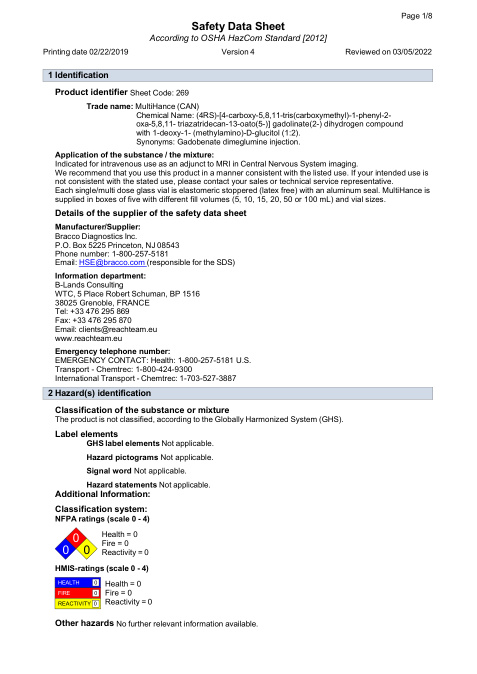
Page 1
Page 1/8 Safety Data Sheet According to OSHA HazCom Standard [2012] Printing date 02/22/2019 Version 4 Reviewed on 03/05/2022
1 Identification
Product identifier Sheet Code: 269
Trade name: MultiHance (CAN) Chemical Name: (4RS)-[4-carboxy-5,8,11-tris(carboxymethyl)-1-phenyl-2- oxa-5,8,11- triazatridecan-13-oato(5-)] gadolinate(2-) dihydrogen compound with 1-deoxy-1- (methylamino)-D-glucitol (1:2). Synonyms: Gadobenate dimeglumine injection. Application of the substance / the mixture: Indicated for intravenous use as an adjunct to MRI in Central Nervous System imaging. We recommend that you use this product in a manner consistent with the listed use. If your intended use is not consistent with the stated use, please contact your sales or technical service representative. Each single/multi dose glass vial is elastomeric stoppered (latex free) with an aluminum seal. MultiHance is supplied in boxes of five with different fill volumes (5, 10, 15, 20, 50 or 100 mL) and vial sizes. Details of the supplier of the safety data sheet
Manufacturer/Supplier: Bracco Diagnostics Inc. P.O. Box 5225 Princeton, NJ 08543 Phone number: 1-800-257-5181 Email: HSE@bracco.com (responsible for the SDS)
Information department: B-Lands Consulting WTC, 5 Place Robert Schuman, BP 1516 38025 Grenoble, FRANCE Tel: +33 476 295 869 Fax: +33 476 295 870 Email: clients@reachteam.eu www.reachteam.eu Emergency telephone number: EMERGENCY CONTACT: Health: 1-800-257-5181 U.S. Transport - Chemtrec: 1-800-424-9300 International Transport - Chemtrec: 1-703-527-3887
2 Hazard(s) identification
Classification of the substance or mixture The product is not classified, according to the Globally Harmonized System (GHS). Label elements GHS label elements Not applicable.
Hazard pictograms Not applicable.
Signal word Not applicable.
Hazard statements Not applicable. Additional Information: Classification system: NFPA ratings (scale 0 - 4) 0 Health = 0 Fire = 0 0 0 Reactivity = 0
HMIS-ratings (scale 0 - 4)
HEALTH 0 Health = 0 FIRE 0 Fire = 0 REACTIVITY 0 Reactivity = 0
Other hazards No further relevant information available.
Page 2
Page 2/8 Safety Data Sheet According to OSHA HazCom Standard [2012] Printing date 02/22/2019 Version 4 Reviewed on 03/05/2022
48.1. Results of PBT and vPvB assessment PBT: Not applicable. vPvB: Not applicable.
3 Composition/information on ingredients
Chemical characterization: Mixtures
Description: Mixture: consisting of the following components.
Hazardous Components: Not applicable. Information on components CAS No. Name Qty. (4 R, S)-[(4-carboxy-5,8,11-tris(carboxymethyl)-1-phenyl-2-oxa-5,8,11- 127000-20-8 triazatridecan-13-oato(5-)) Gadolinite (2-)], dihydrogen, compound with 1-deoxy- 1- 50-100% (methylamino)-D-glucitol (1:2)
4 First-aid measures
Description of first aid measures
General information: No special measures required. After inhalation: Move patient to fresh air, if symptom arise consult a doctor. Supply fresh air. If required, provide artificial respiration. Consult doctor if symptoms persist.
After skin contact: Immediately wash with water and soap and rinse thoroughly. Contact a doctor if symptoms arise. After eye contact: Rinse opened eye for several minutes under running water. If irritation persists get medical attention. After swallowing: Immediately call a doctor. Induce vomiting, only if affected person is fully conscious. Most important symptoms and effects, both acute and delayed No further relevant information available. Indication of any immediate medical attention and special treatment needed No further relevant information available.
5 Fire-fighting measures
Extinguishing media
Suitable extinguishing agents: In case of fire, flood with Water Special hazards arising from the substance or mixture In case of fire, the following can be released: Carbon Dioxide (CO2) In the absence of Oxygen: Carbon Monoxide (CO) Nitrogen Oxides (NxOy) Gadolinium Oxide (Gd2O3) Advice for firefighters Evacuate personnel to an upwind direction, remove unneeded material and cool container(s) with water from a maximum distance. Move container from fire area if you can do it without risk.
Page 3
Page 3/8 Safety Data Sheet According to OSHA HazCom Standard [2012] Printing date 02/22/2019 Version 4 Reviewed on 03/05/2022
Protective equipment: Firefighters should wear adequate personal protective equipment with protection of respiratory tract (selfcontained breathing apparatus) (SCBA). In addition, firefighters should wear flame and chemicals resistant clothing, boots and gloves.
6 Accidental release measures
Personal precautions, protective equipment and emergency procedures Keep away from ignition sources Wear protective equipment. Keep unprotected persons away. Environmental precautions: Do not allow to enter sewers/ surface or ground water. Dilute with plenty of water. Methods and material for containment and cleaning up: Absorb with liquid-binding material. Absorb with liquid-binding material (sand, diatomite, vermiculite) or other non combustible absorbent material. Place spilt material in an appropriate container for disposal. The spill area should be ventilated and decontaminated after material is collected. Reference to other sections See Section 7 for information on safe handling. See Section 8 for information on personal protection equipment. See Section 13 for disposal information. Protective Action Criteria for Chemicals PAC-1: None of the ingredients are listed. PAC-2: None of the ingredients are listed. PAC-3: None of the ingredients are listed.
7 Handling and storage
Precautions for safe handling Avoid splashes or spray in enclosed areas. Avoid contact with the eyes and skin.
Information about protection against explosions and fires: No special measures required. Conditions for safe storage, including any incompatibilities
Requirements to be met by storerooms and receptacles: Store in a cool, dry place in well sealed receptacles.
Information about storage in one common storage facility: Not required.
Further information about storage conditions: Store in cool, dry conditions in well sealed receptacles. Container Requirements: Single dose glass vial is elastomeric stoppered (latex free) with an aluminum seal. MultiHance is supplied in boxes of five with different volumes (5, 10, 15, 20, 50 or 100 mLs) and vial sizes. Storage Conditions: Store at 15-30 °C (59 to 86 °F). Do not freeze. Specific End use(s) No further relevant information available.
8 Exposure controls/personal protection
Control parameters Components with limit values that require monitoring at the workplace: The product does not contain any relevant quantities of materials with critical values that have to be monitored at the workplace.
Additional information: The lists that were valid during the creation were used as basis.
Page 4
Page 4/8 Safety Data Sheet According to OSHA HazCom Standard [2012] Printing date 02/22/2019 Version 4 Reviewed on 03/05/2022 Exposure controls
Personal protective equipment
General protective and hygienic measures: The usual precautionary measures for handling chemicals should be followed. Wash hands before breaks and at the end of work. Ensure good ventilation/exhaustion at the workplace.
Do not eat, drink and smoke while working.
Breathing equipment: Not anticipated for normal clinical environment. In non-routine exposure conditions, where risk assessment shows air-purifying respirators are appropriate, use respirators and components tested and approved under appropriate government standards such as NIOSH (US) or CEN (EU). Self-contained breathing apparatus should be available for emergency use.
Protection of hands:
Protective gloves
The glove material must be impermeable and resistant to the product/ the substance/ the preparation. Due to missing tests no recommendation to the glove material can be given for the product/ the preparation/ the chemical mixture. Selection of the glove material on consideration of the penetration times, rates of diffusion and the degradation
Material of gloves Natural rubber, NR Nitrile rubber, NBR The selection of the suitable gloves does not only depend on the material, but also on further marks of quality and varies from manufacturer to manufacturer. As the product is a preparation of several substances, the resistance of the glove material can not be calculated in advance and has therefore to be checked prior to the application. Penetration time of glove material The exact break through time has to be found out by the manufacturer of the protective gloves and has to be observed.
Eye protection:
Safety glasses
Body protection: Protective work clothing
9 Physical and chemical properties
Information on basic physical and chemical properties
General Information
Appearance: Form: Liquid. Color: Colorless.
Odor: Undistinguishable Odor threshold: Not determined.
pH-value: 6.5 - 7.5
Melting point/Melting range: Not determined.
Boiling point/Boiling range: 100 °C (212 °F)
Flash point: Not determined.
Flammability (solid, gaseous): Not applicable.
Ignition temperature: Not determined.
Page 5
Page 5/8 Safety Data Sheet According to OSHA HazCom Standard [2012] Printing date 02/22/2019 Version 4 Reviewed on 03/05/2022 Decomposition temperature: Not determined.
Auto igniting: Product is not selfigniting.
Danger of explosion: Product does not present an explosion hazard. Not determined. Flammability Limits: Lower: Not Determined. Upper: Not Determined.
Explosion limits: Lower: Not determined. Upper: Not determined.
Oxidizing properties Not determined.
Vapor pressure: Not determined.
Density at 20 °C (68 °F): 1.22 g/cm³ (10.1809 lbs/gal)
Relative density Not determined.
Vapor density > 1.0 ( Greather than Air )
Evaporation rate Not determined.
Solubility in / Miscibility with Water: Fully miscible.
Partition coefficient (n-octanol/water): Not determined.
Viscosity: Dynamic: T = 20 °C, η = 9.2 mPas T = 37 °C, η = 5.3 mPas Kinematic: Not determined. Water: 47.1 % VOC content: 0.00 % Solids content: 0.0 % Other information No further relevant information available.
10 Stability and reactivity
Reactivity No data available. No further relevant information available. Chemical stability
Thermal decomposition / conditions to be avoided: No decomposition if used according to specifications. Possibility of hazardous reactions No dangerous reactions known. Conditions to avoid No further relevant information available. Incompatible materials No further relevant information available. Hazardous decomposition products No dangerous decomposition products known.
11 Toxicological information
Information on toxicological effects
Acute toxicity: LD/LC50 values that are relevant for classification: 127000-20-8 (4 R,S)-[(4-carboxy-5,8,11-tris(carboxymethyl)-1-phenyl-2-oxa-5,8,11-triazatridecan-13- oato(5-)) Gadolinate (2-)], dihydrogen, compound with 1-deoxy-1-(methylamino)-D- glucitol (1:2)
Page 6
Page 6/8 Safety Data Sheet According to OSHA HazCom Standard [2012] Printing date 02/22/2019 Version 4 Reviewed on 03/05/2022
>26,400 mg/kg (Mouse) LD50 >15,800 mg/kg (Rat) Oral 8.3 g/kg (Mouse) LD50 iv 9.7 g/kg (Rat)
Primary irritant effect: on the skin: No irritant effect. Material contains low concentration of components that are mild irritants or possible irritants. It may have potential to cause mild irritation, however, moderate or severe irritation is not expected. on the eye: No irritating effect. No irritation effects reported. However, the product should be considered as a potential irritant.
Sensitization: No sensitizing effects known. The product can cause inflammation in people allergic to gadolinium and its compounds
Other information (about experimental toxicology): By Inhalation: Inhaling small doses of aerosolized material would not be expected to result in symptoms. By Ingestion: Inadvertent ingestion of trace amounts of this material would not be expected to result in symptoms. Germ Cell Mutagenicity: A number of in vitro studies including the Ames test and in vivo mutagenicity studies including the rat micronucleus study did not show mutagenicity for MultiHance. Reproductive Toxicity: Reproduction studies on rats with daily doses of Multihance 20 times the daily human dose showed no evidence of effects on fertility or harm to the fetus. No teratogenic events were evident on intravenous administration of MultiHance to pregnant rabbits and rats. Subacute to Chronic Toxicity: No harmful effects are expected from MultiHance under normal use conditions. Repeated and prolonged exposure to skin may cause skin irritation. MultiHance is not intended. for chronic use and there is no information on the possible adverse effects associated with chronic exposure Additional toxicological information: The product is not subject to classification according to internally approved calculation methods for preparations. When used and handled according to specifications, the product does not have any harmful effects to our experience and the information provided to us. Contact with small quantities of material for short periods is not expected to result in pharmacologic or toxic effects. Co-administration of isosorbide, epirubicin, diazepam, clonazepam, prednisolone and promethazine did not change the acute toxicity of MultiHance after injection in rats. MULTIHANCE is contraindicated in patients with known allergic or hypersensitivity reactions to Gadolinium or any other ingredients including Benzyl Alcohol. MULTIHANCE may possibly potentiate sickle erythrocyte alignment in patients with sickle cell anemia.
Carcinogenic categories IARC (International Agency for Research on Cancer) None of the ingredients are listed. NTP (National Toxicology Program) None of the ingredients are listed. OSHA-Ca (Occupational Safety & Health Administration) None of the ingredients are listed.
12 Ecological information
Toxicity Aquatic toxicity: 127000-20-8 (4 R,S)-[(4-carboxy-5,8,11-tris(carboxymethyl)-1-phenyl-2-oxa-5,8,11-triazatridecan-13- oato(5-)) Gadolinate (2-)], dihydrogen, compound with 1-deoxy-1-(methylamino)-D- glucitol (1:2) LC50 >875 mg/L (Rainbow Trout) EC50 >1,000 mg/L (Activated Sludge) >961 mg/L (Daphnia) EC50/72h >110 mg/L (Selenastrum Capricornutum)
Page 7
Page 7/8 Safety Data Sheet According to OSHA HazCom Standard [2012] Printing date 02/22/2019 Version 4 Reviewed on 03/05/2022 Persistence and degradability No further relevant information available. Bioaccumulative potential No further relevant information available. Mobility in soil No further relevant information available. Additional ecological information
General notes: Water hazard class 1 (Self-assessment): slightly hazardous for water Do not allow undiluted product or large quantities of it to reach ground water, water course or sewage system. Results of PBT and vPvB assessment PBT: Not applicable. vPvB: Not applicable. Other adverse effects No further relevant information available.
13 Disposal considerations
Waste treatment methods Recommendation: Smaller quantities can be disposed of with household waste. Must not be disposed of together with household garbage. Do not allow product to reach sewage system. Reutilise if possible or contact a waste processor for recycling or safe disposal. Uncleaned packagings: Recommendation: Disposal must be made according to official regulations. Packagings that cannot be cleansed are to be disposed of in the same manner as the product. Recommended cleansing agent: Water, if necessary, with cleansing agents.
14 Transport information
UN-Number DOT, ADR, ADN, IMDG, IATA Not applicable. UN proper shipping name DOT, ADR, ADN, IMDG, IATA Not applicable. Transport hazard class(es)
DOT, ADR, ADN, IMDG, IATA Class Not applicable. Packing group DOT, ADR, IMDG, IATA Not applicable. Environmental hazards: Marine pollutant: No Special precautions for user Not applicable. Transport in bulk according to Annex II of MARPOL73/78 and the IBC Code Not applicable.
15 Regulatory information
Safety, health and environmental regulations/legislation specific for the substance or mixture
Sara
Section 355 (extremely hazardous substances):
None of the ingredients are listed.
Section 313 (Specific toxic chemical listings):
None of the ingredients is listed.
Page 8
Page 8/8 Safety Data Sheet According to OSHA HazCom Standard [2012] Printing date 02/22/2019 Version 4 Reviewed on 03/05/2022 Proposition 65 Chemicals known to cause cancer: None of the ingredients is listed. Chemicals known to cause reproductive toxicity for females: None of the ingredients are listed. Chemicals known to cause reproductive toxicity for males: None of the ingredients are listed. Chemicals known to cause developmental toxicity: None of the ingredients are listed.
Carcinogenic categories EPA (Environmental Protection Agency) None of the ingredients are listed. TLV (Threshold Limit Value established by ACGIH) None of the ingredients are listed. NIOSH-Ca (National Institute for Occupational Safety and Health) None of the ingredients are listed.
GHS label elements Not applicable. Hazard pictograms Not applicable. Signal word Not applicable. Hazard statements Not applicable.
16 Other information
This information is based on our present knowledge. However, this shall not constitute a guarantee for any specific product features and shall not establish a legally valid contractual relationship. Training Hints: All persons handling this product should be informed on the existence of the hazard, on any possible risk they might be subjected to and about all required protective measures to prevent such a damage or to reduce the exposition. WARNINGS: Diagnostic agents are intended for use under direction of a physician and/or under the conditions of use described on the label and in the product’s package insert. As a general precaution, personnel who handle drug substances should avoid contact (ingestion, inhalation, skin and eye contact) with these substances. Contact: Bracco Diagnostics Inc. P.O. Box 5225 Princeton, NJ 08543 Date of preparation / last revision 03/05/2022, revision 4 Changes: General revision of the entire Safety Data Sheets, changes in section 3.
Abbreviations and acronyms: RID: Règlement international concernant le transport des marchandises dangereuses par chemin de fer (Regulations Concerning the International Transport of Dangerous Goods by Rail) ICAO: International Civil Aviation Organisation ADR: Accord européen sur le transport des marchandises dangereuses par Route (European Agreement concerning the International Carriage of Dangerous Goods by Road) IMDG: International Maritime Code for Dangerous Goods DOT: US Department of Transportation IATA: International Air Transport Association ACGIH: American Conference of Governmental Industrial Hygienists EINECS: European Inventory of Existing Commercial Chemical Substances ELINCS: European List of Notified Chemical Substances CAS: Chemical Abstracts Service (division of the American Chemical Society) NFPA: National Fire Protection Association (USA) HMIS: Hazardous Materials Identification System (USA) VOC: Volatile Organic Compounds (USA, EU) LC50: Lethal concentration, 50 percent LD50: Lethal dose, 50 percent
Same material — SDS from other publishers
0 documents in this material index. Product grades, hydration states and formulations must be checked in each original PDF.
No other publisher PDF is currently indexed for this material.
Original publisher & company information
- Brand / organization
- Bracco
- Country / office
- United States
- Website
- bracco.com
- SDS contact email
- HSE@bracco.com
- Business phone in SDS
- 1-800-257-5181
- Product / reference
- Sheet Code: 269
Official global site identifies Bracco Group, its Milan registered office and official contact form; no general sales email published on the verified page.
View extracted supplier details
Details of the supplier of the safety data sheet

   Manufacturer/Supplier:
   Bracco Diagnostics Inc.
   P.O. Box 5225 Princeton, NJ 08543
   Phone number: 1-800-257-5181
   Email: HSE@bracco.com (responsible for the SDS)
About Bracco Diagnostics Inc.
Official global site identifies Bracco Group, its Milan registered office and official contact form; no general sales email published on the verified page.
Company website & profileDocument source & record history
Original record: MultiHance (CAN) — Safety Data Sheet — Bracco
Added: 2026-09-13T12:49:21.000Z · Record updated: 2026-09-14T03:03:45.639Z
Original file SHA-256: c3ede1b4fef32b30239628f03d626fae79cc17eedb3ad996241755325cb04c5e
Original source PDFReport a correction or request a document update
Report incorrect metadata, extraction errors, a newer supplier version or a rights concern. Reports are stored for the site operator to review; a submission does not immediately change a published SDS.
Your report and optional email are stored privately for handling this request. They are not published on this site. Do not include sensitive information.
Official chemical reference sources
Source guide ↗CAS references recorded in this SDS. Properties below describe individual substances, not necessarily the complete product. Check the original SDS for mixtures, grades and hydrate states.
CAS 127000-20-8Chemical reference & source links
CAS 127000-20-8 · CAS Common Chemistry ↗ · PubChem ↗
- Chemical name (IUPAC)
- View at PubChem ↗
- Molecular formula
- View at PubChem ↗
- Molecular weight
- View at PubChem ↗
- Selected synonyms
- View at PubChem ↗
- Chemical structure
- Open structure at PubChem ↗
Open this reference to retrieve available PubChem properties. Official lookup links remain available.
ECHA CHEM · search CAS 127000-20-8 ↗ · AICIS inventory · search CAS 127000-20-8 ↗
GHS provides classification criteria. The applicable hazard classification must be checked for the specific product and jurisdiction.
Suppliers of this material
Companies identified from matching material SDS and checked official product pages. Confirm grade, formulation and availability with the supplier. Missing contacts are not inferred.
No additional supplier has been verified for this material yet.
Search the web for more suppliers
Search this material across search engines
Search query: MultiHance (CAN) SDS
Material background on Wikipedia
Look up MultiHance (CAN) on Wikipedia. A matching article introduction is displayed when available; product-specific mixtures and reference materials may not have a dedicated article.
Find this material on Wikipedia ↗Introduction from Wikipedia contributors; CC BY-SA 4.0. General material background, not a replacement for this product’s SDS.