Gadobutrol Monohydrate SDS
Original Cleanchem safety data sheet for Gadobutrol Monohydrate. Original PDF retained without modification. Source collected on 2026-09-13.
Free SDS PDF download · No registration or login required.
PDF preview
FREE TO VIEW AND DOWNLOAD · NO REGISTRATION OR LOGIN REQUIRED.
Loading PDF…
Normalized SDS data & document analysis
RESDS derives the results below from this document’s extracted text and the site’s same-material index. Detected codes are not reclassified. “Not detected” does not mean “not present”; confirm the original PDF for safety-critical use.
GHS & transport evidence
Page links show the first occurrence found in extracted text.
SDS 16-section coverage
16 section headings detected; 0 not detected by the parser.
Same-material SDS comparison
2 indexed documents · 2 publishers · 1 languages · 1 stated revisions · page range 7–8. This compares document metadata, not product equivalence.
Material & document specifications
- Material
- Gadobutrol Monohydrate
- Product / grade
- Gadobutrol Monohydrate
- Publisher
- Cleanchem
- Region
- Not stated
- File name
- 125_Gadobutrol_Monohydrate_Cleanchem_EN.pdf
- Document type
- SDS
- CAS reference(s)
- 198637-52-4
- Language
- English
- Original revision
- Not stated
- Pages
- 8
- File size
- 45 KB
- Downloads
- 15
- Date added
- 2026-09-13
Full document text
8 pages · Original document language
Text extracted from the original PDF. Page order and original wording are preserved; tables and symbols may differ from the PDF layout. Check the original PDF for safety-critical details.
Page 1
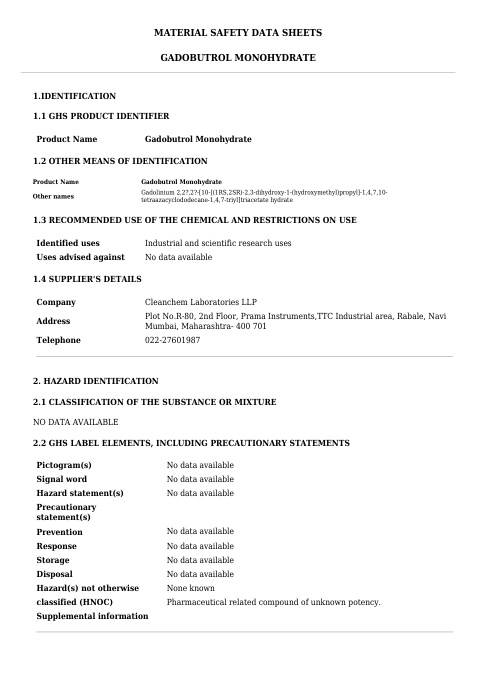
MATERIAL SAFETY DATA SHEETS
GADOBUTROL MONOHYDRATE
1.IDENTIFICATION
1.1 GHS PRODUCT IDENTIFIER
Product Name Gadobutrol Monohydrate
1.2 OTHER MEANS OF IDENTIFICATION
Product Name Gadobutrol Monohydrate Gadolinium 2,2?,2?-[10-[(1RS,2SR)-2,3-dihydroxy-1-(hydroxymethyl)propyl]-1,4,7,10- Other names tetraazacyclododecane-1,4,7-triyl]triacetate hydrate
1.3 RECOMMENDED USE OF THE CHEMICAL AND RESTRICTIONS ON USE
Identified uses Industrial and scientific research uses Uses advised against No data available
1.4 SUPPLIER'S DETAILS

 Company               Cleanchem Laboratories LLP
                              Plot No.R-80, 2nd Floor, Prama Instruments,TTC Industrial area, Rabale, Navi
 Address
                       Mumbai, Maharashtra- 400 701
 Telephone              022-27601987
2. HAZARD IDENTIFICATION
2.1 CLASSIFICATION OF THE SUBSTANCE OR MIXTURE
NO DATA AVAILABLE
2.2 GHS LABEL ELEMENTS, INCLUDING PRECAUTIONARY STATEMENTS
Pictogram(s) No data available Signal word No data available Hazard statement(s) No data available Precautionary statement(s) Prevention No data available Response No data available Storage No data available Disposal No data available Hazard(s) not otherwise None known classified (HNOC) Pharmaceutical related compound of unknown potency. Supplemental information
Page 2
3. COMPOSITION/INFORMATION ON INGREDIENTS
3.1 SUBSTANCES
NO DATA AVAILABLE
MOLECULAR FORMULA: C18H31GDN4O9 : H2O MOLECULAR WEIGHT: 604.7 : 18.0
Chemical name Common names and synonyms CAS number
Gadolinium 2,2?,2?-[10-[(1RS,2SR)-2,3- dihydroxy-1- NA 198637-52-4 (hydroxymethyl)propyl]-1,4,7,10- tetraazacyclododecane-1,4,7- triyl]triacetate hydrate
4. FIRST-AID MEASURES
4.1 DESCRIPTION OF NECESSARY FIRST-AID MEASURES
General advice
Medical attention is required. Consult a doctor. Show this safety data sheet (SDS) to the doctor in attendance
Inhalation
If breathing is difficult, remove to fresh air and keep at rest in a position comfortable for breathing. Call a physician if symptoms develop or persist.
Following skin contact
Take off contaminated clothing immediately. Wash off with soap and plenty of water. Consult a doctor.
Following eye contact
Rinse with pure water for at least 15 minutes. Consult a doctor.
Following ingestion
Rinse mouth with water. Do not induce vomiting. Never give anything by mouth to an unconscious person. Call a doctor or Poison Control Center immediately.
4.2 MOST IMPORTANT SYMPTOMS/EFFECTS, ACUTE AND DELAYED
may cause physiological effects
Page 3
4.3 INDICATION OF IMMEDIATE MEDICAL ATTENTION AND SPECIAL TREATMENT NEEDED, IF NECESSARY
Treat symptomatically
5. FIRE-FIGHTING MEASURES
5.1 EXTINGUISHING MEDIA
Suitable extinguishing media
Water, use dry chemical, carbon dioxide or alcohol-resistant foam.
5.2 SPECIFIC HAZARDS ARISING FROM THE CHEMICAL
Carbon oxides, Nitrogen oxides, Hydrogen fluoride, Sulphur oxides
5.3 SPECIAL PROTECTIVE ACTIONS FOR FIRE-FIGHTERS
Wear self-contained breathing apparatus for fire fighting if necessary.
6. ACCIDENTAL RELEASE MEASURES
6.1 Personal precautions, protective equipment and emergency procedures
Keep unnecessary personnel away. Wear appropriate personal protective equipment. Avoid
Inhalation of dust from the spilled material. Do not touch damaged containers or spilled material
Unless wearing appropriate protective clothing. Ensure adequate ventilation.
6.2 ENVIRONMENTAL PRECAUTIONS
Avoid discharge into drains, water courses or onto the ground.
6.3 METHODS AND MATERIALS FOR CONTAINMENT AND CLEANING UP
Avoid the generation of dusts during clean-up. Sweep up or vacuum up spillage and collect in
Suitable container for disposal. Clean surface thoroughly to remove residual contamination. For
Waste disposal
7. HANDLING AND STORAGE
7.1 Precautions for safe handling
Avoid contact with skin and eyes. Avoid formation of dust and aerosols. Provide appropriate exhaust ventilation at places where dust is formed
Page 4
7.2 CONDITIONS FOR SAFE STORAGE, INCLUDING ANY INCOMPATIBILITIES
Keep container tightly closed in a dry and well-ventilated place
Keep in a dry place.
Storage conditions: Refrigernator
8. EXPOSURE CONTROLS/PERSONAL PROTECTION
8.1 Control parametersg
Occupational Exposure limit values
No exposure limits noted for ingredient
8.2 Appropriate engineering controls
A laboratory fume hood or other appropriate form of local exhaust ventilations
8.3 Individual protection measures, such as personal protective equipment (PPE)
Eye/face protection
Wear tightly fitting safety goggles with side-shields conforming to EN 166(EU) or NIOSH (US).
Skin protection
Wear fire/flame resistant and impervious clothing. Handle with gloves. Gloves must be inspected prior to use. Wash and dry hands. The selected protective gloves have to satisfy the specifications of EU Directive 89/686/EEC and the standard EN 374 derived from it.
Respiratory protection
Recommended respirators are NIOSH-approved N100 or CEN-approved FFP3 particulate respirators. These are to be only used as
a backup to local exhaust ventilation or other engineering controls. If the respirator is the only means of protection, a full-face
supplied air respirator must be used
Thermal hazards
Wear appropriate thermal protective clothing, when necessary
9. PHYSICAL AND CHEMICAL PROPERTIES
Physical state Colour
Page 5
Odour Melting point/ freezing point Boiling point or initial boiling point and boiling range Flammability Lower and upper explosion limit / flammability limit Flash point NA Auto-ignition temperature NA Decomposition NA temperature pH Kinematic viscosity Solubility Partition coefficient n- octanol/water Vapour pressure NA Density and/or relative NA density Relative vapour density NA Particle characteristics NA
10. STABILITY AND REACTIVITY
10.1 Reactivity
The product is stable and non-reactive under normal conditions of use, storage and transport
10.2 Chemical stability
Material is stable under normal conditions
10.3 Possibility of hazardous reactions
No dangerous reaction known under conditions of normal use
10.4 Conditions to avoid
Contact with incompatible materials
10.5 Incompatible materials
Strong oxidizing agents
10.6 Hazardous decomposition products
Irritating and/or toxic fumes or gases. Emits toxic fumes under fire conditions.
Page 6
11. TOXICOLOGICAL INFORMATION
Acute toxicity
ORAL LD50: NO DATA AVAILABLE INHALATION: NO DATA AVAILABLE DERMAL: NO DATA AVAILABLE
Skin corrosion/irritation
No data available
Serious eye damage/irritation
No data available
Respiratory or skin sensitization
No data available
Germ cell mutagenicity
No data available
Carcinogenicity
No data available
Reproductive toxicity
No data available
STOT-single exposure
No data available
STOT-repeated exposure
No data available
Aspiration hazard
Based on available data, the classification criteria are not met
Page 7
12. ECOLOGICAL INFORMATION
12.1 Ecotoxicity
There are no data on the ecotoxicity of this product.
12.2 Persistence and degradability
No data available
12.3 Bioaccumulative potential
No data available
12.4 Mobility in soil
No data available
12.5 Other adverse effects
No data available
13. DISPOSAL CONSIDERATIONS
13.1 Disposal methods
Product
Product may be burned in an incinerator equipped with afterburner and scrubber. Excess and expired materials are to be offered to a licensed hazardous material disposal company. Ensure that all Federal and Local regulations regarding the disposal and destruction of this material are followed.
Contaminated packaging Dispose of as above.
14. TRANSPORT INFORMATION
14.1 DOT: Not regulated as dangerous goods
IATA: Not regulated as dangerous goods
14.2 UN Proper Shipping Name
ADR/RID: No data available IMDG: No data available IATA: No data available
14.2 UN Proper Shipping Name
ADR/RID: No data available IMDG: No data available IATA: No data available
14.3 Transport hazard class(es)
ADR/RID: No data available IMDG: No data available IATA: No data available
Page 8
14.4 Packing group, if applicable
ADR/RID: No data available IMDG: No data available IATA: No data available
14.5 Environmental hazards
ADR/RID: No IMDG: No IATA: No
14.6 Special precautions for user
No data available
14.7 Transport in bulk according to Annex II of MARPOL 73/78 and the IBC Code
It is the shipper's responsibility to determine the correct transport classification at the time of shipment
15. Regulatory information
This product is not known to be a "Hazardous Chemical" as defined by the US federal regulations OSHA Hazard Communication Standard, 29 CFR 1910.1200.
TSCA Section 12(b) Export Notification (40 CFR 707, Subpt. D)
Not regulated.
European Union
Not regulated.
OSHA Specifically Regulated Substances (29 CFR 1910.1001-1052)
Not regulated.
16. OTHER INFORMATION
Abbreviations and acronyms
CAS: CHEMICAL ABSTRACTS SERVICE IATA: INTERNATIONAL AIR TRANSPORTATION ASSOCIATION LD50: LETHAL DOSE 50%
Disclaimer: The above information is believed to be correct but does not purport to be all inclusive and shall be used only as a guide. The information in this document is based on the present state of our knowledge and is applicable to the product with regard to appropriate safety precautions. It does not represent any guarantee of the properties of the product. We as supplier shall not be held liable for any damage resulting from handling or from contact with the above product
Same material — SDS from other publishers
1 documents in this material index. Product grades, hydration states and formulations must be checked in each original PDF.
Original publisher & company information
- Brand / organization
- Cleanchem
- Country / office
- Not stated
- Website
- cleanchemlab.com
- SDS contact email
- Not stated in SDS
- Business phone in SDS
- 022-27601987
- Product / reference
- Gadobutrol Monohydrate
Official site lists Cleanchem India, USA and Bangladesh locations and the general enquiries email.
View extracted supplier details
1.4 SUPPLIER'S DETAILS
Company Cleanchem Laboratories LLP
Plot No.R-80, 2nd Floor, Prama Instruments,TTC Industrial area, Rabale, Navi
Address
Mumbai, Maharashtra- 400 701
Telephone 022-27601987About Cleanchem Laboratories LLP
Official site lists Cleanchem India, USA and Bangladesh locations and the general enquiries email.
Company website & profileDocument source & record history
Original record: Gadobutrol Monohydrate — Safety Data Sheet — Cleanchem
Added: 2026-09-13T12:48:18.000Z · Record updated: 2026-09-14T03:03:45.639Z
Original file SHA-256: b1cc84c96eef52fad8cfc33ce3a0ef906453b663c0c533f7a296ba1b04f9a6e9
Original source PDFReport a correction or request a document update
Report incorrect metadata, extraction errors, a newer supplier version or a rights concern. Reports are stored for the site operator to review; a submission does not immediately change a published SDS.
Your report and optional email are stored privately for handling this request. They are not published on this site. Do not include sensitive information.
Official chemical reference sources
Source guide ↗CAS references recorded in this SDS. Properties below describe individual substances, not necessarily the complete product. Check the original SDS for mixtures, grades and hydrate states.
CAS 198637-52-4Chemical reference & source links
CAS 198637-52-4 · CAS Common Chemistry ↗ · PubChem ↗
- Chemical name (IUPAC)
- View at PubChem ↗
- Molecular formula
- View at PubChem ↗
- Molecular weight
- View at PubChem ↗
- Selected synonyms
- View at PubChem ↗
- Chemical structure
- Open structure at PubChem ↗
Open this reference to retrieve available PubChem properties. Official lookup links remain available.
ECHA CHEM · search CAS 198637-52-4 ↗ · AICIS inventory · search CAS 198637-52-4 ↗
GHS provides classification criteria. The applicable hazard classification must be checked for the specific product and jurisdiction.
Suppliers of this material
Companies identified from matching material SDS and checked official product pages. Confirm grade, formulation and availability with the supplier. Missing contacts are not inferred.
| Company | Country | Website | Phone | Evidence | |
|---|---|---|---|---|---|
| TCI EUROPE N.V. | Belgium | Website | globalbusiness@TCIchemicals.com | +32 (0)3 735 07 00 | Source Same material SDS; verify grade and availability |
Search the web for more suppliers
Search this material across search engines
Search query: Gadobutrol Monohydrate SDS
Material background on Wikipedia
Look up Gadobutrol Monohydrate on Wikipedia. A matching article introduction is displayed when available; product-specific mixtures and reference materials may not have a dedicated article.
Find this material on Wikipedia ↗Introduction from Wikipedia contributors; CC BY-SA 4.0. General material background, not a replacement for this product’s SDS.