OREAS 146 rare-earth and yttrium certified reference material (covered by OREAS RADA SDS) SDS
Collected by RESDS. Original publisher PDF retained. Original OREAS RADA SDS covering listed reference materials including OREAS 146. The SDS hazardous-component table is preserved as published; rare-earth and yttrium linkage comes from the official OREAS 146 product record. Revision 31 May 2024. Publication authorization confirmed by the RESDS site owner on 14 September 2026.
PDF preview
FREE TO VIEW AND DOWNLOAD · NO REGISTRATION OR LOGIN REQUIRED.
Loading PDF…
Normalized SDS data & document analysis
RESDS derives the results below from this document’s extracted text and the site’s same-material index. Detected codes are not reclassified. “Not detected” does not mean “not present”; confirm the original PDF for safety-critical use.
GHS & transport evidence
Page links show the first occurrence found in extracted text.
SDS 16-section coverage
15 section headings detected; 1 not detected by the parser.
Material & document specifications
- Material
- OREAS 146 rare-earth and yttrium certified reference material (covered by OREAS RADA SDS)
- Product / grade
- Not stated
- Publisher
- Ore Research & Exploration Pty Ltd (OREAS)
- Region
- Australia
- File name
- oreas-rada-5199.pdf
- Document type
- SDS
- Language
- English
- Original revision
- 2024-05-31
- Pages
- 6
- File size
- 441 KB
- Downloads
- 6
- Date added
- 2026-09-14
Why this document matches
Composition is not fully established. An unlisted element is not proof of absence.
Other documented elements: Al, Fe
Full document text
6 pages · Original document language
Text extracted from the original PDF. Page order and original wording are preserved; tables and symbols may differ from the PDF layout. Check the original PDF for safety-critical details.
Page 1
Page 1 of 6
                             Safety Data Sheet
                                          according to WHS Regulations

           Print date: 05.06.2024                                                             Revision date: 31.05.2024

        1 Identification

           Product Name: OREAS (RADA)

            Other Means of Identification: Mixture

            Other Name:
                 All products are branded 'OREAS' followed by a number ± letter
            100a, 101a, 101b, 102a, 104, 105, 106, 120, 121, 122, 123, 124, 146

         Recommended Use of the Chemical and Restriction on Use: Reference material

             Details of Manufacturer or Importer:
           Ore Research & Exploration Pty Ltd
          37A Hosie Street
            Bayswater North VIC 3153

          Phone Number: 03 9729 0333
Emergency telephone number: 03 9729 0333
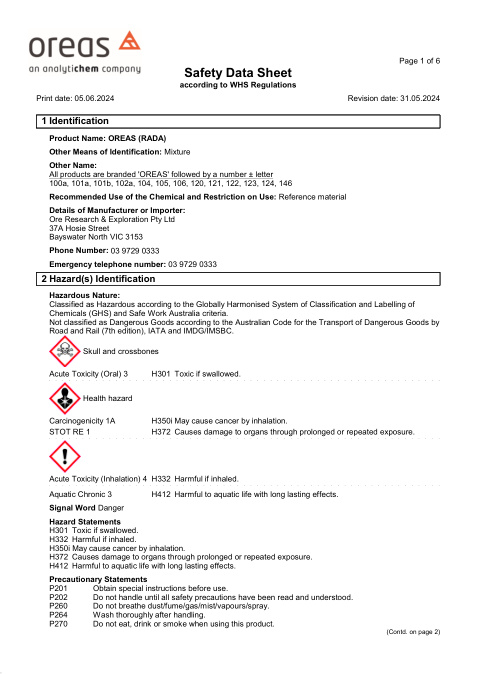
2 Hazard(s) Identification
Hazardous Nature: Classified as Hazardous according to the Globally Harmonised System of Classification and Labelling of Chemicals (GHS) and Safe Work Australia criteria. Not classified as Dangerous Goods according to the Australian Code for the Transport of Dangerous Goods by Road and Rail (7th edition), IATA and IMDG/IMSBC.
Skull and crossbones
Acute Toxicity (Oral) 3 H301 Toxic if swallowed.
Health hazard
Carcinogenicity 1A H350i May cause cancer by inhalation. STOT RE 1 H372 Causes damage to organs through prolonged or repeated exposure.
Acute Toxicity (Inhalation) 4 H332 Harmful if inhaled.
Aquatic Chronic 3 H412 Harmful to aquatic life with long lasting effects.
Signal Word Danger
Hazard Statements H301 Toxic if swallowed. H332 Harmful if inhaled. H350i May cause cancer by inhalation. H372 Causes damage to organs through prolonged or repeated exposure. H412 Harmful to aquatic life with long lasting effects.
Precautionary Statements P201 Obtain special instructions before use. P202 Do not handle until all safety precautions have been read and understood. P260 Do not breathe dust/fume/gas/mist/vapours/spray. P264 Wash thoroughly after handling. P270 Do not eat, drink or smoke when using this product. (Contd. on page 2)
58.0.1
Page 2
Page 2 of 6 Safety Data Sheet according to WHS Regulations
Print date: 05.06.2024 Revision date: 31.05.2024
Product Name: OREAS (RADA)
(Contd. of page 1) P271 Use only outdoors or in a well-ventilated area. P273 Avoid release to the environment. P280 Wear protective gloves/protective clothing/eye protection/face protection. P301+P310 IF SWALLOWED: Immediately call a POISON CENTER/ doctor. P321 Specific treatment (see on this label). P330 Rinse mouth. P304+P340 IF INHALED: Remove victim to fresh air and keep at rest in a position comfortable for breathing. P308+P313 IF exposed or concerned: Get medical advice/attention. P312 Call a POISON CENTER/doctor if you feel unwell. P314 Get medical advice/attention if you feel unwell. P405 Store locked up. P501 Dispose of contents/container in accordance with local/regional/national/international regulations.
3 Composition and Information on Ingredients
Chemical Characterization: Mixtures Description: Mixture of substances listed below with nonhazardous additions. Hazardous Components: CAS: 7631-86-9 Silica 30-82% Carcinogenicity 1A, H350i; STOT RE 1, H372 CAS: 7440-50-8 Copper 0.01-<3% Aquatic Chronic 2, H411 CAS: 7440-61-1 Uranium <0.2% Acute Toxicity (Oral) 1, H300; Acute Toxicity (Inhalation) 1, H330; STOT RE 2, H373
Non Hazardous Components: CAS: 1309-37-1 Iron(III) oxide 1-10% CAS: 12001-26-2 Potassium Aluminum Silicate 1-10%
4 First Aid Measures
Inhalation: If inhaled, remove to fresh air. Seek medical attention if breathing problems develop.
Skin Contact: In case of skin contact, immediately remove contaminated clothing and wash affected areas with water and soap. Seek medical attention if irritation occurs.
Eye Contact: In case of eye contact, rinse with water for several minutes, including under eyelids. Remove contact lenses, if present and easy to do. Continue rinsing for at least 15 minutes. Seek medical attention if irritation persists.
Ingestion: If swallowed, do not induce vomiting. Immediately rinse mouth with water. Never give anything by mouth to an unconscious person. Seek immediate medical attention.
Symptoms Caused by Exposure: Inhalation: Harmful if inhaled. May cause cancer by inhalation. May cause respiratory irritation. Skin Contact: May cause skin irritation. Eye Contact: May cause eye irritation. Ingestion: Toxic if swallowed. May cause gastrointestinal irritation, nausea, diarrhoea and vomiting.
5 Fire Fighting Measures
Suitable Extinguishing Media: Use fire extinguishing methods suitable to surrounding conditions.
Specific Hazards Arising from the Chemical: Hazardous combustion products include toxic gases. Product is not flammable. Containers close to fire should be removed only if safe to do so. Use water spray to cool fire exposed containers. (Contd. on page 3)
58.0.1
Page 3
Page 3 of 6 Safety Data Sheet according to WHS Regulations
Print date: 05.06.2024 Revision date: 31.05.2024
Product Name: OREAS (RADA)
(Contd. of page 2) Prevent run-off from fire fighting entering drains or water courses.
Special Protective Equipment and Precautions for Fire Fighters: When fighting a major fire wear self-contained breathing apparatus and protective equipment.
6 Accidental Release Measures
Personal Precautions, Protective Equipment and Emergency Procedures: Wear approved dust/particulate filter respirator and full protective clothing. Evacuate all non-essential personnel from affected area. Do not breathe dust. Ensure adequate ventilation. Avoid generating dust.
Environmental Precautions: In the event of a major spill, prevent spillage from entering drains or water courses. Inform respective authorities in case of seepage into water course or sewage system.
Methods and Materials for Containment and Cleaning Up: Stop leak if safe to do so and sweep granules into a pile and shovel into drums for subsequent disposal. Avoid generating dust. Provide adequate ventilation. Decontaminate spill area with detergent and water.
7 Handling and Storage
Precautions for Safe Handling: Use of safe work practices are recommended to avoid eye or skin contact and inhalation of dust. Food, beverages and tobacco products should not be stored or consumed where this material is in use. Always wash hands before smoking, eating, drinking or using the toilet. Wash contaminated clothing and other protective equipment before storage or re-use. Provide eyewash fountains and safety showers in close proximity to points of potential exposure.
Conditions for Safe Storage: Store in a cool, dry and well ventilated area. Keep container tightly closed when not in use. Keep away from strong oxidising agents such as fluorine, bromine trifluoride, chlorine trifluoride, manganese trifluoride, oxygen difluoride, and ozone; acids such as hydrofluoric acid, and hydrochloric acid; strong alkalis; vinyl acetate, and xenon hexafluoride.
8 Exposure Controls and Personal Protection
Exposure Standards: CAS: 7631-86-9 Silica WES TWA: 2 mg/m³ CAS: 1309-37-1 Iron(III) oxide WES TWA: 5 mg/m³ CAS: 12001-26-2 Potassium Aluminum Silicate WES TWA: 2.5 mg/m³ CAS: 7440-50-8 Copper WES TWA: 1* 0.2** mg/m³ *dust & mists (as Cu) **fume CAS: 7440-61-1 Uranium WES STEL: 0.6 mg/m³ TWA: 0.2 mg/m³ as U
Engineering Controls: Ensure adequate ventilation of the working area, keeping airborne concentrations below occupational exposure standards.
Respiratory Protection: Where an inhalation risk exists, wear approved particulate respirator (filter type P). At high dust levels, wear a powered air purifying respirator (PAPR) with P3 filter or an air-line respirator or a full-face P3 (particulate) respirator. See Australian/New Zealand Standards AS/NZS 1715 and 1716 for more information. (Contd. on page 4)
58.0.1
Page 4
Page 4 of 6 Safety Data Sheet according to WHS Regulations
Print date: 05.06.2024 Revision date: 31.05.2024
Product Name: OREAS (RADA)
(Contd. of page 3)
Skin Protection: Protective gloves. See Australian/New Zealand Standard AS/NZS 2161 for more information. When selecting gloves for use against certain chemicals, the degradation resistance, permeation rate and permeation breakthrough time should be considered. Occupational protective clothing (depending on conditions in which it has to be used, in particular as regards the period for which it is worn, which shall be determined on the basis of the seriousness of the risk, the frequency of exposure to the risk, the characteristics of the workstation of each worker and the performance of the protective clothing). See Australian/New Zealand Standard AS/NZS 4501 for more information.
Eye and Face Protection: Eye and face protectors for protection against dust. See Australian/New Zealand Standard AS/NZS 1337 for more information.
9 Physical and Chemical Properties
Appearance: Form: Powder Colour: Pale grey to tan to dark grey Odour: None Odour Threshold: No information available pH-Value: Not applicable Melting point/freezing point: No information available Initial Boiling Point/Boiling Range: No information available No information available Flash Point: Not applicable Flammability (solid, gas): No information available Auto-ignition Temperature: No information available Decomposition Temperature: No information available Explosion Limits: Lower: No information available Upper: No information available Vapour Pressure: Not applicable Density: No information available Evaporation Rate: Not applicable Solubility in Water: Insoluble Partition Coefficient (n-octanol/water): No information available Viscosity: No information available
10 Stability and Reactivity
Possibility of Hazardous Reactions: No dangerous reactions known under conditions of normal use.
Chemical Stability: Stable at ambient temperature and under normal conditions of storage and use.
Conditions to Avoid: No further relevant information available.
Incompatible Materials: Strong oxidising agents such as fluorine, bromine trifluoride, chlorine trifluoride, manganese trifluoride, oxygen difluoride, and ozone; acids such as hydrofluoric acid, and hydrochloric acid; strong alkalis; vinyl acetate, and xenon hexafluoride.
Hazardous Decomposition Products: Toxic gases. (Contd. on page 5)
58.0.1
Page 5
Page 5 of 6 Safety Data Sheet according to WHS Regulations
Print date: 05.06.2024 Revision date: 31.05.2024
Product Name: OREAS (RADA)
(Contd. of page 4)
11 Toxicological Information
Toxicity: LD50/LC50 Values: CAS: 7631-86-9 Silica Oral LD50 10,000 mg/kg (Rattus norvegicus (rat)) CAS: 1309-37-1 Iron(III) oxide Oral LD50 >15,000 mg/kg (Rattus norvegicus (rat)) CAS: 7440-50-8 Copper Oral LD50 >2,000 mg/kg (Rattus norvegicus (rat))
Acute Health Effects Inhalation: Harmful if inhaled. May cause cancer by inhalation. May cause respiratory irritation. Skin: May cause skin irritation. Eye: May cause eye irritation. Ingestion: Toxic if swallowed. May cause gastrointestinal irritation, nausea, diarrhoea and vomiting.
Skin Corrosion / Irritation: Based on classification principles, the classification criteria are not met.
Serious Eye Damage / Irritation: Based on classification principles, the classification criteria are not met.
Respiratory or Skin Sensitisation: Based on classification principles, the classification criteria are not met.
Germ Cell Mutagenicity: Based on classification principles, the classification criteria are not met.
Carcinogenicity: Crystalline silica and uranium are classified by IARC as Group 1 - Carcinogenic to humans. May cause cancer by inhalation.
Reproductive Toxicity: Based on classification principles, the classification criteria are not met.
Specific Target Organ Toxicity (STOT) - Single Exposure: Based on classification principles, the classification criteria are not met.
Specific Target Organ Toxicity (STOT) - Repeated Exposure: Causes damage to organs through prolonged or repeated exposure.
Aspiration Hazard: Based on classification principles, the classification criteria are not met.
Chronic Health Effects: No data associated with long term health effects.
Existing Conditions Aggravated by Exposure: No data available.
12 Ecological Information
Ecotoxicity:
Aquatic toxicity: Harmful to aquatic life with long lasting effects. CAS: 7440-50-8 Copper EC50/48 h 0.792 mg/l (Daphnia magna (water flea)) EC50/72 h 0.333 mg/l (Algae) LC50/96 h 0.0068-0.0156 mg/l (Pimephales promelas (fathead minnow))
Persistence and Degradability: No data available on finished product.
Bioaccumulative Potential: No data available on finished product.
Mobility in Soil: No data available on finished product. (Contd. on page 6)
58.0.1
Page 6
Page 6 of 6 Safety Data Sheet according to WHS Regulations
Print date: 05.06.2024 Revision date: 31.05.2024
Product Name: OREAS (RADA)
(Contd. of page 5)
Other adverse effects: No further relevant information available.
13 Disposal Considerations
Disposal Methods and Containers: Dispose according to applicable local and state government regulations.
Special Precautions for Landfill or Incineration: Please consult your state Land Waste Management Authority for more information.
14 Transport Information
UN Number Not regulated
Proper Shipping Name Not regulated
Dangerous Goods Class Not regulated
Packing Group: Not regulated
15 Regulatory Information
Australian Inventory of Industrial Chemicals: All ingredients are listed.
Standard for the Uniform Scheduling of Medicines and Poisons (SUSMP) - Poison Schedule: Not a scheduled poison.
16 Other Information
Date of Preparation or Last Revision: 31.05.2024
Prepared by: MSDS.COM.AU Pty Ltd www.msds.com.au
Abbreviations and acronyms: GHS: Globally Harmonised System of Classification and Labelling of Chemicals CAS: Chemical Abstracts Service (division of the American Chemical Society) LC50: Lethal concentration, 50 percent LD50: Lethal dose, 50 percent IARC: International Agency for Research on Cancer STEL: Short Term Exposure Limit TWA: Time Weighted Average NES: National Exposure Standard (Safe Work Australia - Workplace Exposure Standards For Airborne Contaminants) Acute Toxicity (Oral) 1: Acute toxicity – Category 1 Acute Toxicity (Oral) 3: Acute toxicity – Category 3 Acute Toxicity (Inhalation) 4: Acute toxicity – Category 4 Carcinogenicity 1A: Carcinogenicity – Category 1Ai STOT RE 1: Specific target organ toxicity (repeated exposure) – Category 1 STOT RE 2: Specific target organ toxicity (repeated exposure) – Category 2 Aquatic Chronic 2: Hazardous to the aquatic environment, long-term (Chronic). Category 2 Aquatic Chronic 3: Hazardous to the aquatic environment, long-term (Chronic). Category 3
Disclaimer This SDS is prepared in accord with the Safe Work Australia document “Code of Practice for the Preparation of Safety Data Sheets for Hazardous Chemicals - July 2020”. The information contained in this safety data sheet is provided in good faith and is believed to be accurate at the date of issuance. Ore Research & Exploration Pty Ltd makes no representation of the accuracy or comprehensiveness of the information and to the full extent allowed by law excludes all liability for any loss or damage related to the supply or use of the information in this material safety data sheet. MSDS.COM.AU Pty Ltd is not in a position to warrant the accuracy of the data herein. The user is cautioned to make their own determinations as to the suitability of the information provided to the particular circumstances in which the product is used.
58.0.1
Same material — SDS from other publishers
0 documents in this material index. Product grades, hydration states and formulations must be checked in each original PDF.
No other publisher PDF is currently indexed for this material.
Original publisher & company information
Ore Research & Exploration Pty Ltd (OREAS)
- Brand / organization
- OREAS
- Country / office
- Not stated
- Website
- oreas.com
- SDS contact email
- Not stated in SDS
- Business phone in SDS
- 03 9729 0333
- Product / reference
- OREAS 146 rare-earth and yttrium certified reference material (covered by OREAS RADA SDS)
Official OREAS contact page verifies the legal company name, headquarters and sales email.
View extracted supplier details
Page 1 of 6
Safety Data Sheet
according to WHS Regulations
Print date: 05.06.2024 Revision date: 31.05.2024
1 Identification
Product Name: OREAS (RADA)
Other Means of Identification: Mixture
Other Name:
All products are branded 'OREAS' followed by a number ± letter
100a, 101a, 101b, 102a, 104, 105, 106, 120, 121, 122, 123, 124, 146
Recommended Use of the Chemical and Restriction on Use: Reference material
Details of Manufacturer or Importer:
Ore Research & Exploration Pty Ltd
37A Hosie Street
Bayswater North VIC 3153
Phone Number: 03 9729 0333About Ore Research & Exploration Pty Ltd (OREAS)
Official OREAS contact page verifies the legal company name, headquarters and sales email.
Company website & profileDocument source & record history
Original record: OREAS RADA Reference Materials Including OREAS 146 – Safety Data Sheet
Added: 2026-09-14T01:00:03.000Z · Record updated: 2026-09-14T04:25:19.286Z
Original file SHA-256: 0ed7b1a12cfe384a607719aaa54629268d6882b3c4de74cf92804d2c39bda736
Original source PDFReport a correction or request a document update
Report incorrect metadata, extraction errors, a newer supplier version or a rights concern. Reports are stored for the site operator to review; a submission does not immediately change a published SDS.
Your report and optional email are stored privately for handling this request. They are not published on this site. Do not include sensitive information.
Official chemical reference sources
Source guide ↗CAS references recorded in this SDS. Properties below describe individual substances, not necessarily the complete product. Check the original SDS for mixtures, grades and hydrate states.
CAS 7631-86-9Chemical reference & source links
CAS 7631-86-9 · CAS Common Chemistry ↗ · PubChem ↗
- Chemical name (IUPAC)
- View at PubChem ↗
- Molecular formula
- View at PubChem ↗
- Molecular weight
- View at PubChem ↗
- Selected synonyms
- View at PubChem ↗
- Chemical structure
- Open structure at PubChem ↗
Open this reference to retrieve available PubChem properties. Official lookup links remain available.
ECHA CHEM · search CAS 7631-86-9 ↗ · AICIS inventory · search CAS 7631-86-9 ↗
CAS 7440-50-8Chemical reference & source links
CAS 7440-50-8 · CAS Common Chemistry ↗ · PubChem ↗
- Chemical name (IUPAC)
- View at PubChem ↗
- Molecular formula
- View at PubChem ↗
- Molecular weight
- View at PubChem ↗
- Selected synonyms
- View at PubChem ↗
- Chemical structure
- Open structure at PubChem ↗
Open this reference to retrieve available PubChem properties. Official lookup links remain available.
ECHA CHEM · search CAS 7440-50-8 ↗ · AICIS inventory · search CAS 7440-50-8 ↗
CAS 7440-61-1uranium
CAS 7440-61-1 · CAS Common Chemistry ↗ · PubChem ↗
- Chemical name (IUPAC)
- uranium ↗
- Molecular formula
- U ↗
- Molecular weight
- 238.0289 g/mol ↗
- Chemical structure
- Open structure at PubChem ↗
PubChem reference retrieved 2026-09-14. Exact CAS synonym match.
ECHA CHEM · search CAS 7440-61-1 ↗ · AICIS inventory · search CAS 7440-61-1 ↗
CAS 1309-37-1Chemical reference & source links
CAS 1309-37-1 · CAS Common Chemistry ↗ · PubChem ↗
- Chemical name (IUPAC)
- View at PubChem ↗
- Molecular formula
- View at PubChem ↗
- Molecular weight
- View at PubChem ↗
- Selected synonyms
- View at PubChem ↗
- Chemical structure
- Open structure at PubChem ↗
Open this reference to retrieve available PubChem properties. Official lookup links remain available.
ECHA CHEM · search CAS 1309-37-1 ↗ · AICIS inventory · search CAS 1309-37-1 ↗
CAS 12001-26-2Chemical reference & source links
CAS 12001-26-2 · CAS Common Chemistry ↗ · PubChem ↗
- Chemical name (IUPAC)
- View at PubChem ↗
- Molecular formula
- View at PubChem ↗
- Molecular weight
- View at PubChem ↗
- Selected synonyms
- View at PubChem ↗
- Chemical structure
- Open structure at PubChem ↗
Open this reference to retrieve available PubChem properties. Official lookup links remain available.
ECHA CHEM · search CAS 12001-26-2 ↗ · AICIS inventory · search CAS 12001-26-2 ↗
GHS provides classification criteria. The applicable hazard classification must be checked for the specific product and jurisdiction.
Suppliers of this material
Companies identified from matching material SDS and checked official product pages. Confirm grade, formulation and availability with the supplier. Missing contacts are not inferred.
No additional supplier has been verified for this material yet.
Search the web for more suppliers
Search this material across search engines
Search query: OREAS 146 rare-earth and yttrium certified reference material (covered by OREAS RADA SDS) SDS
Material background on Wikipedia
Look up OREAS 146 rare-earth and yttrium certified reference material (covered by OREAS RADA SDS) on Wikipedia. A matching article introduction is displayed when available; product-specific mixtures and reference materials may not have a dedicated article.
Find this material on Wikipedia ↗Introduction from Wikipedia contributors; CC BY-SA 4.0. General material background, not a replacement for this product’s SDS.